

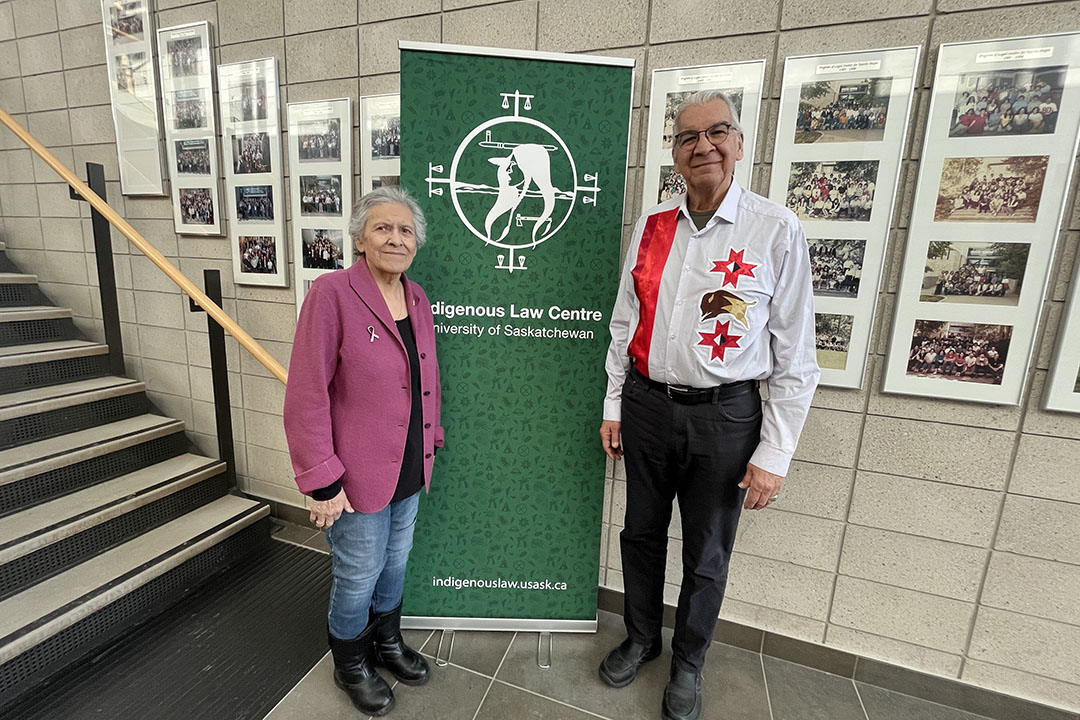
Advancing access to legal education for Indigenous peoples for 50 years
The Indigenous Law Centre (ILC), based at the University of Saskatchewan (USask) College of Law, is preparing to celebrate more than 50 years of facilitating access to legal education for Indigenous peoples.
By Donella HoffmanHere are five things to know about the ILC:
1. The centre was founded in 1975 by Dr. Roger Carter (LLD), a professor and former dean at USask Law.
Carter, dean of the College of Law from 1968 to 1974, was committed to social justice issues and worked with the university to establish a centre to facilitate access to legal education for Indigenous peoples. It was initially known as the Native Law Centre.
2. For decades, Indigenous law students from across Canada came to USask to attend the ILC’s Summer Law Course for Indigenous Students.
One of the centre’s first programs was a preparatory course offered during the spring/summer for Indigenous students accepted to a Canadian law school. Students would temporarily move to Saskatoon to take the course, which emphasized developing skills needed for success in law school, in addition to learning substantive legal content. Over time, the course became an introductory property law course that included significant material relating to Indigenous/Aboriginal property.
ILC director Chris Lafleur said the sense of camaraderie and support that develops among students is beneficial.
“Students realize they have people they identify with, people that can help them through law school,” Lafleur said. “Dean Martin Phillipson always says getting through law school is a team sport and that sense of community is even more prevalent in Indigenous spaces.”
Since the COVID pandemic, the course has moved online, with enrolment continuing to be drawn from across Canada.
3. The ILC remains a place of community in the College of Law for both Indigenous and non-Indigenous students.
The ILC routinely brings in speakers to explore issues in Indigenous law or discuss their experience as lawyers. It also currently has two cultural advisors: Joesph Naytowhow and Julie Pitzel.
“With the two Elders here, we want the ILC to be a community centre where students feel comfortable coming in and talking to the Elders or having lunch, or coming in for a speaker,” said Lafleur. “This is a place of learning and we want it to be a place where students feel safe as they learn.”
Naytowhow said he strives to give students insight into Indigenous culture through stories and song and through ceremonies like smudging or a pipe ceremony.
“Developing relationship is the foundation of being in a friendship,” he said. “I want to give them a glimpse of the people who were here on the land and what they did, and help them get to know that First Nation and Métis people are still here, practicing their culture and ceremonies.”
4. The ILC is a critical way that USask Law is responding to the Calls to Action from the Truth and Reconciliation Commission (TRC).
In Call to Action No.28, the TRC called upon law schools in Canada to require all law students to take a course in Aboriginal people and the law.
“For 50 years the Indigenous Law Centre has made a profound and lasting contribution to the advancement of Indigenous legal education in Canada,” said Dean Martin Phillipson.
“More recently, the centre has played a huge role in assisting the College of Law in meeting its obligations under Call to Action 28 of the TRC. From providing cultural advice and support to students, to supporting curriculum reform and the development of land-based learning opportunities and hosting Indigenous speakers, the centre is a key focal point of the college’s reconciliation initiatives.”
5. The ILC is recognizing its 50th anniversary this spring with a gathering on May 9.
Students from the summer program or those who graduated from the Indigenous Law Centre are invited to the milestone celebration.
The key themes of the gathering are reconnect, reflect, celebrate.
Lafleur notes that this is the first gathering of its kind for ILC alumni.
“This is an emerging community,” he said. “We want to reconnect with our alumni and renew their connection with the ILC.”