

Health researcher: What my USask degree did for me
Dr. Harini Aiyer (PhD) didn’t know quite what to expect when she left family and friends back home in Asia and headed overseas to North America more than a decade ago.
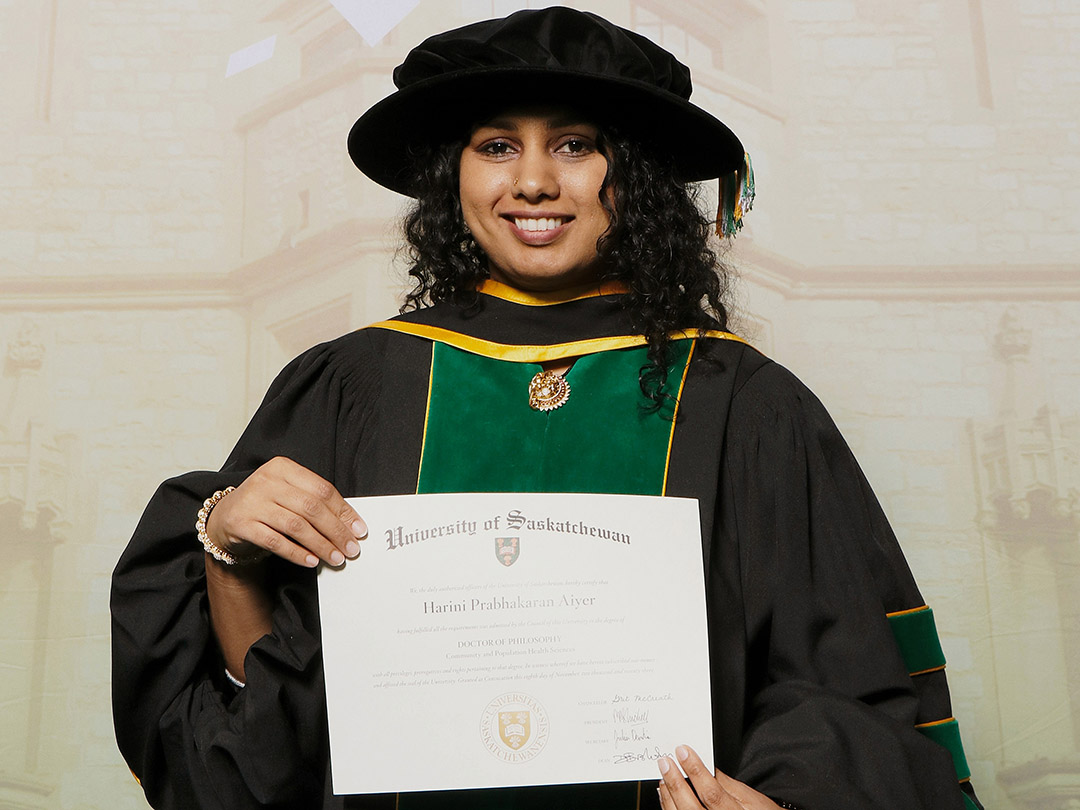
By James ShewagaLooking back at her academic journey – culminating in completing her doctorate at the University of Saskatchewan (USask) in 2023 – it was the best decision she ever made.
“I am incredibly grateful because USask shaped me to be the researcher and the leader that I am today,” said Aiyer, who earned her PhD in Community and Population Health Sciences in USask’s College of Medicine. “I think my time at USask was very pivotal in my career because I was switching fields from working in lab sciences to working with people in the community to have real world impact. And USask offered me a range of options and different areas in which I was able to grow and explore and really learn about my own strengths and what I’m good at, and find areas where I would like to learn more.”
An award-winning scholar from India, Aiyer was first accepted by prestigious Johns Hopkins University in the United States and completed her master’s degree in reproductive health and cancer biology in 2014, before heading to Saskatchewan to earn her doctorate. At USask, Aiyer found the perfect PhD program for her, as well as a true sense of community on campus.
“I would highly recommend students choose the University of Saskatchewan for their higher education for a variety of reasons,” said Aiyer, who is fluent in four languages and has studied several others, including elementary Cree at USask. “My master’s is from Johns Hopkins University and I want to preface that by saying yes, I went to one of the best schools for my master’s in the world. But when I came to USask, I truly felt a sense of community. I felt incredibly supported. I felt that the faculty, the staff, and everyone who was offering guidance or mentorship, was watching out for me and they had my best interests in mind. I felt a genuine sense of support and that they wanted me to succeed.”
Aiyer points to her PhD supervisor for special praise in supporting her social and academic adjustment at USask, in particular the change in culture and climate from back home.
“My supervisor, Dr. Kalyani Premkumar (MD, PhD), I remember the first thing she told me,” Aiyer shared. “She said that I should be pacing myself and adjusting for a cultural change and every form of adjustment that comes to moving to a new place like Saskatchewan, including the weather. At USask, everyone would check in with me first as a person, before looking at my productivity, and that really shaped the kind of leader I came to be.”
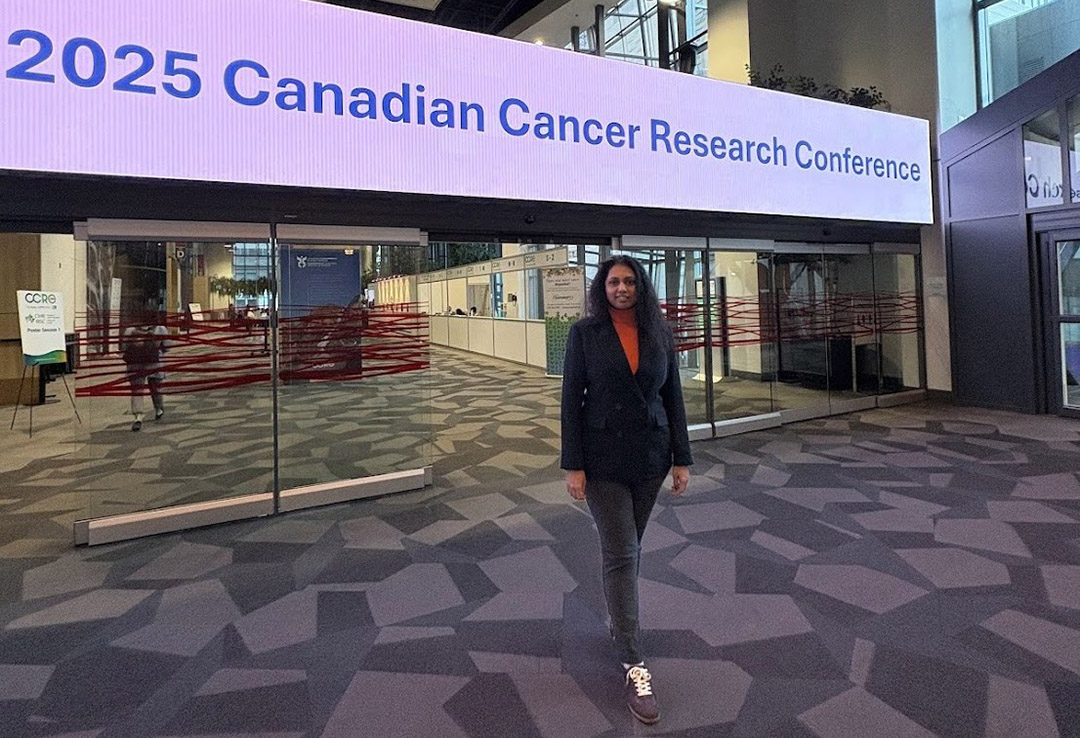
Aiyer said her graduate studies at USask not only paved the way on the path to her profession as a community health researcher, but also prepared her for the challenge of helping lead a major international health conference. That was a role she filled working with the Canadian Partnership Against Cancer over the past year, helping head the 2025 Canadian Cancer Research Conference from Nov. 2-4 in Calgary that featured 1,200 delegates, including participants from USask.
“When I was a student at the University of Saskatchewan, I had the opportunity to do over 40 different conference presentations over my five years as a PhD student, and that was also before, during, and after COVID, locally, nationally and internationally,” she said. “And I think that really helped me understand the scale and the perspectives that go into planning and pulling off an event. So I was able to bring in a lot of what I saw at the different conferences and experienced what worked and what didn’t.”
Aiyer cherishes the guidance she received at USask from her PhD committee: Dr. Stacey Lovo (PhD), Dr. Margeurite Koole (PhD), and Dr. Nazeem Muhajarine (PhD). She also appreciates the guidance of Dr. Alexandra King (MD), among others, in helping her learn how to work with Indigenous communities to address priorities around health and wellness. She found that grounding particularly helpful in envisioning her conference setup through an inclusive lens.
“Reflecting on my journey, I have realized how much my time as a PhD student at USask shaped my ability to lead a national conference, particularly in terms of bringing values around reconciliation, equity, and centering the needs of students and trainees, and I would attribute that entirely to my time at the University of Saskatchewan,” said Aiyer, whose PhD thesis focused on social accountability and how institutions can be more responsive to the needs of society. “I’m originally from India and I did my master’s in the U.S., so any learning that I’ve done around the history of colonization on Turtle Island has been on Treaty 6 territory. Everything that I’ve learned has been during my time at USask.”
Aiyer is currently serving as a scientific engagements specialist with the Canadian Partnership Against Cancer in Toronto on a term position that concludes at the end of January. She also continues to assist with three ongoing interdisciplinary collaborative health research projects at USask.
“I do still have lots of connections at the university,” said Aiyer, who earned a number of awards and scholarships during her time at USask, including the Interdisciplinary Research Excellence Award from the Graduate Students Association. “I am still involved in a couple of research projects that I began while I was a student at USask, so I am trying to wind those up … I want to continue to work reciprocally with the university and community because there are so many people that helped me there. My work has certainly been shaped by my time at the University of Saskatchewan.”