

Financial town hall answers the call to connect with campus
When it comes to facing the campus community, the tougher the questions the better for Deidre (Dee) Henne.
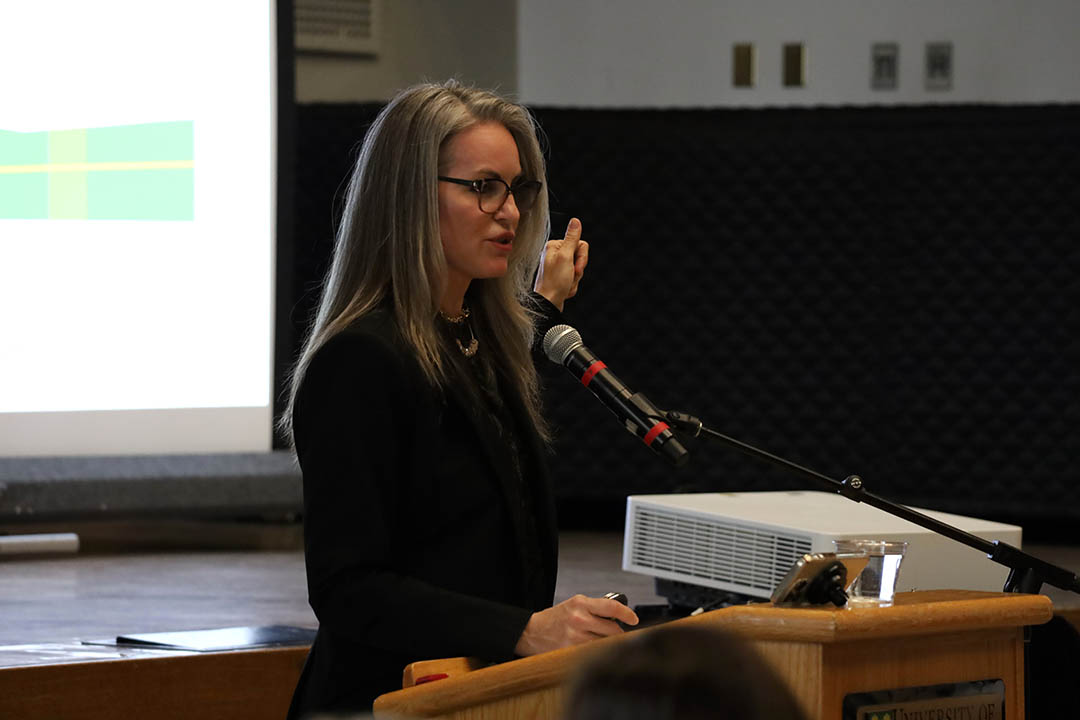
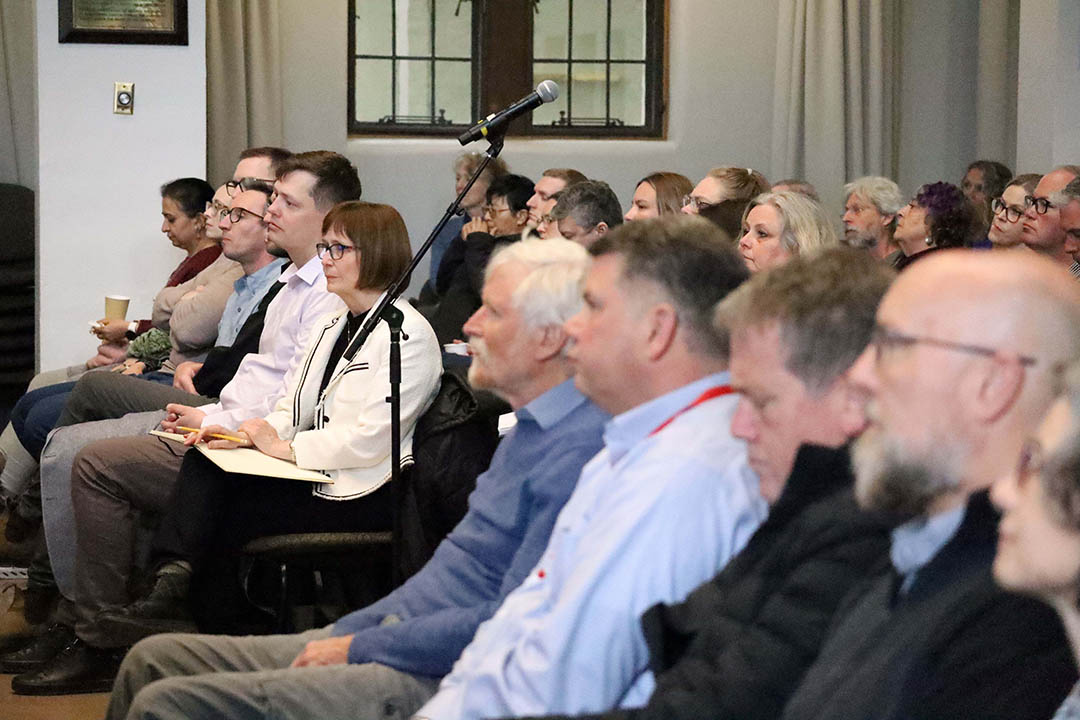
By James ShewagaThe chief financial officer (CFO) of the University of Saskatchewan (USask) recently completed her fourth Financial Town Hall on April 23 in Convocation Hall. Speaking along with Dr. Patti McDougall (PhD), USask’s interim provost and vice-president academic, Henne faced a variety of questions and queries while presenting to the campus community on the state of university finances and the plan moving forward.
Click here to view the April 23 town hall recording.
“I value rigorous questioning,” Henne said. “If I am unwilling or unprepared to address difficult questions, then I am not doing my job well. Challenging questions keep our thinking sharp and often prompt new perspectives that lead to stronger ideas and better solutions. When questions stop, it often signals a loss of engagement. An active, inquisitive community demonstrates shared commitment—people ask questions because they are invested, aligned in purpose, and eager to contribute to collective success.”
The town halls are designed to provide the campus community with a big-picture update on university finances and budget challenges and opportunities moving forward. The spring and fall events also provide a forum for any member of the campus community – from faculty and staff to students and stakeholders – to ask questions about big-picture fiscal policies, plans, and processes. Henne said over the past year the twice-annual town halls were often followed by smaller sessions that dealt directly with questions at the college or unit level.
“People sometimes come to the town halls wanting very specific granular data on their specific situation, their department or their college,” Henne said. “So what the interim provost and I have done, with each dean, is hold a series of smaller town halls, when people want a deeper dive.”
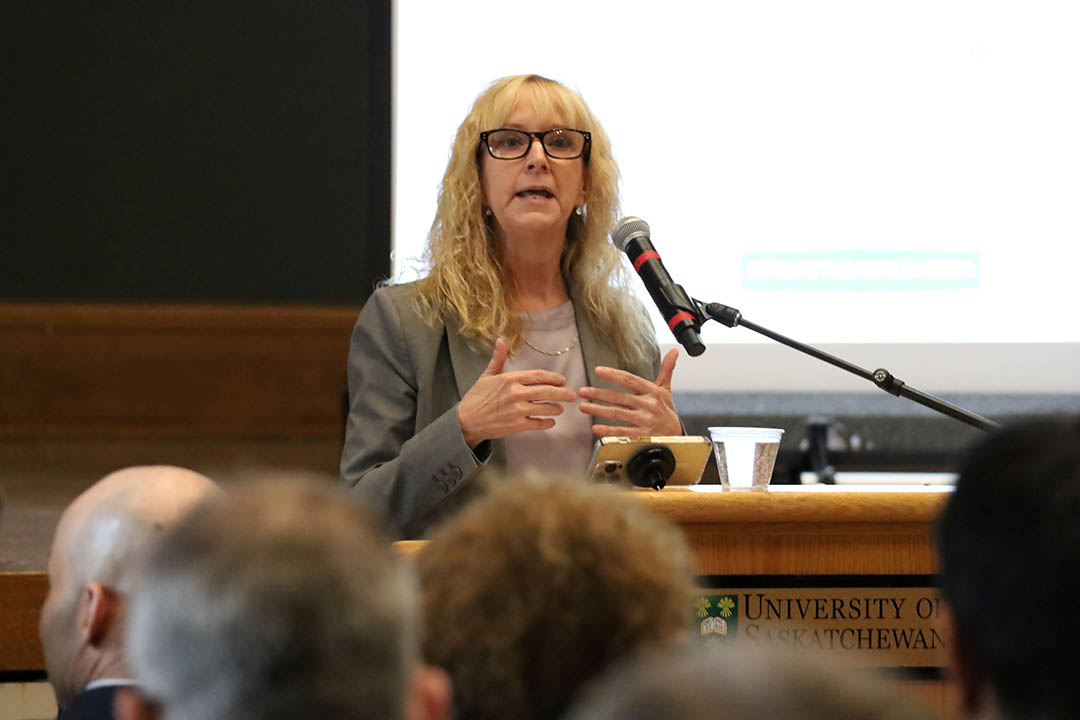
“When the provost and the CFO come together with leaders of colleges and schools, we speak to the core of how academic strategy leads decision-making with financial realities supporting,” McDougall added.
Most importantly, Henne said the town halls offer a measure of accountability and transparency for the province’s largest publicly funded educational institution.
“Accountability means deploying our resources wisely in service of our mission and demonstrating that responsibility through transparency,” Henne said. “As stewards of public funds, we must operate with clear, strategically aligned, intentional plans. Through the Strategic Finance Committee—comprising all vice-presidents—we develop a rigorous, evidence-informed framework for allocating resources to leaders’ portfolios, including deans/executive directors and vice-presidents. We then entrust leaders to apply the same level of judgment, discipline, and accountability as they make complex decisions within their respective areas.”
McDougall said holding town halls is an effective way to connect with the campus community.
“One of the strengths of having Dee in the CFO role is her capacity to amplify strategic financing to better inform the university community about higher education funding and to position USask within that context, thereby providing a public forum for informed dialogue,” McDougall said.
Henne added that the objective of the town halls is not only to enhance financial transparency, but also to strengthen financial literacy across the campus community.
“Town halls build a shared understanding of how allocation and strategic investment decisions are made,” she said. “One example I often highlight is university funding as a proportion of GDP, because our value proposition is inherently linked to both economic and societal benefits. By educating and graduating students in areas of labour‑market demand, the university contributes directly to economic growth. By conducting research and making new discoveries, the university advances societal well-being. Public investment, in turn, enables us to fulfil that role—as a driver of workforce development, innovation, and the broader provincial economy.”

Juggling funding requirements and requests with the realities of financial limitations is a challenging process and Henne said pleasing everyone is next to impossible when balancing increasing operating costs and needed capital expenditures. Maximizing alternative sources of revenue, from increased donor gifts to other alternative revenue generation is important as the university deals with inflationary pressures and the need for increased capital support.
“It is important to explain why alternative revenue sources are important to support our university mission because there are limitations to what our province can afford,” she said. “So I share our financial reality and how USask fits in that context, hoping we all can work toward solutions together.”
An important element in the university’s financial picture is tuition.
“Decisions around tuition are made carefully, and we strive to limit increases in tuition to only what is needed to maintain academic excellence across multiple platforms of program delivery, address rising costs, and staying attuned to evolving students’ needs,” McDougall said.
Henne noted that one of the priority projects on the plate for USask is the long-awaited update of university operating systems, which comes with a significant price tag.
“We don’t have enough operating money for all the investments that we would like, but we will take on financing to do critical projects like the systems project, where we will be investing in the foundation of the university,” she said. “It’s for enrolment, it’s for payroll, it’s for finance, it’s the essence of what every university requires to be viable and meet the expectations of students and employees in today’s tech-savvy era. So we have a strategy that aligns with USask priorities and our accountability reporting framework with the Ministry of Advanced Education, that delivers on Saskatchewan goals.”
TOP 5 TAKEAWAYS FROM USASK’S APRIL 23 FINANCIAL TOWN HALL:
2. Unlike other post-secondary institutions in Saskatchewan and North America, USask is not currently considering across-the-board layoffs, hiring freezes, or cuts to programs. However, as with any organization of USask’s size, ongoing adjustments to unit-specific programming and workforce needs are part of sound fiscal management.
3. USask is fortunate that the provincial operating grant is a firm foundation for enabling the delivery of high-quality education and providing a wide array of supports for students. However, the operating grant alone is not sufficient to meet all financial needs and obligations. Tuition and fees are a necessary source of revenues, reinforced by the need for more revenue diversification.
4. As USask moves forward, sustained, responsible, and proactive action remains essential, with continued focus on implementing financial balancing strategies in certain colleges, schools, and units facing structural deficits.
5. Units with significant reserve funds are expected to continue strategic spending to support institutional and unit priorities and maintain overall financial balance.