

USask AgBio research: Saving Prairie grasslands
As the United Nations spotlights the International Year of Rangelands and Pastoralists 2026, University of Saskatchewan (USask) researchers are in a race against time to preserve vital lands and resources.
By Joanne PaulsonOne of the most iconic images of the Western Canadian Prairies is undoubtedly herds of cattle or bison, grazing placidly on wide fields stretching as far as the eye can see.
While a road trip across the plains still brings such sights, few may realize those fields are under extreme pressure, while also increasingly being reduced in size and number.
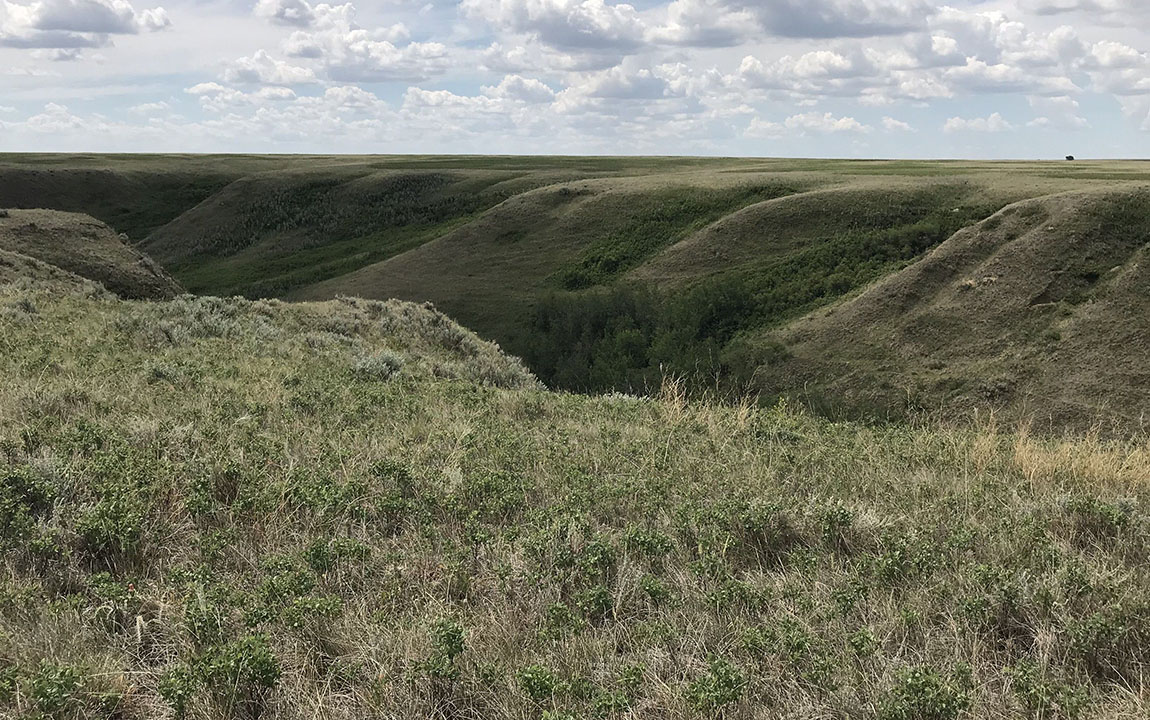
Before the 1800s, herds of millions of bison roamed the Great Plains, contributing to widely diverse flora and fauna in rangeland ecosystems. In fact, pre-colonization, Canada had 61 million hectares of native grassland; now, there are 11 million, or less than 20 per cent.
Researchers in the USask College of Agriculture and Bioresources are seeking ways to preserve, protect and improve those lands.
“No landscape in Canada is more impacted by human activity,” said Dr. Eric Lamb (PhD), professor in the Department of Plant Sciences.
Only one to five per cent of grasslands on the most fertile prairie soils remain intact today, he said.
“Of our mixed-grass prairie, there’s much more remaining because the soil is not as good, so we don’t use it so much for annual or perennial cropping. Only five per cent of grassland in the parkland remains intact.”
Grasslands are crucially important not just for raising food animals, but also for the wider ecosystem. Many plants and animals, for example, are specific to these systems and at risk — and some are listed under the Species at Risk Act.
“The majority of those are birds that require large areas of open grassland for their nesting. I suspect there’s a lot of additional plant and insect species that should be listed; they just haven’t been assessed yet.”
“Without these rangeland habitats, without conservation and good management of these habitats, a lot of these biological resources and diversity would be lost,” said Dr. Jon Bennett (PhD), associate professor in the Department of Plant Sciences. “It’s incredibly important we continue to manage them well.”
This is crucial from both an environmental perspective and from a human food perspective, notes assistant professor Dr. Flavia van Cleef (PhD), a specialist in forage management.
“Food demand is increasing, population is increasing, and yet people are leaving the rural areas. That’s why we need to be more efficient and being more efficient means being more sustainable, too.”
The importance of microbes ... and bees

Bennett has a dozen projects underway, largely focused on Saskatchewan but also Alberta and Manitoba, which seek to understand plant interactions with microbes in the soil — bacteria, fungi and other pathogens.
“In Saskatchewan, we have a bad problem with an invasive plant called leafy spurge that’s spread through a good chunk of the grasslands, especially in sandy sites in the province,” he said. “It’s just getting worse as the climate warms.”
His research shows that the plant interacts with specific mycorrhizal fungi, important to how it performs. His group is trying different fertilizers to enhance control of leafy spurge. It appears that increasing fertilizer alters plant-microbe interactions to benefit native plants over the invasive one.
“We also have some trials where we’re trying to look at how reintroducing native rangeland plants into seeded grasslands might improve ecosystem services like carbon sequestration,” Bennett said.
“The goal for management in those systems isn’t just to produce food for cows. It is to preserve the biodiversity as well,” he said.
That means, for example, pollinators, which are also vitally important to growing crops on the Prairies.
“Our collaborators on one of our projects have sampled 30 different sites across Saskatchewan and Manitoba, and there are 200 different kinds of bees,” Bennett noted.
From a carbon perspective, rangelands are extremely important as well. Approximately 34 per cent of carbon stocks are located in grassland soils, he said.
“A rancher’s primary goal is to make a living. At the same time, we’re working with Dr. Patrick Lloyd-Smith (PhD) here in [the Department of] Agricultural and Resource Economics to put a value on the secondary services we get out of the grasslands.”
He said it’s important to be able to put a value on such things in order to advocate from policy and economic perspectives.
“Biodiversity and aesthetics are services provided by these ecosystems that have been and are in many cases maintained very well by ranchers and it’s not something they get any recompense for. People need to be rewarded for managing these lands and the societal good that comes of them.
“Without strong policy intervention, I don’t see it changing to the point where we can reverse some of these declines.”
Sparking the fire of regrowth

Lamb, a plant ecologist, is interested in the processes that maintain biodiversity and ecosystem functions.
“Grasslands are a unique ecosystem in that they are not determined just by climate, temperature and precipitation,” he said. “They are also determined by the presence of recurring disturbances that remove some of the biomass on a periodic basis. That means grazing, and it means fire.
“The northern grasslands around the word evolved under grazing by large herbivores and evolved under a regime of fairly frequent fire.”
Canadian grasslands are in a fire deficit. Typically, fires would have occurred every one to 20 years on any given site, but most grasslands have not seen fire for 50 to 100 years.
“We tend to see woody plants moving in where they may not have been before,” Lamb said. “We see declines in biodiversity. We may see impaired grassland productivity in some cases. And we also see high fire risk because we have in many cases accumulated unburned fuel. We live in a flammable ecosystem.”
Typically, conservation agencies have used fire on a small scale, such as the Meewasin Valley Authority (MVA) in Saskatoon.
A number of collaborative fire projects have also emerged, such as one with the Nature Conservancy of Canada which provided funding to Lamb to do research on returning fires to southwestern Saskatchewan.
The Canadian Prairies Prescribed Fire Exchange, funded by the Weston Family Foundation and housed within the MVA, is a partnership including USask, conservation organizations, ranching industry groups and Indigenous organizations dedicated to the idea of returning fire safely to the landscape.
“There has been a huge increase in the amount of fire we’ve been able to do because we’ve improved our training,” Lamb said. “We’ve improved our communication between organizations. We’ve improved our equipment. We now are at the point where we have a critical mass of people with the training able to do this work.
“My research program is closely linked into this. We’re not just burning something to burn something. We’re burning under a prescription where we have a particular ecosystem effect we want to see, whether it’s to improve biodiversity, remove some excess litter, or knock back some woody species.”
Forage management

Adding to the diversity of research and outreach, van Cleef — the Beef Industry Integrated Forage Management and Utilization (IFMU) Chair at USask — began a forage management program in March, for which she is now seeking student help and funding.
“It’s been exciting to get to know the ecosystems, getting to understand the management of the producers here,” said van Cleef, who is originally from Brazil.
“We are going to look into the management strategies that the livestock producers are performing and see how we can give feedback on that, by doing some research in improving this connectivity between research and its applicability. For example, if they are using continuous stocking methods, rotational methods, how can we improve that? In terms of what kind of forages they are using, how can we better design the land use with technologies such as stockpiling grass, bale grazing, or supplementing the animals?
“My job specifically was created to integrate everything in all the systems, all the resources together — environment, animals, forage, water — and translate it into science and then back to the producers.”
An interesting challenge will be seeking adaptive forage varieties to use in various areas across the Prairies. For example, varieties that would thrive in the Saskatoon area probably won’t be the same as those that grow well in Outlook, or Swift Current, or Val Marie.
“This requires specificity for the various soil zones and conditions,” she said. “Whatever you do in Saskatoon is very different 50 kilometres from here.”
She said her research will specifically address the questions producers are seeking answers for, notably ways to make the land more sustainable.
“Research has been done on finding forage species that are more adaptive to drought,” van Cleef noted. “From what I’ve seen, it’s being highly adapted by producers.
“If we can find ways of being more efficient, such as with water and nitrogen use, we can work with policy-makers to find ways to compensate producers.”
With a greater understanding of forage practices, plant ecology and fire application, USask research and its partners will contribute to saving grasslands for the future.