

Lands management certificate gives USask graduate a stepping stone to future career
Roy Saddleback combines his Elders’ teachings with knowledge gained at the College of AgBio
By Jenn SharpGrowing up, Roy Saddleback was surrounded by knowledge shared by the Elders in his community. One of the key messages they instilled in him was that when we take care of the land, it takes care of us.
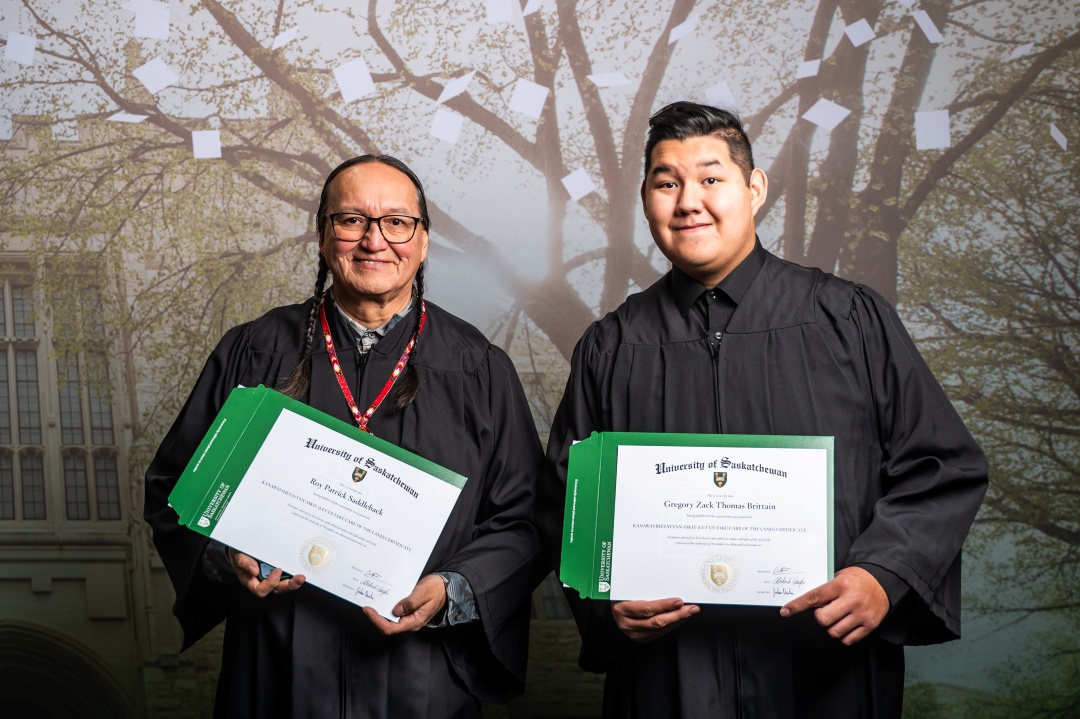
Saddleback has carried those teachings with him throughout a diverse career, both in the workforce and in academia. He recently earned the Kanawayihetaytan Askiy (KA) certificate, (which means let us take care of the land), at the University of Saskatchewan (USask). Earning the KA certificate, which is offered through the College of Agriculture and Bioresources (AgBio), aligned perfectly with the teachings he has known since a young age.
“The KA program gives us more of a scientific Western knowledge and incorporates it with our own Indigenous ecological knowledge,” said Saddleback, who grew up in the Maskwacîs (Bear Hills) community in central Alberta
“We do have our own scientific knowledge (and) we utilize it by feeling, demonstrating and visualizing through nature itself, how it’s all reacting and what we need to do to help it along.”
As a young man, Saddleback would go hunting with his Elders, who taught him about the forest, the animals and the vegetation, which all had meaning.
“My late great-grandmother would get up early in the morning, look at the sky and tell us what we needed to do during the day to prepare for that evening or the next day. She was always spot on.”
Tackling complex land management challenges
The KA certificate provides a pathway to the College of AgBio for students who want to further their studies and career options in lands management and stewardship. Many Indigenous communities have complex lands management issues. The KA certificate equips students to tackle those challenges in a holistic way. Topics covered include Indigenous rights, land use planning, traditional knowledge, resource management and intellectual property law.
Jordie Gagnon, Senior Strategic Officer – Indigenous Programs and Partnerships at the College of AgBio, said many of the KA certificate’s graduates are working in leadership positions in their communities.
“The certificate lays a good foundation for students who want to continue working in lands management or pursue diplomas in governance or renewable resource management.”
The holistic approach to learning was a big part of what attracted Saddleback to the program. He chuckled when asked about his decision to return to university at a time in life when others are considering retirement.
“From our perspective, we’re always lifelong learning. We never stop. This is something I had to do. I don’t feel like I’m the oldest (in class). I give out advice to the kids in class, but I don’t scold them!”
For Gagnon, Saddleback’s presence in the classroom was always welcome: “He engaged in really good discussions and his life experience helped him help others in areas of their learning.”
The appeal of hybrid and experiential learning
The KA certificate offers a unique hybrid learning experience. Partly done in their home communities and partly done through learning intensives at the College of AgBio, students engage in a mix of experiential, hands-on opportunities.
“It gives students the chance to decide on what learning option is best for them,” said Gagnon.
For Saddleback, the small class size (there were 21 other students with him from across Canada) and collaborative group experience was both enjoyable and helpful.
“The group work will transfer to a future career,” he said. “The majority of my fellow students are already working in lands departments with their First Nations.”
Saddleback enjoyed the program so much that he’s decided to continue his education with the Professional Lands Management Certification Program, which is developed and delivered by the National Aboriginal Lands Management Association (the KA certificate qualifies students to take this professional certification).
Looking to the future, Saddleback’s goal is to move into a role where he can put the knowledge he’s gained into action, a role for which he is well-prepared.
“(The KA certificate) has complimented my understanding of environmental monitoring that was taught to me by the Elders growing up and will allow me to develop the proper skills towards a lands management position.”
According to Gagnon, the KA program is an opportunity to show that Indigenous students have a place in lands management and similar careers. It’s also a stepping stone for students to take as an entry to university.
“This will contribute to them finding meaningful careers,” he said. “It gives agriculture a bigger footprint with hiring an Indigenous workforce.”
It all comes full circle for Saddleback as he combines the education he received at USask with his Elders’ teachings. Going forward, he will now be teaching others how to approach lands management in holistic ways.
“We need to make sure the future generations are able to enjoy what we have right now… and hopefully better than what we have right now.”
The KA certificate is open to everyone. Learn more about it here:
https://admissions.usask.ca/kanawayihetaytan-askiy.php#Programoptions