

From lectures to labs: Biomedical sciences students earn honours degrees
For two University of Saskatchewan (USask) undergraduate students, their education was more than lectures, labs and exams, it was also about discovery.
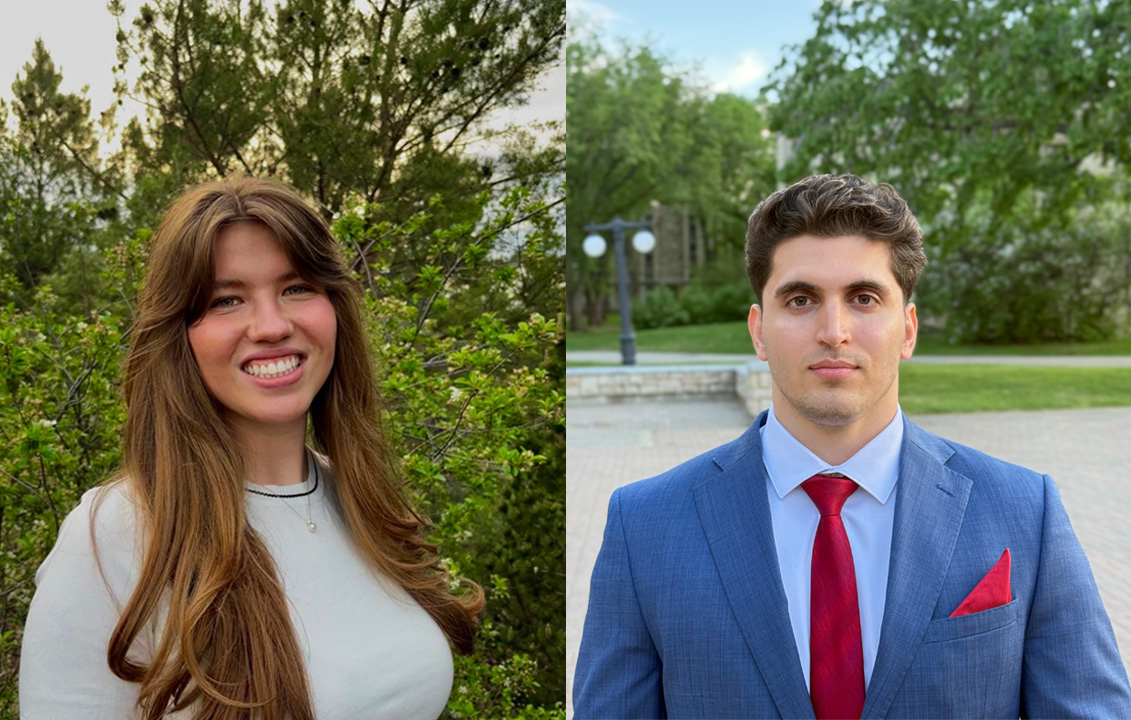
By Amanda WoroniukOutside of the classroom, Laura Dyck and Ario Safaeian gained hands-on research experience through the Biomedical Science honours program.
Dyck completed a Bachelor of Science (Honours) degree in Biochemistry, Microbiology and Immunology, while Safaeian earned a Bachelor of Science (Honours) degree in Biomedical Neuroscience. Both received their degrees during Spring Convocation on June 2.
The undergraduate biomedical sciences program is jointly offered by the Colleges of Medicine and Arts and Science, and provides students with the opportunity to pursue an honours program in their fourth year. The program is designed for learners who are interested in exploring more in-depth research and who may be considering graduate studies or research-focused careers.
We connected with Dyck and Safaeian to learn more about their time at USask, research experiences and their future plans.
Investigating antibiotic resistance
Dyck knew from an early age she wanted to pursue a career in health care. Growing up in Warman, she loved high school science classes and had heard about the biomedical sciences program at USask.
Dyck explored different types of biomedical research, but it wasn’t until one of her third-year labs that everything clicked, and she could see how knowledge she gained in the classroom could be applied in practice.
“I really loved the hands-on nature of it and getting to actually see what I've been reading in textbooks and learning in lectures, and seeing how that pans out in the lab and in the real world,” she said. “I think what really drew me into doing research and doing the honours program was getting to see the literature and the textbooks come together in real time.”
During her third year, Dyck emailed researcher Dr. Jessica Sheldon (PhD) out of the blue to see if there was an opening in her lab for a student.
“I had read and liked her articles. I also really liked my microbiology classes and was interested in antibiotic resistance,” said Dyck. “I was lucky enough she (Sheldon) had an honours spot for me.”
Sheldon’s lab studies the molecular pathogenesis of multidrug resistant bacteria. One of the lab’s project explores how antibiotic-resistant bacteria called Acinetobacter baumannii use histamine to evade the body’s defenses during infection.
Dyck was interested in the widespread effects of antibiotic-resistance bacteria and the public health threat it has become.
“There's the human side of it, but also the animal and environmental side of it. From a One Health perspective, all of these interconnected systems can contribute to antibiotic resistance,” she said. “I think that's what really interested me about it—that it has a large real-world impact. It's becoming increasingly more worrisome.”
Dyck added: “What I was looking at is how histamine impacts A. baumannii's gene expression, and how the bacteria can change its genes to better respond and try to overcome the human's host histamine response. My work helps us better understand how A. baumannii can respond to that and persist within infections and within a host.”
She says this research contributes to the broader understanding of antibiotic resistance, which could assist with more targeted therapies in the future.
Reflecting on her time as a USask, Dyck highlighted the importance of taking on new challenges.
“I had never done research before. I felt like I wasn't going to be qualified or I wouldn't be able to do anything relevant or have any actual impact on the field. It was outside of my comfort zone to reach out and start in the lab. I was intimidated at first, but thankfully I had an awesome supervisor and an awesome lab team around me that were always willing to help and help me with experiments and any questions I had,” she said.
“I think just putting myself out of my comfort zone, that really ended up shaping probably the most meaningful part of my university experience. It taught me a lot of valuable skills and taught me a lot more about the field of research and how that actually works.”
Now that she has finished her degree, Dyck will enjoy some well-deserved time off and travel. She has been accepted into the doctor of medicine class and will join the incoming class at the Saskatoon campus.
Dyck encourages students to stay open to new academic interests and opportunities.
“For future students, I'd want to encourage them to focus less on having everything perfectly planned and stay curious about what you're learning and open to new experiences, because you never know what type of classes you might like, or fall in love with a new field that you didn't think you'd enjoy,” she said. “I think staying open to new things and trying new things is a really big part of university, and I think helped me have a more full and well-rounded experience.”
Neuroscience meets physiology
Safaeian’s path into research was shaped by a personal experience. During his second year of university, Safaeian watched his father struggle with diabetes, which inspired him to seek out research opportunities and join a physiology lab.
“At the time, I was in a metabolic laboratory under Dr. Changting Xiao's (PhD) supervision and was investigating the mechanism of metabolic disease,” said Safaeian. “We looked at the efficacy of drugs for weight loss that could eventually help treat diabetes and other metabolic disorders. With the science I was learning in the classroom, I was able to help my dad understand his medications at home.”
However, in his third year Safaeian discovered his passion for the field of neuroscience.
“I remember taking a few neuroscience classes …and I really wanted to know what was going on in my own brain and everybody else's.”
For his honours research project, Safaeian looked for something that would challenge him academically and combine his interests in neuroscience and physiology. He contacted researcher Dr. John Howland (PhD), whose lab specializes in behavioural neuroscience.
One of the lab’s projects investigates how exposure to high-potency cannabis smoke affects brain development in rodents. Safaeian joined the Howland lab and also worked with Dr. Catherine Ivy (PhD) in the Department of Biology, which allowed for interdisciplinary collaboration between the two units.
“What’s really interesting to me is how two different departments can work together to actually make the research happen,” Safaeian said. “From the neuroscience cluster, Dr. John Howland provided the neuroscience background and the cannabis aspect. And from the biology department, Dr. Catherine Ivy provided the physiology, the respirometry, and plethysmography for this research.”
Safaeian’s project contributed to research on how breathing in cannabis smoke immediately affects metabolism and breathing. Since cannabis was only legalized in Canada in the last decade, there is limited research on the physiology and effects.
“It's a very new field when it comes to answering exactly how this affects the lungs. Ultimately, my goal was to help improve the field and contribute to public health” said Safaeian.
His project investigated how metabolism (oxygen consumption, CO2 production, and body temperature), and breathing pattern (frequency and volume) were impacted by cannabis smoke.
While not yet published, Safaeian said preliminary findings show the negative effects of inhaling cannabis smoke on the lungs.
For students who want to pursue a similar educational path, Safaeian encourages them to explore classes in areas that interest them and reach out to faculty to better understand the field.
“‘If you like it, you can make it,’ that's my personal motto for anyone who wants to study neuroscience. Try to take a class or reach out to someone and have a conversation with them. I remember in my second year, when I was deciding between majors, I made an appointment with a professor. We talked about the field and they gave me a great sense of what was going on in that area.”
Looking back on his degree, Safaeian highlighted both the educational and social opportunities he had at USask.
“The ability to connect with people and make friends, along with a once in a lifetime opportunity like my anatomy class, made it incredibly special. I will always remember the privilege of holding a human brain, and being able to observe and learn from it.”
What’s next for Safaeian now that he’s completed his degree?
“Although I had the opportunity to continue my research through a master’s program funded by Canadian Institutes of Health Research (CIHR), I chose to pursue medicine directly after my undergrad. I will be an upcoming first-year medical student here at USask in Saskatoon,” he said.
“It was a great opportunity for me to be able to take neuroscience as my undergrad, and hopefully I can focus on neuroscience in medical school and try to pursue that in my residency. But that’s not set in stone. There are many other medical fields and I would like to pursue a field in medicine that I can have the most impact on patient lives.”
Article re-posted on .
View original article.