

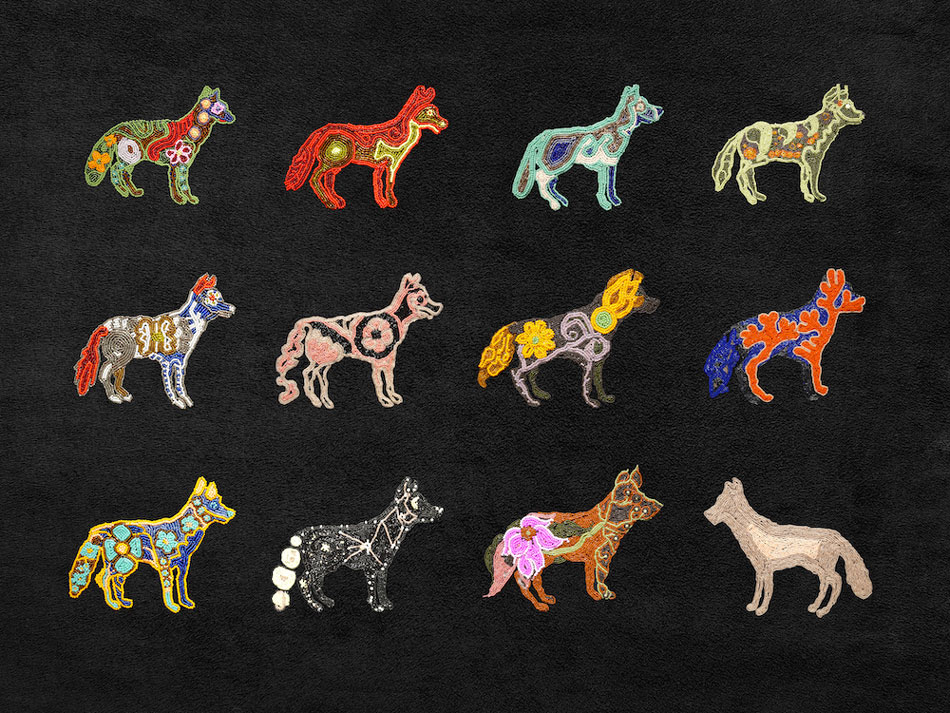
Exploring culture and identity through beadwork
Acclaimed Métis artist Corinna Wollf (BA’96, BFA’14, MFA’16), a former Saskatoon resident and three-time USask graduate, now lives and works in northern Italy
By SHANNON BOKLASCHUKExpressing herself through beadwork has become second nature for University of Saskatchewan (USask) graduate Corinna Wollf (BA’96, BFA’14, MFA’16), a professional artist whose work will be showcased during a solo exhibition in Italy this summer.
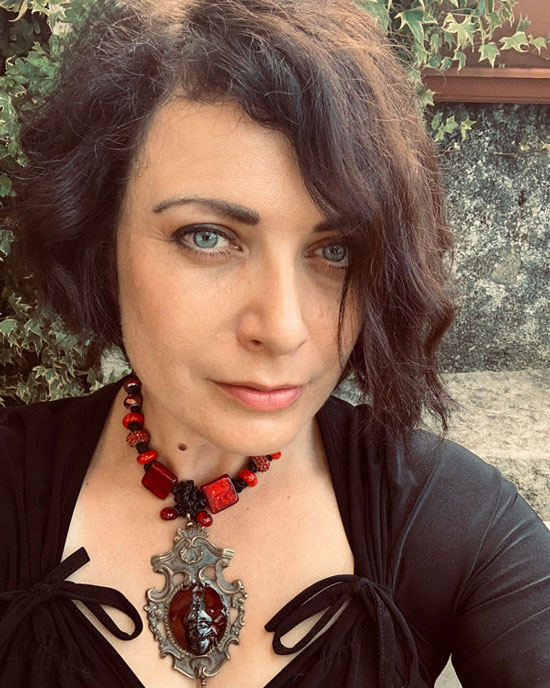
“It’s natural to me to do it. It’s the way I like to express myself,” said Wollf, a Red River Métis (Manitoba Métis Federation citizen) and ethnic Mennonite artist who explores identity, culture, and place primarily through beads, as well as through natural materials, photography, and performance.
“I like it because it’s very meditative,” Wollf said of beading. “It’s a slow mode of working. I have lots of time to think about the subject and it’s really a nice way to come into relation with your subject.”
Throughout her time as a USask student, Wollf was inspired by other USask alumni artists who are known for featuring beadwork in their practices, such as Ruth Cuthand (BFA’83, MFA’92) and Catherine Blackburn (BFA’07). Cuthand, one of Saskatchewan’s leading artists, has created intricate beaded images of disease-causing viruses and bacteria—such as smallpox, cholera, and tuberculosis—that reference colonization and trading, and their impacts on Indigenous people. Blackburn, meanwhile, has talked about the relationship between beadwork and using her body as a tool, honouring the “ancestral connection that refers to a cultural history of love and exchange.”
“They were very active when I was doing my degrees,” Wollf said of Cuthand and Blackburn.
“In my family, beadwork is just something that’s been done forever and ever and ever,” Wollf added. “But I was able to refine it by going to workshops at the Aboriginal Students’ Centre (now the Gordon Oakes Red Bear Student Centre) on campus. So, a lot of the practice came along that way.”
Born in Edmonton, Alta., Wollf grew up in Saskatoon, Sask., on Treaty 6 Territory and the Homeland of the Métis, where she enrolled in the College of Arts and Science at USask in the 1990s after graduating from Mount Royal Collegiate. By studying at USask, Wollf became the first person in her family to attend university.
“I knew that I wanted to go to university, but I didn’t really know what that meant,” she said. “So, during my first degree, it was really just getting the experience.”
A young mother at the time, Wollf took her son to daycare on campus as she worked toward earning her first degree. After completing a Bachelor of Arts degree in psychology in 1996, she worked in administration in the biotechnology field for about 15 years before returning to USask to work in the College of Kinesiology.
Wollf had always been interested in art, and while employed at the College of Kinesiology she reignited that passion by enrolling in one class at USask each semester. Wollf’s USask colleagues were “amazingly supportive” of her artistic pursuits, and, over the course of seven years, she went on to earn a Bachelor of Fine Arts (BFA) degree in studio art in 2014 while working on campus full-time.
“It was a wonderful place to work and also allowed me to study,” she said.
After completing her BFA degree, Wollf was inspired to continue her studies and to pursue a Master of Fine Arts (MFA) degree at USask. She was awarded the prestigious Joseph Armand Bombardier Canada Graduate Scholarship-Master’s through the Social Sciences and Humanities Research Council of Canada (SSHRC) to help fund her graduate studies, through which she focused on Métis aesthetics in contemporary art. Wollf was determined to achieve her dreams and earn her MFA.
“Even though I got a little bit of a late start—I was in my 40s when I started my master's degree—I still thought, ‘I can do it. I’m going to do it.’ ”
Wollf earned her MFA in 2016, with her thesis exhibition at USask’s Gordon Snelgrove Gallery, Water Over the Bridge, featuring large format drawing, printmaking, installation, and beading. One of those MFA thesis exhibition artworks, a drawing/painting called The Woman and the Wolf, measuring six feet by eight feet, has since been showcased around the world on the cover of the international best-selling novel, The Break. Written by Métis author Katherena Vermette, the winner of the Governor General’s Literary Award, The Break is about a multigenerational Métis–Anishnaabe family and is set in Winnipeg’s North End neighbourhood.
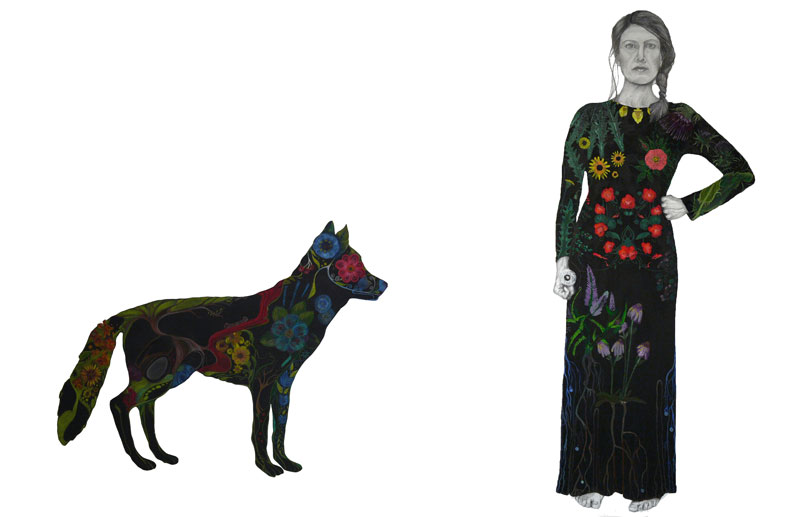
“Having my work on the cover of The Break was huge for me,” said Wollf, who has enjoyed seeing the cover of the book translated into different languages in countries across the globe.
During the creation of the Woman and the Wolf, Wollf was researching Métis identity from a visual perspective, looking closely at the work of numerous contemporary Métis artists as well as at historical family photos. Wollf said it felt natural to have her artwork on the cover of The Break. She had the opportunity to read Vermette’s novel before it was officially released and she immediately felt connected to the storytelling.
“I knew I wanted the art on the cover because I grew up in the Saskatoon inner-city. When I went to high school, I lived on Avenue R South in a public housing project. So, I could really relate to the characters in the book,” Wollf said.
“Even though she was talking about the Winnipeg North End, I felt a real kinship with those characters, and I knew I wanted my art on the cover. So, I did. And that turned out to be a wonderful decision to do that because it allowed my art to go everywhere that the book went, which was extensive. She really had a great success with that book.”
Another life-changing moment for Wollf occurred when she was an undergraduate student working on her BFA degree at USask. She enrolled in a study abroad course in the College of Arts and Science, which took her to Florence, Italy, and to Utrecht in the Netherlands in 2010. While in Italy, Wollf fell in love with the country and met her future partner there. Their relationship evolved over the years and, after Wollf completed her master’s degree at USask in 2016, she moved to the Biellese Alps of northern Italy, where she lives with her partner, Giuseppe, and their beloved dog, Tilly.
Wollf said moving to Italy has enabled her to focus on her artistic practice on a full-time basis. While Italy is now her home, Wollf continues to be connected to Canada; for example, she is represented by The Gallery / art placement inc., a commercial art gallery in downtown Saskatoon that exhibits and sells contemporary, modern, and historical art by Saskatchewan and Western Canadian artists. Wollf’s son is now 34 years old and is based in Ottawa, Ont., where he is a Master Sailor in the Royal Canadian Navy.
Wollf’s most recent body of work, which was supported through a grant from the Canada Council for the Arts, was inspired by the annual rhythm of livestock in the Biellese Alps. In that area of Italy, the animals are known for moving to and from the high mountains for summer grazing. Wollf said the ancient practice, called transhumance, is passionately preserved by the local people there and the animals are held in high regard.
“It’s really an important part of life,” said Wollf. “The whole territory is based upon this movement of animals up and down. So, I was inspired by that. And I also worked with a local Knowledge Keeper who is an Elder. He’s in his late 80s and he’s writing a book about the transhumance of the area. He helped me inform my vision to understand where the routes of passage were.
“When you come to a new country, sometimes the integration is not easy,” Wollf added. “So, this project really allowed me to get into the community that I’m in, and what was resulting was beaded animal portraiture—beaded cows.”
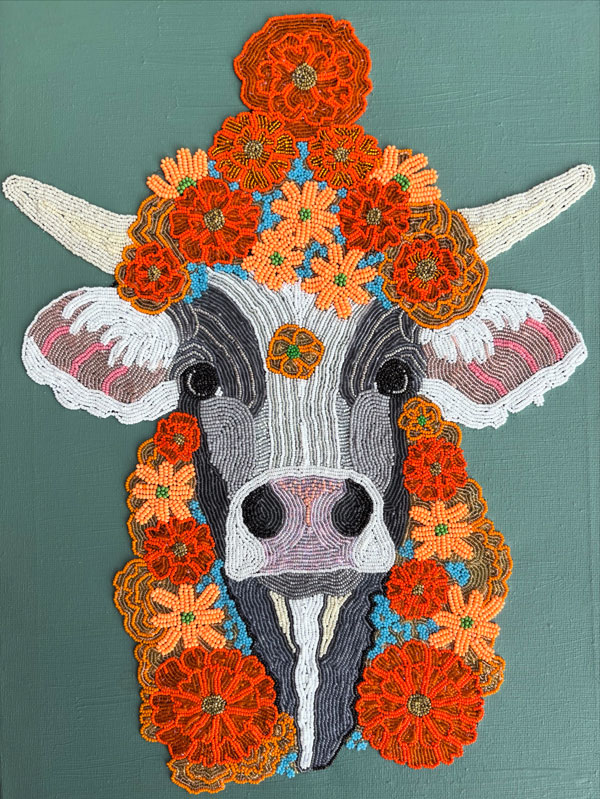
In addition to her beaded works, Wollf collaborated with an Italian artist to create sculptural works that incorporate cowbells and speak to the transhumance tradition. Funded by Pacefuturo and the Canada Council for the Arts and curated by Andrea Trivero, Wollf’s work on transhumance will be exhibited at Villa Piazzo in Pettinengo, Biella, Italy, during July, August, and September 2026. Her artworks will then come to Canada in 2027.
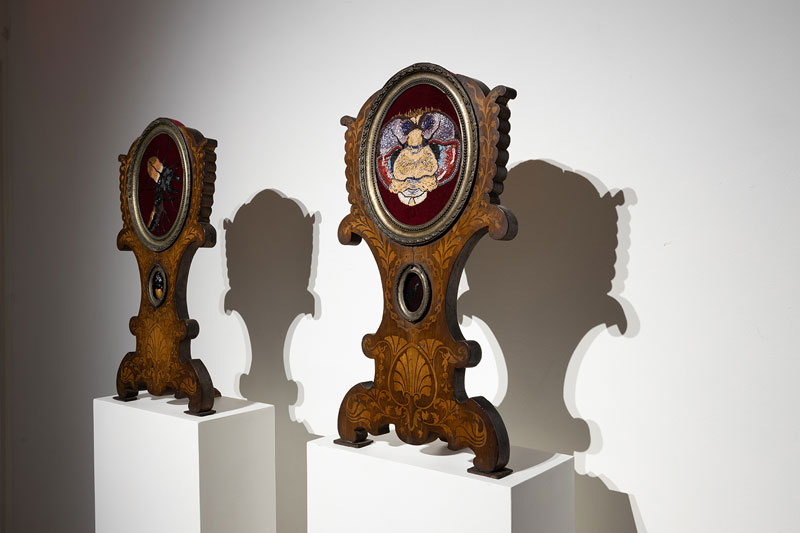
Wollf estimates that about 85 per cent of her artistic practice includes beadwork. Prior to the transhumance project, Wollf focused on The Antiquarian’s House, a body of work that was also supported by the Canada Council for the Arts. That work, dating back to 2020, was created to bring contemporary beading into conversation with the Baroque period of art history.
“I’m interested in this period as a time when European nations were accumulating great wealth from the colonial project, which fuelled artistic production. I was thinking a lot about how the Métis fit into this but are absent from the visual record of the time,” Wollf wrote on her website. “Living close (to) Venice, where beads prized by the Métis originated, when I thought about what my Grandmothers and Aunties would want me to bring back from this place, the answer was beads, lots of beads, and my stories. These were the first thoughts about this series of work, which evolved considerably after its inception.”
When asked about her advice for current USask students and recent graduates who may want to follow in her footsteps as an artist, Wollf said her biggest piece of advice for any artist is to “create a good, solid body of work.”
“That’s the first thing. It’s compulsory. Before you worry about anything else, get your vision in place.”
Wollf said it’s important for artists to find people “who really believe in your work and who want to help you succeed.” She said she is exceedingly grateful for the support she’s received from funders, curators, gallerists, and collectors.
Wollf also noted that “everybody has their own path.”
“Mine is so, so strange in some ways and so unique,” she said. “But the first thing I would say to anybody who's considering going back (to university) later in life, as I did, is that it's never too late. It's never too late to explore your passion.”
Article re-posted on .
View original article.