

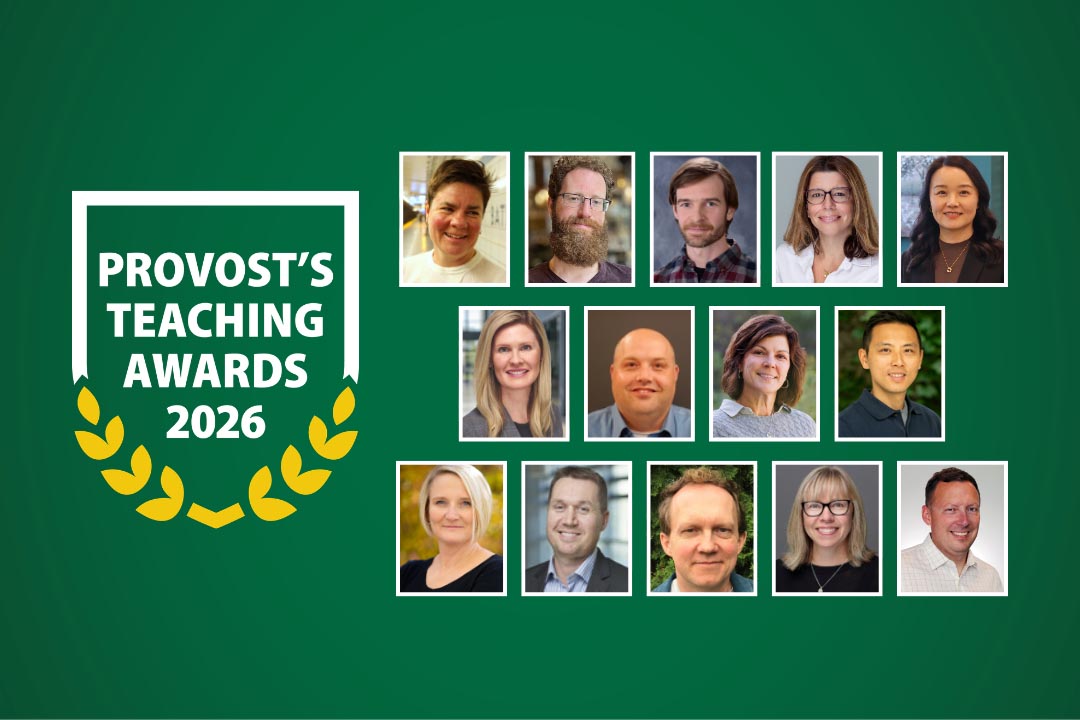
USask celebrates the 2025/26 Provost’s College Awards recipients
Excellence in teaching takes many forms across the University of Saskatchewan (USask), from inspiring classroom experiences to innovative approaches that strengthen student learning.
By BROOKE KLEIBOERThe Provost’s College Awards for Outstanding Teaching recognize educators from across the colleges whose dedication, creativity, and impact exemplify USask’s commitment to teaching and learning. One award is awarded annually to an educator in each college or school. Awards are also awarded at the institutional level each year.
“The recipients of the Provost’s College Awards for Outstanding Teaching demonstrate the scale and scope of remarkable teaching practice that defines our university,” said Dr. Patti McDougall (PhD), interim provost and vice-president academic. "Their dedication to their students, their disciplines, and to the practice of teaching reflect the strength of USask’s learning culture. By fostering engaging, inclusive, and supportive learning environments, these educators make a lasting impact on students and play a vital role in strengthening the communities we serve.”
This year, each award recipient was asked the question: “What lesson, habit, or way of thinking do you hope students carry forward from their learning opportunities with you?” Read on to find out their answers.
All award winners will be celebrated at the USask Staff and Faculty Awards event on June 17. A full list of recipients of USask Staff and Faculty Awards is available online.
Dr. Katherine Stewart (PhD), College of Agriculture and Bioresources
“I hope my students carry forward a sense of wonder and curiosity and have built confidence to put their knowledge into action as participants in their communities, believing that they can make positive changes in the world. I hope my students continue to self-assess and reflect deeply, especially when learning from challenges and failures. Finally, I hope my students bring collaborative and interdisciplinary approaches to forge new relationships, knowledge and solutions to today’s challenges.”
Dr. Kyle McLeister (PhD), College of Arts and Science, BA, BMus or BFA Programs
“University should be fun – all too often we concentrate exclusively on making sure that students have mastered a specific topic or learned some new skill. And while those things are obviously important, focusing too much on them can make university feel like a slog to get through or a list of checkpoints to hit. So, I try to make my classroom a place not just for curiosity and learning, but also for laughter and fun. And I hope that students come away from my classes remembering to have fun, regardless of what they’re working on.”
Dr. Matthew Toohey (PhD), College of Arts and Science, BSc Programs
“I hope that my students carry forward an appreciation of how the concepts of physics relate to our everyday life and a sense for the importance of curiosity and play to thinking like a physicist. Most of all, I hope that they remember a moment when something clicked, when some concept that was once nebulous and vague became infinitely clearer, and they experienced the deep feeling of reward that comes from understanding.”
Dr. Michelle Siqueira (DDS), College of Dentistry
“I hope students carry forward the understanding that learning is not about getting everything right on the first try, but about staying curious, asking questions, and being willing to refine their thinking over time.”
Dr. Jing Xiao (PhD), College of Education
“Learning brings out the strengths that are already in you. I hope students leave my classroom trusting that their background, culture, and lived experience are not barriers to success, but sources of insight and resilience. Whether you are an international student or a domestic student, you already bring with you valuable knowledge. My goal is to help my students recognize it, strengthen it, and apply it with confidence in whatever path they choose on their learning journey.”
Brooke Klassen, Edwards School of Business
“I hope students come away with the confidence to embrace a growth mindset and remain open to change. There are many ways to understand the world, and the best decisions are rarely simple or obvious. I encourage students to consider multiple perspectives, question assumptions, and see uncertainty as an opportunity for learning rather than a barrier. Through this process, I have seen them grow in their ability to think critically and navigate challenges with both humility and purpose.”
Brad Schmid, College of Engineering
“I hope students from my engineering classes take with them the ability to critically evaluate their solutions. I try to stress the importance of understanding if their solutions make practical sense. I often ask students for a ‘gut check.’ They critique their solution to consider if the result makes practical sense. The ability to identify when your solution may be incorrect, no matter how good the analysis appears to be, is essential.”
Dr. Michelle Bussiere-Prytula (PhD), Johnson Shoyama Graduate School of Public Policy
“I hope students leave my courses with the understanding that learning is not just about grades, but about developing the knowledge, skills, and judgment they will need throughout their careers. When students understand and reflect on both their strengths and areas for growth, they are better equipped to continue learning, adapt to new challenges, and contribute thoughtfully to the organizations and communities they serve.”
Shannon Forrester, College of Kinesiology
“It is my hope that students carry forward a strength-focused, compassionate approach to movement. One that honours diverse perspectives, values inclusion, and supports both personal and collective well-being. I encourage thoughtful, evidence-informed physical activity promotion that is adaptable and empowering. Practices that help people build confidence, resilience, and connection, while respecting the health of individuals, society, and the planet.”
Dr. Clayton Bangsund (PhD), College of Law
“Most of my students become practicing lawyers who serve clients of all sorts including individuals, corporations, and governments. I hope that students emerge from my classroom with foundational knowledge of the law along with a pragmatic mindset that enables them to identify and effectively resolve problems in their future clients’ best interests.”
Dr. Stan Bardal (PhD), College of Medicine
“My advice to students is to embrace the opportunities that change may bring. The fact that my field (pharmacology) is constantly evolving is what keeps me interested and engaged, but I understand that constant change can also be unsettling. This generation of graduates will likely see more workplace change than any before it. Be flexible, adaptable, learn from your mistakes, and listen to those around you. Most importantly, stay curious and keep learning. Make us proud!”
Jill Zdunich, College of Nursing
"Nursing education has brought much joy and fulfilment to my career. My goal has always been to improve the overall experience for students while helping to empower the next generation of competent and committed future nurses through collaboration and integrating knowledge with practice. It continues to be a privilege to support students while also challenging them to think critically. I hope that students realize their potential and always remember to approach nursing with curiosity, humour, and compassion."
Dr. Jason Perepelkin (PhD), College of Pharmacy and Nutrition
“I hope students leave with a habit of thinking critically for themselves. To question, reflect, and adjust, even when answers are not clear or easy. To stay curious, seek feedback, and keep learning in their personal and professional lives. To connect knowledge to practice and take responsibility for their decisions. To be comfortable saying “I don’t know” and then finding the answer. And to contribute with care, humility, and empathy, while also taking care of themselves.”
Dr. Michael Wu (PhD), Western College of Veterinary Medicine
“In teaching foundational knowledge to future veterinarians, I want students to continually ask how their classroom learning applies in clinical and real-world contexts. I hope that by taking time to reflect on this knowledge, they will be better able to explain and interpret the scenarios they encounter in their own experiences with animals, which I hope will greatly enrich their knowledge mastery.”