

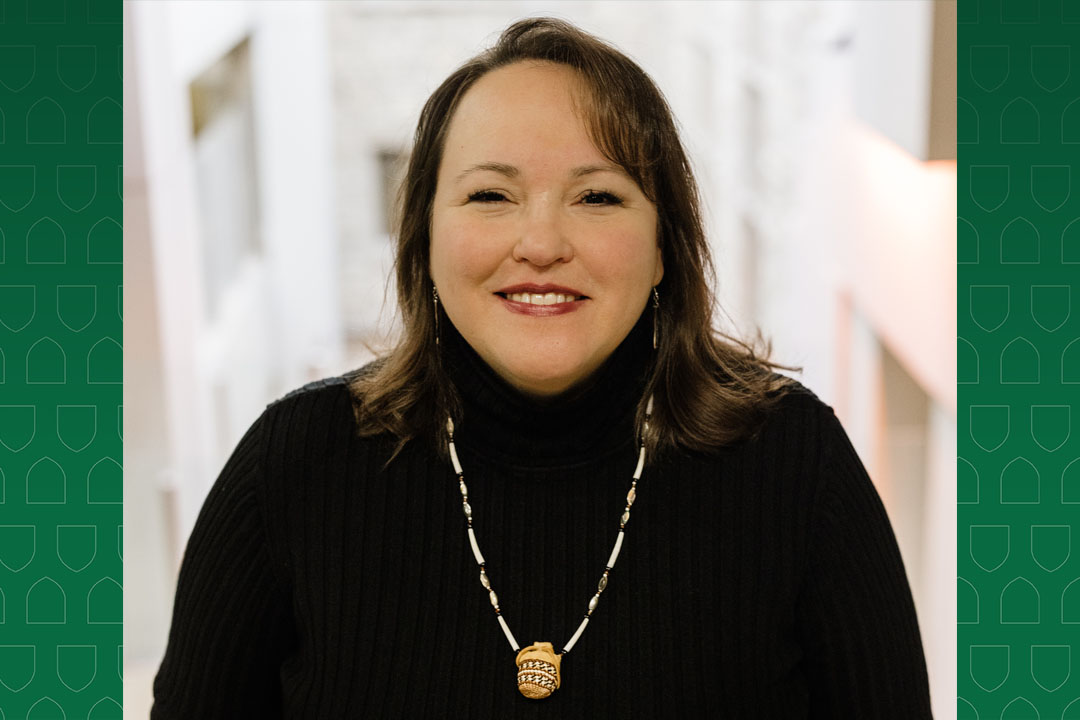
Farewell message from Dr. Angela Jaime
Dr. Angela Jaime (PhD) is leaving her role of Vice-Provost, Indigenous Engagement for a new position as Vice-President Indigenous, at the University of Victoria.
I came to the University of Saskatchewan (USask) on July 1, 2020 in the middle of a pandemic with my two boys. It was a move from Laramie, Wyoming where I had raised my boys for 16 years. We were ready for a change and USask offered us that opportunity. Over the course of the last six years, I have learned many life lessons and embarked on relationships I will continue to nurture into the future. I am grateful to the USask community for welcoming me to the prairies. It has been my honour to serve the university community and external partners in the work of speaking our Truth and working toward the path of Reconciliation. I am grateful for the opportunity to support and guide this work through the roles of Vice-Dean Indigenous and Vice-Provost Indigenous Engagement.
The work of the Office of the Vice-Provost Indigenous Engagement (OVPIE) is vast and always growing. Serving Indigenous students, staff and faculty, the team within the OVPIE portfolio works tirelessly to guide policy challenges, manage procedures at the college and university level and steward new initiatives and programming. All of this work is done with ohpahotân | oohpaahotaan Indigenous Strategy in mind and follows protocols set forth by our Wise Ones. The work of OVPIE is difficult, taxing and it demands our whole self to address the needs of the USask Indigenous community. Many of our efforts extend beyond the borders of the university to support Indigenous Nations and their people through agreements and community engagement work. These relationships help us with our strategic and operational advocacy, but within them are personal ties that connect us, and call on us to seek Truth. OVPIE continues to advocate for the implementation of ohpahotân | oohpaahotaan and the people of OVPIE are willing and excited to walk with you in this journey toward Truth.
As a university community, we are working together to realize the aspirations of those who wrote the strategy. While we have made progress in our understanding of what ohpahotân | oohpaahotaan is telling us, realizing the gift means we need action. Critical systems change is the next step in uplifting the gift.
A holistic, strategic approach to transforming a system by addressing its root causes, not just symptoms, to create sustainable change. This involves shifting underlying structures, policies, and attitudes by working across different parts of a system to achieve a new, more effective institution.
The work of critical systems change requires us to ask critical questions about who is not at the table, and take note that the voices missing from the conversation are not just absent, they are silenced and not allowed to contribute to the work. Asking critical questions about the work we do for Indigenous students, staff and faculty and whether they are being supported in a way that fosters success and creates safe spaces for them to thrive is the path forward.
If we see challenges Indigenous people are faced with and simply try and address the immediate issues without addressing the root cause of the challenge, then we are not achieving critical systems change that challenges the attitudes and behaviours that cause harm. We must push past the reaction to place a band-aid on the situation, but rather we must challenge the system of complacency and tolerance that leads to harm.
We must challenge the response by some that “this is how things have always been done.” We must challenge the weaponization of historical memory that prevents us from building sustainable pathways toward success for Indigenous people. Policies that are not written for the success of students but rather the assumption of guilt and punitive measures hindering learning. If we are not here to support and guide students toward becoming productive and thriving citizens of a diverse and complex society, then we are not doing our job as an institution of higher learning. We must challenge the exclusionary nature of colonial policies and structures built to keep Indigenous people submissive and oppressed.
I wholeheartedly believe the University of Saskatchewan can, and will, do this work. I believed it when I arrived six years ago and I believe it now. I believe in the people within the university to do the right thing, to strive for safety and accountability and I believe people want more for this institution. It is my hope for you all here to embrace challenges and collaborate to strive for better. I leave you with a full heart.