

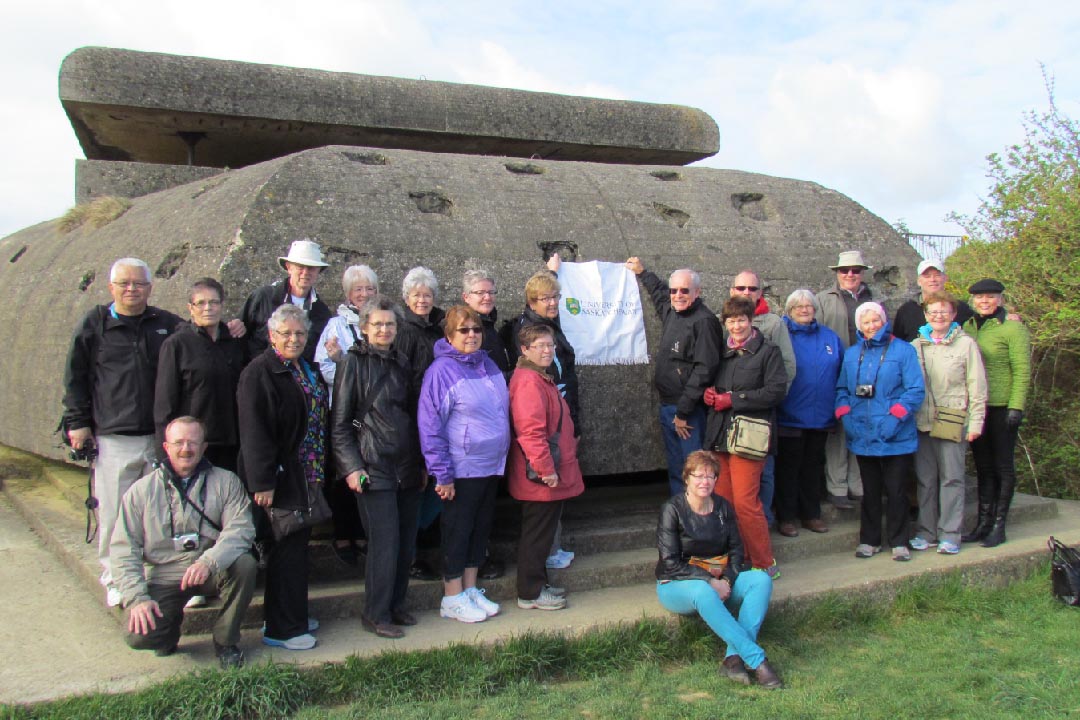
Recollections of War
USask Chancellor Emerita Vera Pezer hosted five Chancellor’s Alumni World War Tours to Europe
By Vera Pezer, USask Chancellor EmeritaBetween 2011 and 2019, I was privileged to host five University of Saskatchewan (USask) Chancellor’s Alumni World War Tours to Europe focusing on themes of Canada’s contributions to two World Wars—the 1914-1918 Great War and the 1939-1945 Second World War.
First World War “Great War” Tours
The first trip, devised over lunch with Bill Waiser, a historian and USask distinguished professor emeritus, led to the First World War tour describing Saskatchewan’s role, with special attention to university faculty and students.
Twenty-one travellers began a journey of exploration in London in late April 2011. Bill’s recommended reading gave us insight into what we would see. Individual assignments, where we shared stories of Saskatchewan soldiers over dinner on tour, provided a human perspective to the cemeteries and memorials we visited.
Although not on our formal itinerary, we joined thousands of visitors to experience London’s excitement the day before the royal wedding of Prince William and Kate Middleton. Along with visits to familiar sites, such as Trafalgar Square and Buckingham Palace, our interest in Canadian history took us to the Canadian War Memorial in Green Park.
A morning view of the White Cliffs of Dover greeted us as we departed England by ferry for Belgium and France. The next eight days provided visits to numerous cemeteries and sites of famous battles. One trip was to Valenciennes, France, and a nearby cemetery marking the resting place of Sergeant Hugh Cairns, the Saskatoon plumber who earned a Victoria Cross for repeated assaults over several hours on German troops. Severely wounded, he died on Nov. 2, 1918, nine days before the end of the First World War. Valenciennes honours him with Hugh Cairns Avenue. A memorial, a school, and armory bear his name in Saskatoon.
Another visit took us to Canadian physician Dr. John McCrae’s field hospital near Ypres, Belgium, where he wrote “In Flanders Fields.” A century later, poppies thrive on the roadside near his hospital bunker. Sadly, McCrae died in France of pneumonia and meningitis on Jan. 28, 1918, immediately before the onset of the 1918-20 influenza pandemic.
Ypres, a city about the size of Prince Albert, Sask., is home to the Menin Gate memorial, famous for its 15-minute Last Post ceremony at 8 pm each evening. Interrupted only by German occupation during the Second World War, the ceremony, featuring bands from Europe and England, has been performed continuously from 1928 to the present day. Visitors pay tribute to the 54,986 missing Allied soldiers named on the Gate who marched through on their way to the front. On behalf of USask, we laid a wreath during the ceremony.
Along with other sites, such as the large statue of a somber soldier at Vancouver Corner and the railway car in the Compiègne Forest where the Armistice was signed, the Battle of the Somme area—that led to one million casualties on both sides between July and November 1916—proved emotionally unsettling. A statue of a huge caribou visible for miles is located at Beaumont-Hamel village, where a Newfoundland regiment was obliterated. Of 780 men, 68 answered roll call on July 2nd. There was little conversation on the bus ride back to our hotel. This tour exposed us to the slaughter that marked the Great War.
Our final day in Europe saw us at Vimy Ridge, the memorial to 11,285 missing Canadian soldiers. As we gathered on the steps for a group photo, a spontaneous rendition of “O Canada” led to tears and hugs.
On the walls of USask’s Peter MacKinnon Building, the Great War is remembered with the names of students and faculty engraved on memorial ribbons and plaques. During 1914-1918, 345 students, faculty, and staff enlisted when at the time, the university, barely a decade old, had approximately 400 students and 80 to 90 faculty and staff. This underscores that the university pulled significantly above its weight to support the “war to end all wars.”
Second World War Tours
The first tour provided a template for four successive tours focusing on the Second World War on alternate years between 2013 and 2019. Approximately 10 participants joined each tour, where the welcome reception became a reunion that accepted new participants who shared a common interest in Canada’s military history. Each tour took us to museums and monuments along with battlefields and military cemeteries, many maintained by the Canadian government.
The 2013 tour of Western Europe, starting from Portsmouth in England to Juno Beach in Normandy, France, followed the exact route taken by Canadians on D-Day. Of the 45,000 Canadians who lost their lives during the Second World War, 5,500 were killed during the Battle of Normandy and 381 on D-Day. Canadian troops helped liberate France, Belgium, and Holland, culminating in victory on May 7, 1945.
We were fortunate to celebrate the end of the Second World War in Holland to participate in ceremonies and celebrations, including a parade. A plaque on a museum in Wageningen marks the site where Canadian General Charles Foulkes took the surrender from German General Johannes Blaskowitz.
Our 2015 journey of discovery to Italy provided a different perspective from our experience in Western Europe. Italy offered fewer sites because, as our guide Giuseppe explained, Italy has trouble reconciling its role in the Second World War.
Initially allied with Hitler, Italy signed an armistice with the Allies in 1943 when dictator Benito Mussolini was deposed. This led to civil war where German invaders supported the fascists, and many Italians joined the Allies. Canadian troops were caught between increasingly desperate Germans and an unpredictable Italian population. They fought and succeeded without the huge accolades that troops received in Western Europe.
Italy, without a clear role or military successes in the Second World War, offered our trip a more muted historical chapter. The Allied invasion and capture of Sicily contributed to the fall of Mussolini. Our visit to the island taught us that Canadian troops, with 20,000 casualties between the July 1943 Sicily landing and victory in 1945, played a costly, significant, and less celebrated role in helping to win the Second World War.
Remembering Canada’s Role in both World Wars
The final alumni tours—Germany in 2017 and England in 2019—focused on these two main antagonists in both world wars. Canadian soldiers fought out of Holland into Germany in the spring of 1945 to contribute to Germany’s surrender. Canada maintained a military presence in West Germany following the war to aid reconstruction and to thwart Soviet expansion into Western Europe. Canadian troops transitioned from fighters to peacekeepers.
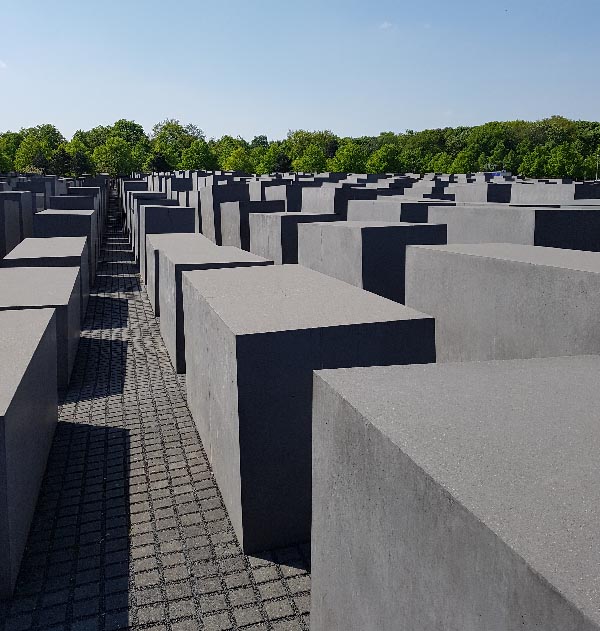
Memorials we saw in Potsdam and Berlin acknowledge Germany’s role in the Second World War factually and with restraint. Berlin’s Holocaust Memorial to the murdered Jews in Europe consists of 2,700 stark concrete slabs of various sizes arranged on a sloping field. Visitors walking the memorial are gradually lost to view, a stark reminder of what happened to six million Jews. Hitler’s bunker in Berlin, where he died by suicide on April 30, 1945, was demolished and became a parking lot surrounded by apartments. Nazis remain active in parts of Europe, so the location is unmarked to discourage any recognition that might contribute to a Hitler shrine. Germany, like Italy, acknowledges but does not promote its role in the Second World War.
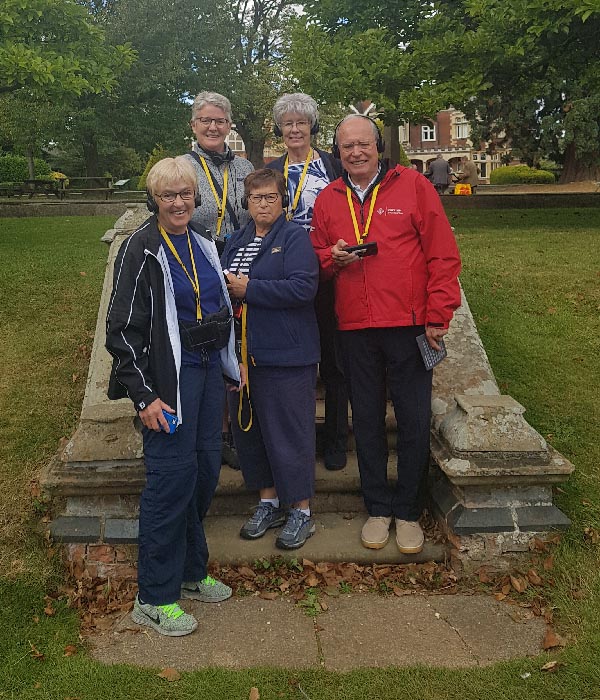
Canada, with loyal historical ties to Great Britain, was one of its staunchest allies during both world wars. A strong Canadian presence exists throughout London and southern England.
The Canada Memorial in Green Park near Buckingham Palace pays tribute to nearly one million Canadian military personnel who served in both world wars. A corner of Brookwood Cemetery contains 2,400 Canadian graves, including 43 men who died of wounds suffered during the disastrous 1942 Dieppe Raid that produced 3,400 casualties from a total of 5,000 Canadian troops. The memorial at the south end of Brookwood identifies nearly 3,500 Commonwealth personnel, including Canadians whose circumstances made it impossible to assign them to a specific location. They died on raids, downed airplanes, on hospital ships, or as spies captured and killed by the Germans.
The Battle of Britain Memorial on the white cliffs of Dover lists 112 Canadian pilots, including 10 from Saskatchewan who fought over Great Britain in 1940.
Bletchley Park, Britain’s secret code-breaking headquarters staffed primarily by women, intercepted, translated, and forwarded German enigma codes to aid allied efforts. Staff could never disclose their work, but evidence exists that at least five Canadian navy women worked at Bletchley Park. Winston Churchill described Bletchley staff as “the geese that laid the golden eggs and never cackled.”
During the First World War, of the 345 USask students, staff, and faculty who enlisted to serve, 69 did not return home. During the Second World War, more than 2,500 USask students, staff, faculty, and alumni enlisted and 202 were killed in action. They are remembered every year with a ceremony at the USask Memorial Gates.
Our final evening in London found us at the Phoenix Theatre to attend the Canadian musical Come From Away, based on the remarkable true story of what happened in Gander, Newfoundland and Labrador, following the New York 9/11 attacks. Gander, with a population of 10,000, provided food, shelter, and emotional support to 7,000 passengers from 38 stranded flights.
Our five tours captured Canada’s legacy of service over more than a century. Come From Away tells us the legacy continues in 21st-century Canada.
Editor’s note: This article first appeared in the Nov. 6, 2026, edition of the University of Saskatchewan Retirees Association (USRA) newsletter.