Better berries: USask research lays groundwork for saskatoon berry breeding
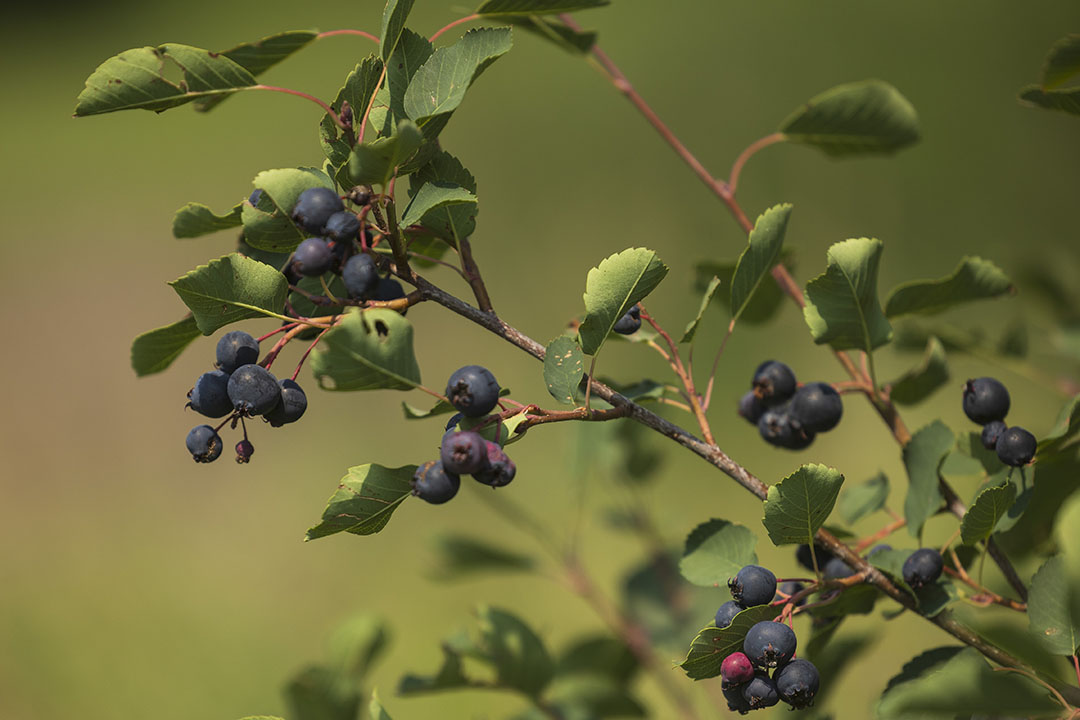
Originally from Slovenia, Dr. Anže Švara (PhD) had never even heard of Saskatoon before seeing a job opening at the University of Saskatchewan (USask), let alone the tiny purplish berries that the city’s name comes from.
By Matt Olson, Research Profile and ImpactBut now, Švara is helping lead an innovative new research project that will give plant scientists and breeders new insights into understanding and breeding new types of saskatoon berries in the future.
“We have two key questions: can certain saskatoon berry plants breed with other saskatoon berry plants? And is there diversity that can be utilized to develop new varieties with improved traits?” said Švara, an associate professor with the Department of Plant Sciences at the College of Agriculture and Bioresources and the lead of the USask Fruit Program.
USask houses a tremendous number of saskatoon berry genetic varieties collected over the decades — around 2,000, per Švara — and this fruit crop is the leading fruit in terms of production and acreage in Saskatchewan.
However, Švara said there are some unique challenges when it comes to breeding saskatoon berries. Specifically, a number of historically successful saskatoon berry cultivars have four sets of chromosomes instead of two. This characteristic is associated with plants that produce seedlings that are nearly identical to the parent plants but makes it extremely difficult to breed those plants with others for specific genetic or physical traits.
Švara’s project will categorize saskatoon berry varieties at USask to better understand and identify traits that can potentially be bred and selected for future, new varieties. He is working with Dr. Tim Sharbel (PhD) in the College of Agriculture and Bioresources, and Dr. Pankaj Bhowmik (PhD) with the National Research Council of Canada on this saskatoon berry research, with the project also receiving support from the Saskatchewan Fruit Growers Association.
As breeding new saskatoon berry cultivars is very rare, the hope for this project is that it can contribute to future innovative berry breeding projects and help bolster growers working with saskatoon berries in the agricultural industry.
“For over 50 years, there has been almost no genetic improvement of saskatoons, no systematic streamlined breeding that has been successfully done because saskatoon berry cultivars ... won’t successfully cross,” Švara said. “This is a huge obstacle for breeders because you cannot bring in new genetics, new combinations, and we’re trying to overcome that.”
The saskatoon berry breeding research project is supported by the Agriculture Development Fund (ADF). This program is funded through the Sustainable Canadian Agricultural Partnership, a five-year (April 1, 2023, to March 31, 2028), $3.5-billion investment by federal, provincial and territorial governments to strengthen competitiveness, innovation, and resiliency of Canada’s agriculture, agri‐food, and agri‐based products sector. This includes $1 billion in federal programs and activities, and a $2.5-billion commitment that is cost-shared 60 per cent federally and 40 per cent provincially/territorially for programs that are designed and delivered by provinces and territories.
Švara has significant experience as an apple researcher from his previous work as a student and researcher. But according to Švara, there are a number of similarities between saskatoon berries and apples, which has helped him dive into his new role leading the USask Fruit Research and Breeding Program focusing on the locally grown berry.
Švara said he’s come to understand the significance of saskatoon berries to the city and the province he now lives in and hopes to continue strengthening saskatoon berry production now and into the future.
“The support from the ADF is vital for us to succeed, to build a team and to advance the research that hopefully will be impactful for the university and the community. And by community, I mean the people here and globally as well,” he said.