

Creating community: USask researcher champions network for human-animal connections
In a world where isolation and anxiety are on the rise, University of Saskatchewan’s (USask) Dr. Colleen Anne Dell (PhD) is fostering powerful connections with both animal companions and human collaborators.
By Erin Matthews, Research Profile and Impact“We are living in an increasingly isolated society, but one thing we know about animals is that they help us feel connected — connected to them, connected to our neighbours and connected to our community,” said Dell.
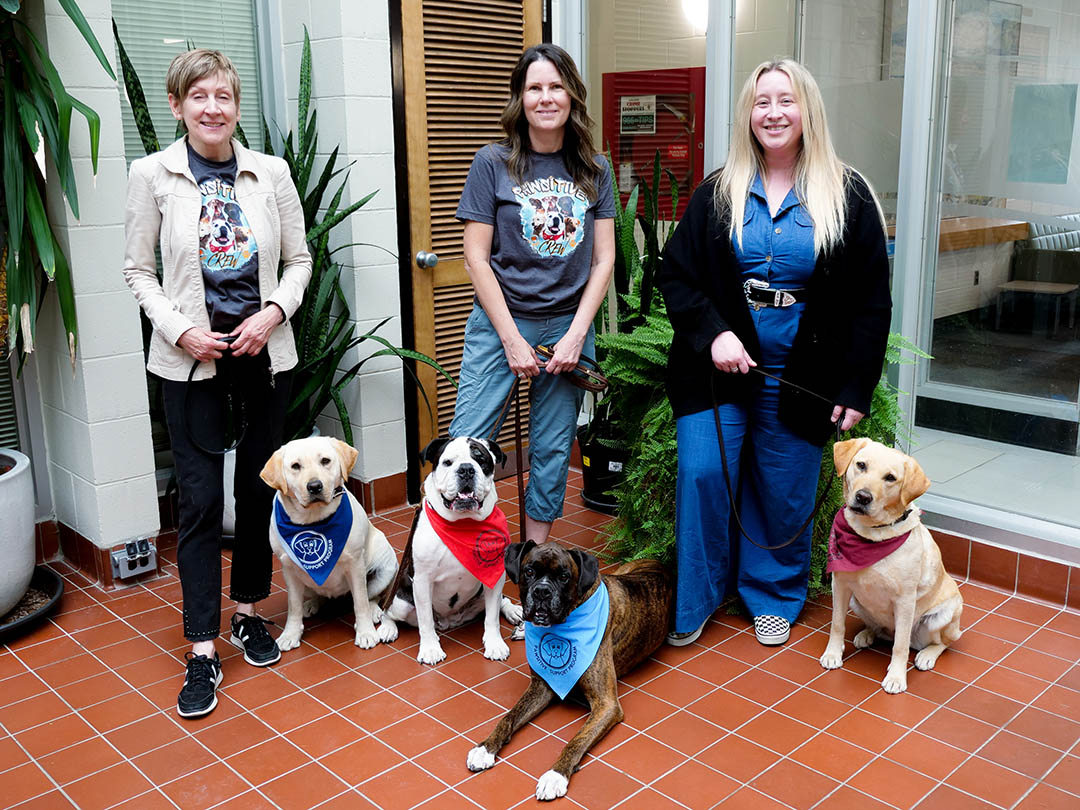
Dell is a professor in the department of sociology at USask’s College of Arts and Science and an associate faculty member in the School of Public Health. She also leads the PAWSitive Connections lab, which looks at the role of human-animal connections and provides innovative, community-based therapy dog programs.
She is now looking to establish a transdisciplinary network to grow the understanding of these complex relationships and their impact on both humans and animals.
Dell recently received a $2.5 million investment from the Social Sciences and Humanities Research Council (SSHRC) that will be instrumental in growing this innovative research network.
“We are thrilled to receive a SSHRC Partnership Grant for our team. We currently have 116 national and international partners with over 250 dogs connected to our members. This investment is an incredible opportunity to grow a first-of-its-kind network and expanding beyond those already involved,” said Dell.
Dell’s research group is looking to better understand how animals support our health through our relationships with them. They are also investigating the challenges that people may face, such as the death of a pet or not being able to care for an animal because of economic restrictions.
“There are so many wonderful things, but there are also so many factors that impact our relationship with the animals in our lives and we really want to bring that to the forefront to really provide an understanding of the animals that are so important to our health,” said Dell.
Dell is also interested in the animal’s experience.
“We want to know how we account for the animal’s perspective and better understand both their experience and their roles in human families or as therapy or service dogs,” said Dell. “Accounting for their perspective is going to be very rewarding and involves a lot of creativity. For example, even just asking the question ‘what is the dog feeling in this encounter’ is a step forward from solely centering the human experience. I think this is where the answer to addressing some of our larger social challenges we are facing today begins.”
According to Dell, one of the most important aspects of the project is ensuring that the network is inclusive and involves active participation from community partners and people with lived experience.
“We have 30 community organizations on our team and 19 independent community collaborators to ensure that whatever we are producing in the university through this partnership grant is responding to a need in the community — a need that is both important to humans as well as important to animal wellbeing,” said Dell.
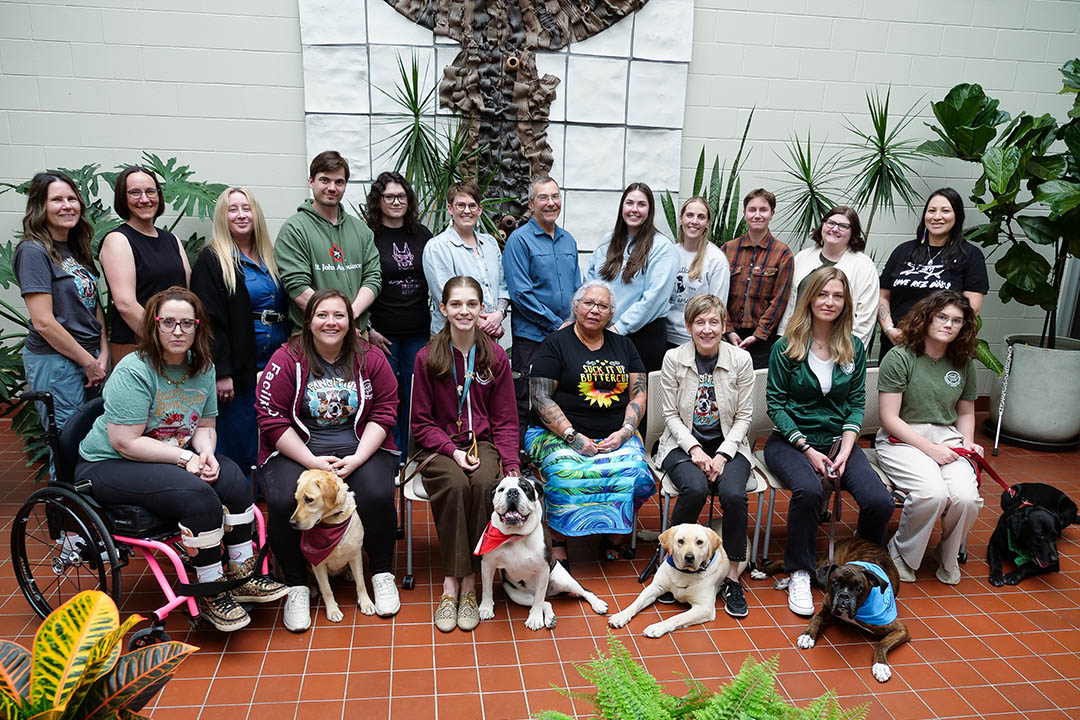
St. John Ambulance Therapy Dog Program in Saskatchewan is a long-time community collaborator of Dell. For nearly 15 years, the program has been working with Dell and other researchers at USask to better understand the impact of human-animal connections on health and well-being.
“Through this long-standing partnership, we have seen firsthand how therapy dogs can reduce depression and anxiety, support mental wellness, foster social connection, and provide comfort and meaning to those who need it most,” said Ben Carey, St. John Ambulance Community Services Director. “Understanding these benefits is especially important as our therapy dog teams visit hospitals, care homes, schools, vaccination centres, and other community settings across Saskatchewan.”
According to Carey, this new project represents an exciting opportunity to build on that foundation and contribute to a growing body of Canadian research exploring the relationship between people and animals.
“We are excited to be part of this growing network of researchers and community partners, working together to better understand, measure, and share the incredible benefits that therapy dog teams bring to so many people's lives and better explore how we can do the same for them,” said Carey.
Dell also hopes that the network will help expand knowledge mobilization and graduate student training, growing and strengthening a community of academics.
“When I entered this field in the early 2000s, we were really breaking new ground. There weren’t a lot of people to work with, and we are still quite a new field,” said Dell. “This is the first time that such a large grant has been secured to develop a network, and with many universities involved, so training is really important and will be available for both early career researchers and students.”
This is the second partnership grant ever for SSHRC to award with a Chair component. Dr. Dell will hold a Chair in One Health & Human-Animal Connections for the entirety of the grant, and is excited for the potential impact this formalized attention to human-animal relationships can have.
Dell says that the network will work towards developing policy and tool kits to help translate research outcomes to a wider audience. The network will also assist researchers in communicating their current research results.
“It’s not just about generating new research, it’s about helping to move along what’s already there, so we are all gaining from and sharing in a co-creation of a story and an experience,” said Dell. “It’s really about creating a community.”
This project includes collaborations with researchers from the University of Regina, the University of British Columbia, Queens University, McMaster University, Dalhousie University, the University of Guelph and more.