

New USask AI research improves how computers interpret the world
For artificial intelligence (AI) tools that rely on interpreting data from the real world, both speed and accuracy are critically important.
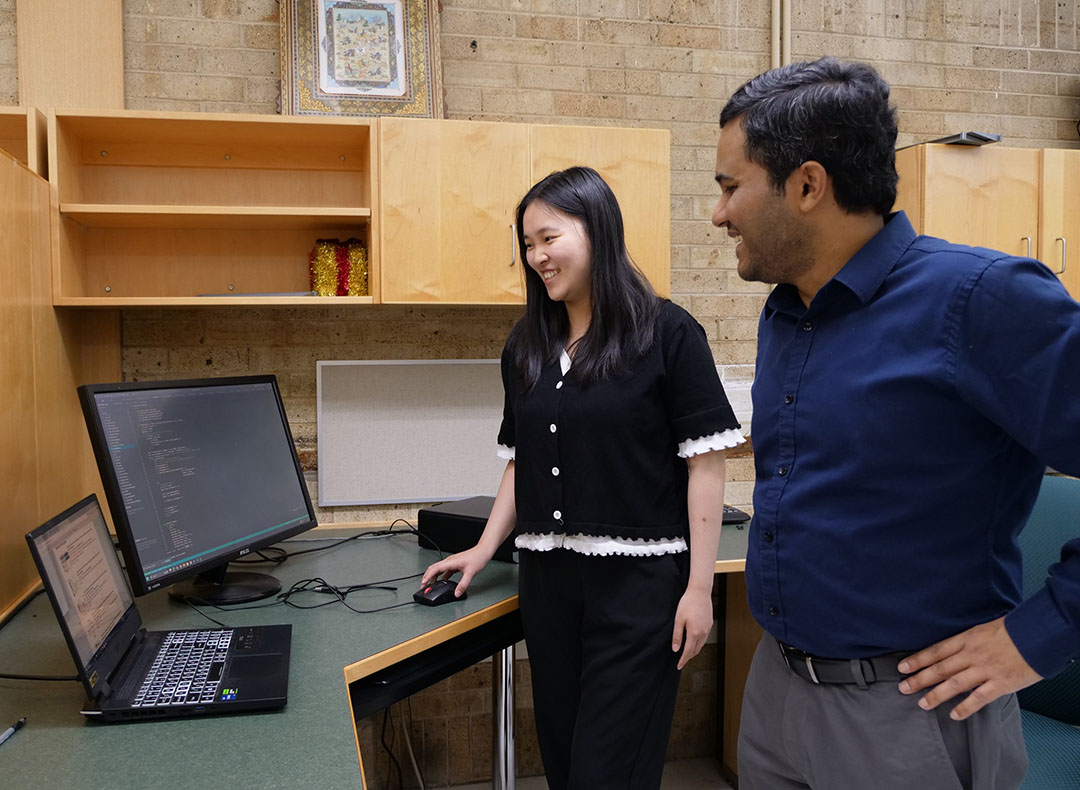
By Matt Olson, Research Profile and ImpactResearchers at the University of Saskatchewan (USask) have developed a tool to make AI that sees the real world – from applications in medical procedures to self-driving cars – faster and more efficient.
“It’s so important for AI models to make decisions faster and more accurately,” said Tzu-Ling Liu, a recent Master of Science graduate at USask and one of the authors of the paper. “Imagine your self-driving car can identify and detect danger in 0.1 seconds, but our model can decide to stop in a fraction of that time. Which car would you buy?”
The paper was published at the Institute of Electrical and Electronics Engineers/Computer Vision Foundation (IEEE/CVF) Conference on Computer Vision and Pattern Recognition (CVPR) 2026. The conference is considered one of the highest-impact publication venues in the world.
The paper was written by Liu and co-authors Dr. Ian Stavness (PhD), the head of the USask’s Department of Computer Science, and Dr. Mrigank Rochan (PhD), an assistant professor in the department.
Using today’s models, when AI sees an action through video data, it can struggle to recognize the action when it is trained in one environment and applied to another environment. For example, an AI trained to recognize someone running on a sunny street has difficulty recognizing that action when it examines someone running in a dark and rainy park.
The problem of training AI models in one environment and struggling to function well in another is known as “domain shift.”
The USask research team developed a system called “Learnable Motion-Focused Tokenization” (LMFT) that acts as a digital filter for training AI models, stripping out the unimportant background information and allowing the model to focus on and learn only from the action taking place.
“The background interferes with the AI’s ability to identify actions, so imagine you can remove those uninformative background patches,” Liu said.
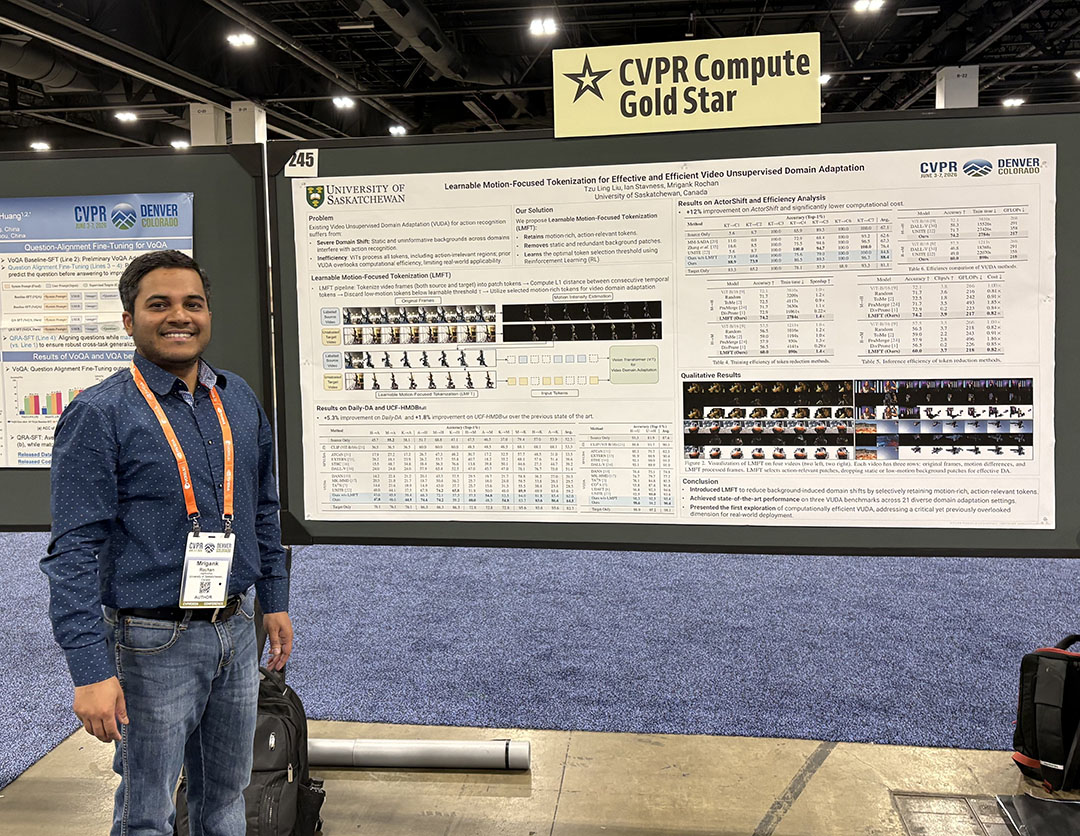
Because the LMFT method also strips out extra information that AI models no longer have to process, it can increase the speed and efficiency of AI analysis as well as its accuracy.
Rochan said one of the biggest hurdles in accessing cutting-edge AI is the sheer computing power AI requires to operate, making it a challenge for the average person and small organizations to own and run high-end AI models.
The streamlining of the LMFT method could reduce the processing power needed for AI models to operate and make more local AI development possible, without relying on massive power and data centres.
“We want to develop AI solutions that are both effective and efficient for a wide range of deployments,” Rochan said. “If we have a less computationally intensive model, we could potentially build it and host it locally.”
In addition to being published at the CVPR, the paper also received the CVPR Computer Gold Star Award for truly outstanding efficiency achievements. Only 18 papers from more than 16,000 submissions received the award.
“It’s a tremendous achievement for our lab and for the university,” said Rochan. “We are doing something relevant that the AI research community recognizes for the impact of how it can transform the AI models we are developing today.”