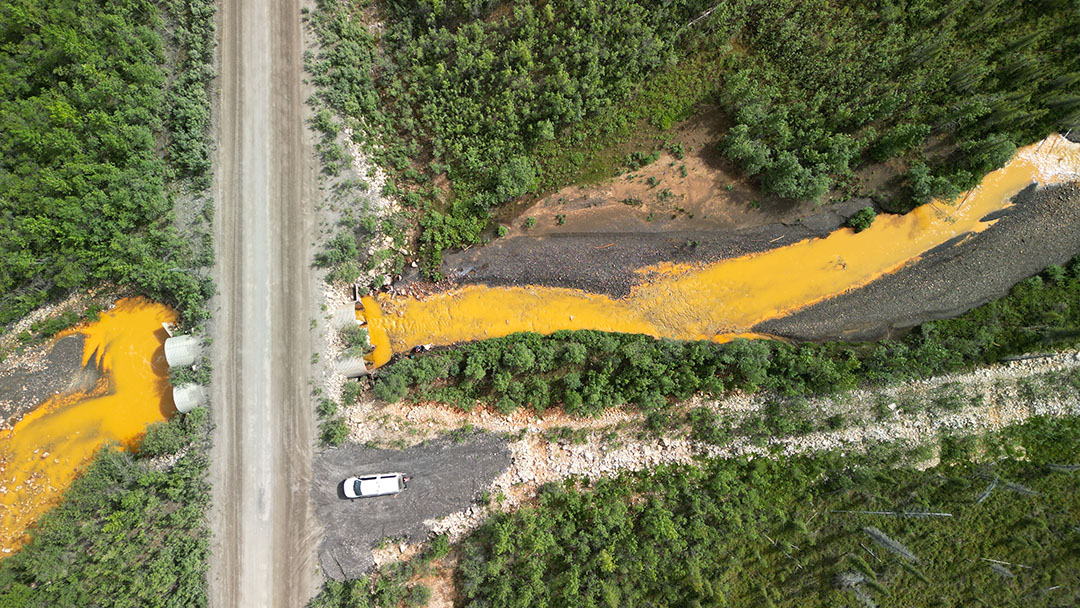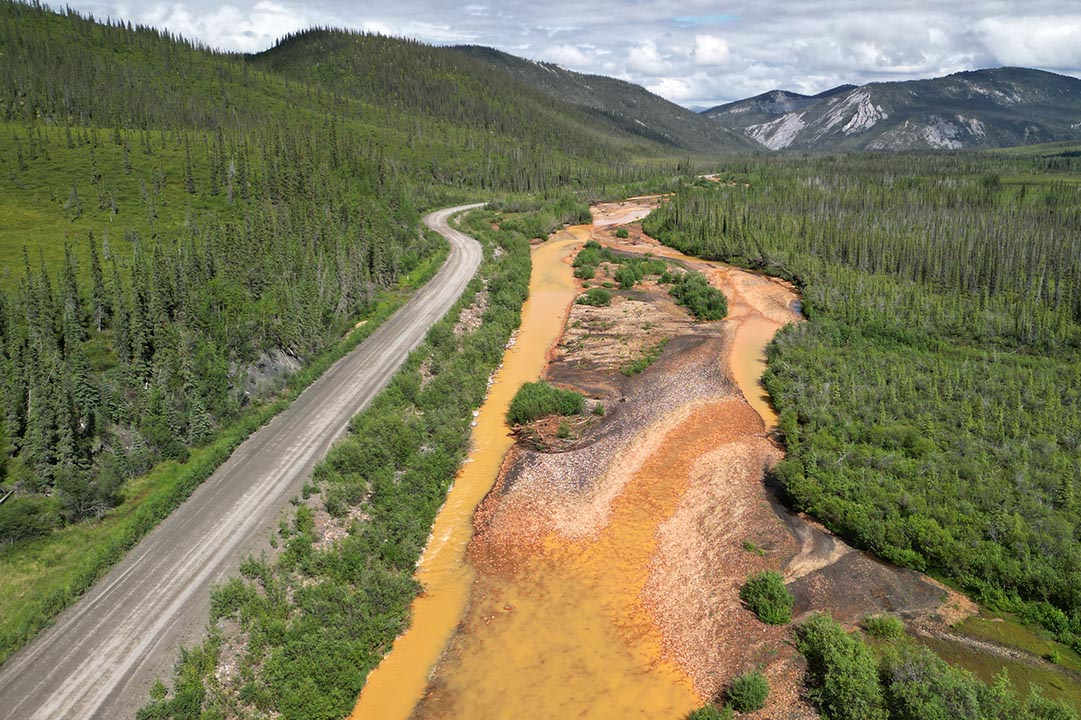
Rapidly 'rusting' subarctic rivers at heart of cross-Canada research project
Rivers are rapidly turning orange in the North – and the cause is metal pollution linked to ongoing climate change.
By Research Profile and ImpactA new research paper from University of Saskatchewan (USask), McMaster University, and Carleton University researchers shows that streams and waterways are being impacted by acidity and metals released from thawing permafrost in the North.
Referred to colloquially as “rusting” rivers, the phenomenon is linked to otherwise clear river water changing colour dramatically to orange and white as new minerals form in impacted streams.
This new paper published in the journal Science suggests that climate change is enhancing a process called ‘acid rock drainage’ in which rocks containing sulfide minerals are weathered. Sulfide minerals like pyrite react with water and oxygen to create highly acidic runoff that dissolves and carries metals like nickel and cadmium into rivers.
Dr. Matthew Lindsay (PhD), a professor in USask’s Department of Geological Sciences, was a co-author on the paper.
He said one of the most shocking parts of this research is how fast the rusting effect is occurring, rapidly rendering streams too tainted for most wildlife and having a distinct effect on the environment.
“What’s striking is both the speed and the scale. Water quality in some of these catchments is deteriorating extremely quickly, and wherever the underlying geology contains sulfide minerals, we’re seeing this occur across entire regions,” he said.
Lindsay credited his fellow researchers at USask and universities across Canada for this groundbreaking publication, including Carleton professor Dr. Elliott Skierszkan (PhD), who also holds an adjunct professor position at USask. Additional support for this research was provided by the Global Water Futures and the Global Water Futures Observatories programs based at USask.
Read the full article on McMaster University’s website here.