

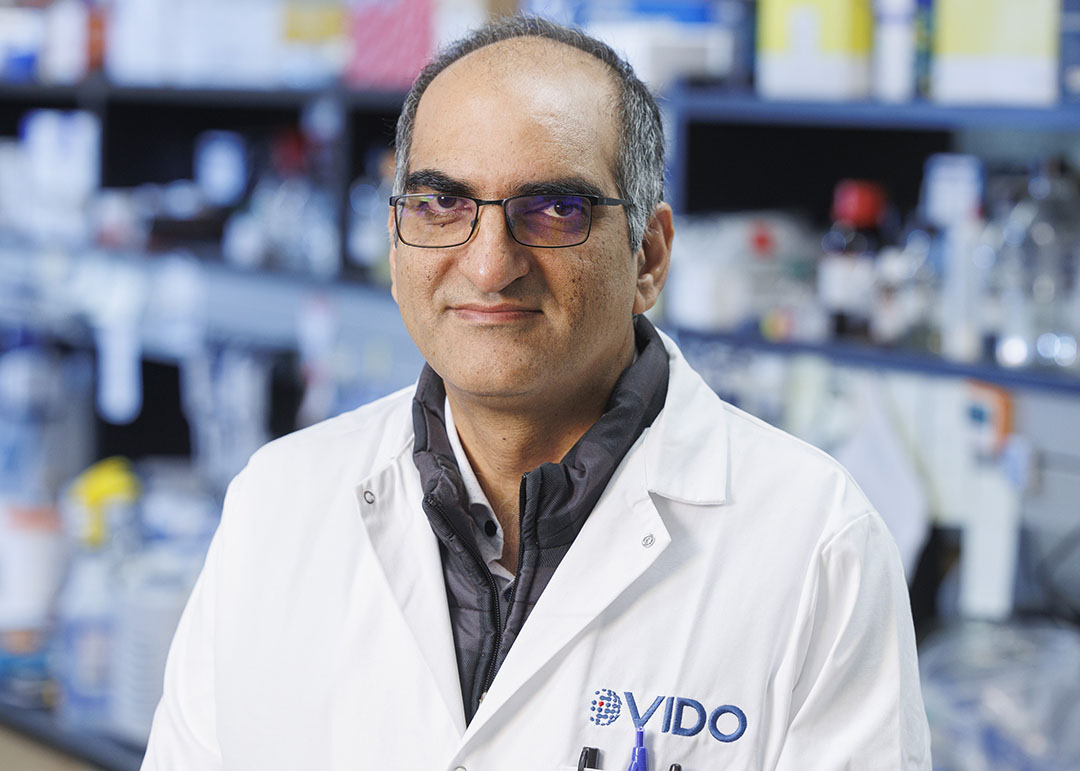
VIDO researchers advancing technology to better understand immune responses
Dr. Neeraj Dhar (PhD), principal scientist at the University of Saskatchewan’s (USask) Vaccine and Infectious Disease Organization (VIDO), is looking to better understand immune responses to specific diseases like tuberculosis — a disease that targets the respiratory system — and the therapies being developed to combat them.
By Erin Matthews, Research Profile and ImpactWith investment from the New Frontiers in Research Fund (NFRF), Dhar’s lab is developing advanced immune organoids, a new approach that can help save both time and money by testing how potential therapies will work.
Organoids are 3D micro tissue models that are developed from human donor tissue. According to Dhar, unlike traditional animal models, organoids closely mimic human biology, allowing researchers to reliably predict how treatments will work in people while also reducing reliance on animal testing.
“We are developing immune organoids and using them as a tool to evaluate therapies like vaccines or antibiotics currently being developed at VIDO, prior to doing large scale trials. This will help us identify our best candidates and eventually lead to higher success rates,” said Dhar.
According to Dhar, organoids offer researchers a crucial advantage because they can be tailored to model specific diseases in target species such as humans. In the case of Dhar’s tuberculosis research, a small piece of lung from a human donor can be used to generate a lung organoid, which can then be used to see how safe and effective treatments could be before bringing it to human trials.
“The difference in physiologies between animals and humans often leads to a disconnect, which means some new treatments or products fall out of the pipeline because they end up not being as effective,” said Dhar. “The organoid behaves like the organ down to its cellular structure, so it allows us to test our therapeutics in a more meaningful model.”
Organoid models have been used in research labs for years, but what makes Dhar’s NFRF-funded project unique is the added immune component. This involves taking the organoid and replicating a host’s immune responses.
While researchers have been using organoids over the last decade, immune organoids have only been in development in the last two to three years, meaning Dhar is bringing leading-edge technology to USask.
Dhar credits his co-collaborator Dr. Eliza Fong (PhD) from the National University of Singapore for supporting the set-up of the immune organoid technology in his lab. Fong is a leading researcher in immune organoids for cancer.
“Once up and running, we won’t be limited to the amount of material we can generate so we can test vaccines as well as antibiotics and we can do that in the context of different immune systems and host species,” said Dhar. “So, for example, we could develop lung organoids for both human and cattle.”
Dhar said that VIDO’s unique facility helps to facilitate this kind of leading-edge research for infectious diseases like tuberculosis, which remains a significant public health concern in Canada and across the globe.
“A lot of researchers are using organoids but not many are using them to study tuberculosis, and the infrastructure at VIDO allows me to carry out this innovative research in the context of a highly infectious and highly relevant respiratory disease,” said Dhar.