

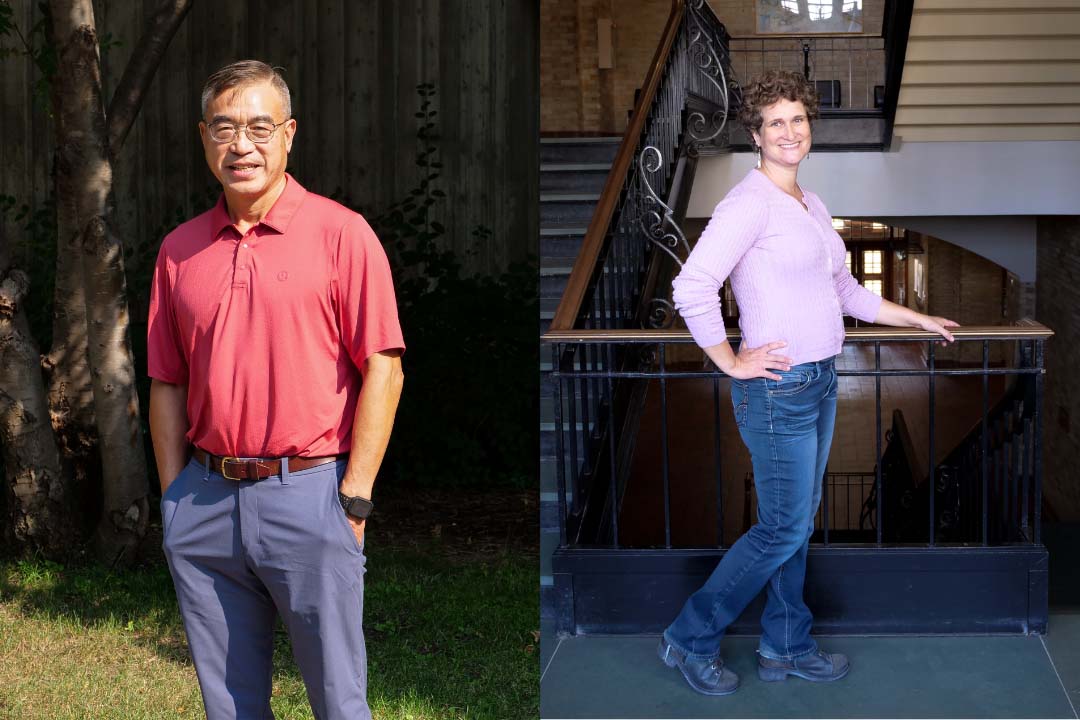
Royal Society of Canada recognizes two USask researchers
From building scaffolds that repair damaged tissue to improving indoor air quality with innovative new techniques, University of Saskatchewan's (USask) Dr. Daniel Chen (PhD) and Dr. Tara Kahan (PhD) are leaders in their respective fields of engineering and chemistry.
By Erin Matthews, Research Profile and ImpactThe Royal Society of Canada (RSC) has recognized their contributions with one of Canada’s highest academic honours — an RSC Fellowship for Chen and an RSC College Membership for Kahan.
“USask is proud to be home to leading academics, scholars, and researchers whose work strengthens communities here in Saskatchewan and around the world. This recognition from the Royal Society of Canada highlights Dr. Chen and Dr. Kahan’s important contributions to their fields and to society,” said USask President Vince Bruni‑Bossio. “Their work is improving lives in communities across Canada and beyond.”
Being named a Fellow is RSC’s prestigious opportunity that recognizes outstanding contributions in the arts, humanities, and sciences. A membership in the RSC College of New Scholars, Artists and Scientists is presented to exceptional mid-career researchers who are emerging as intellectual leaders in their disciplines.
"USask has established itself as a world-renowned leader in many disciplines, and it's thanks to researchers like Dr. Chen and Dr. Kahan that we continue to grow that reputation. These two researchers are making real-world impacts through their discoveries, and we are extremely proud of them both for this outstanding achievement," said USask Vice-President Research Baljit Singh.
Dr. Daniel Chen (PhD)
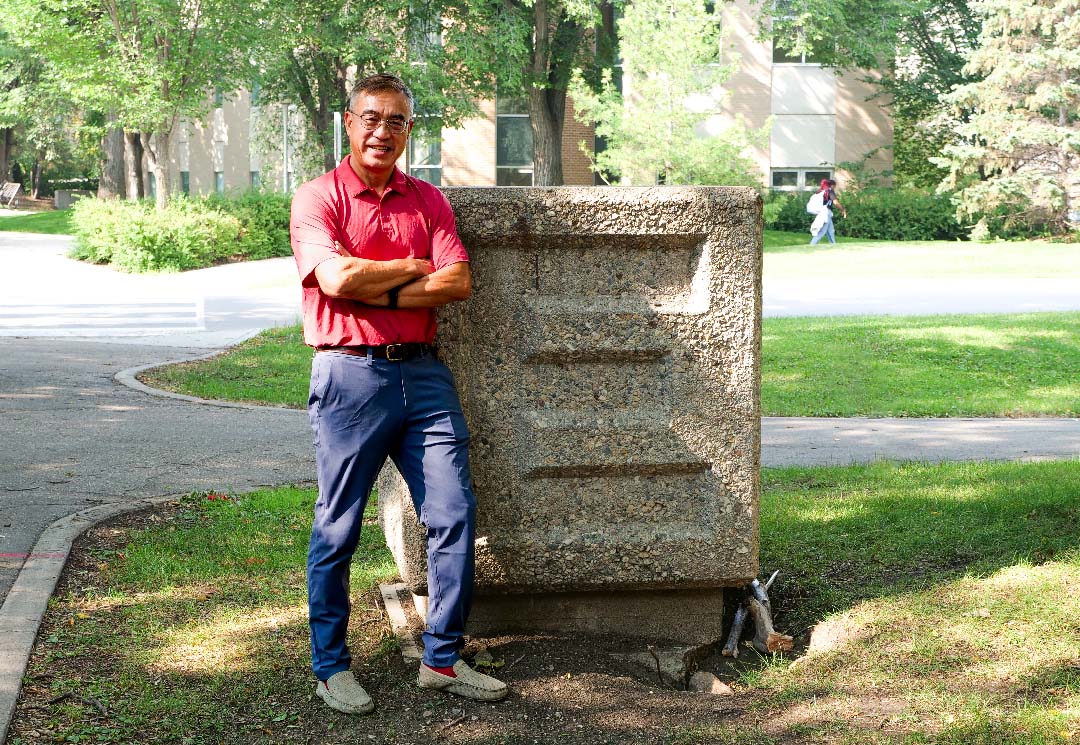
Dr. Daniel Chen (PhD), professor in the Department of Mechanical Engineering in the College of Engineering, has helped build the field of three-dimensional (3D) bioprinting from the ground up.
Early in his career, while completing his PhD at USask, Chen explored innovative approaches to fluid manipulation, which evolved into the concept of 3D bioprinting. Nearly 30 years later, Chen has become one of Canada’s leading researchers and engineers in the field. He has pioneered technology that has advanced biomedical science and engineering, helping to position Canada as a global leader in bioprinting.
“I am lucky because this kind of research is just emerging, so I am very much in the frontier of this field, which is incredibly exciting,” said Chen.
Chen’s research has focused on developing bioprinting techniques to build layered structures or scaffolds from living cells to grow new tissues. His contributions to engineered tissues and organ scaffolds have helped advance the field of regenerative medicine and disease modelling.
One of Chen’s early projects focused on developing scaffolds to bridge damaged peripheral nerves and restore lost function — a collaboration with colleagues at USask’s College of Medicine.
“From an engineering point of view, it’s like building a bridge, but instead you’re using biological materials and living cells. One of the first applications we did, in collaboration with researchers in the College of Medicine, worked to build a bridge between damaged nerves so that function could be recovered,” said Chen.
This project led to other cross disciplinary applications including spinal cord repair, cartilage regeneration, and other regenerative medicine strategies.
Chen has recently expanded the field with new innovations, like using bioprinting to create sophisticated tissue and organs models, such as lung models used to test new therapeutic medications.
“The field has changed a lot during the past decade, and we are now able to print increasingly complex tissue scaffolds. If these are successful, then it means that in the future people who suffer tissue or organ injury could receive engineered scaffolds that help the body regenerate which will ultimately restore normal function,” said Chen.
Chen is a global leader in the field of bioprinting and tissue engineering, but he credits his collaborators, colleagues, and students with his successful career.
“I’m deeply grateful because none of these achievements are mine alone. They reflect the dedication and contributions of my graduate students, postdoctoral fellows and colleagues that I’ve had the privilege to work with over three decades. Together, we have been able to develop new approaches that ultimately aim to improve people’s lives,” said Chen.
Dr. Tara Kahan (PhD)
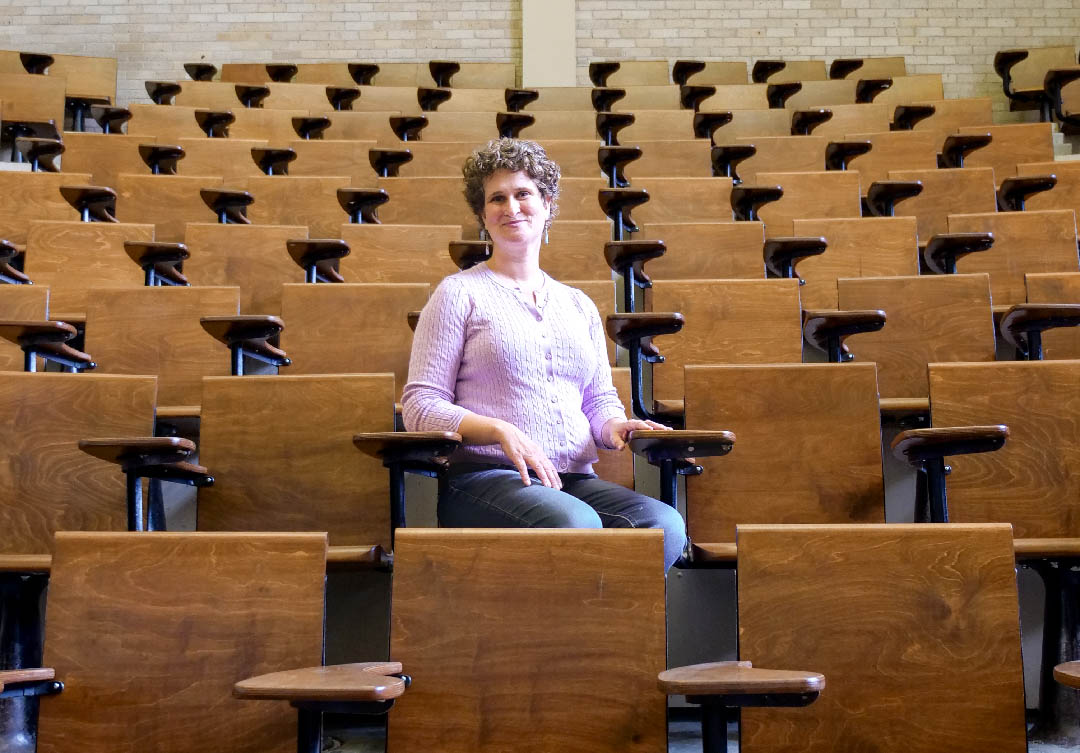
Dr. Tara Kahan (PhD) has broken a lot of barriers in her career as a chemist and academic, surprising even herself.
“I was adamantly opposed to doing a PhD but then I realized I love research, and I like being the one who decides what questions to ask,” said Kahan, professor in the Department of Chemistry in the College of Arts and Science and Canada Research Chair in Environmental Analytical Chemistry.
Early in her career, Kahan originally had her sights on quantum chemistry where she could research what molecules are “feeling,” but she also wanted to explore other aspects of the field. She realized she could combine all her interests with environmental chemistry, the study of chemical reactions, and processes that occur in the environment.
“I do still really like thinking about how molecules feel, and that allows me to think about chemistry in confusing and "messy" environments. I like to make sense of these changing variables,” said Kahan.
Kahan’s research focuses on reactions of pollutants emitted from different types of combustion, like vehicles or forest fires, on various environmental surfaces. These pollutants can form more toxic molecules after reacting, adversely affecting air and water quality. Kahan noted that these reactions occur at very different speeds depending on whether the pollutants were in liquid water or in ice.
Kahan developed new techniques to study chemistry at ice surfaces. These techniques have provided important insights about pollutant fate in cold regions and have the potential to protect polar regions and shape policy on pollutants around the world.
Kahan has also pushed the understanding of photochemistry, or chemistry involving light, in indoor environments. According to Kahan, different sources of light such as sunlight or fluorescents can create different chemical reactions which can have a big impact on the quality of the air we breathe.
Kahan’s work in indoor chemistry has proven to have significant, real-world impacts. Recently she has partnered with First Nations communities that have questions about their indoor air quality.
“It’s really rewarding to help answer questions that people have and be able to see the impact of your work immediately,” said Kahan.
Beyond her accomplishments as a chemist, Kahan works to make sure diverse voices find their way into science, particularly women who may feel they need to choose between academia or motherhood. She recently published a book chapter about her experience being a mom, scientist and professor.
“I think it was a really important thing to write and have out there because you often hear women say they don’t want to go into academia because there is no work-life balance but you can really thrive and if you don’t hear those stories, you don’t know how good academia can actually be,” said Kahan.