

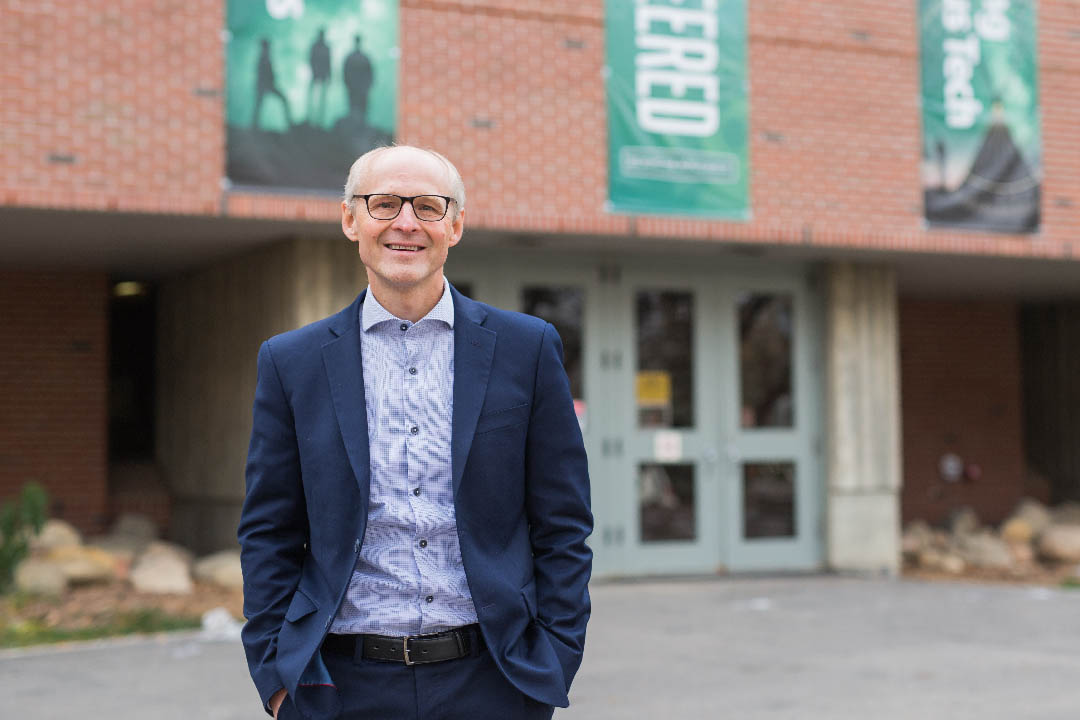
USask engineering professor earns Distinguished Researcher Award
Dr. Carey Simonson’s research focuses on innovative energy efficient heating and ventilating systems
By Matt Olson, Research Profile and ImpactDr. Carey Simonson (PhD) has taught thousands of undergraduate students and mentored nearly 100 graduate students and researchers in his time at the University of Saskatchewan (USask), and if you ask him, they've all helped him get to where he is now.
“The reason I've received recognition as a researcher and as a mentor is because I've had great students," said Simonson, a professor in USask's College of Engineering.
Simonson is the most recent recipient of the USask Distinguished Researcher Award, presented to faculty members in recognition of significant contributions to knowledge or artistic creativity.
Simonson is a leading researcher in the realm of heating, ventilation, and air conditioning (HVAC) engineering, specializing in heat and mass transfer. His work in energy recovery in heat exchangers, particularly in the development of more sustainable and energy-efficient heating systems called liquid-to-air membrane energy exchangers (LAMEEs), has earned him recognition worldwide.
LAMEEs are more efficient than typical heat exchangers because they can transfer both heat and moisture through a thin, specialized membrane using a moisture-attracting substance called a desiccant.
Because of how much energy is contained in water vapour as well as in the air, LAMEEs allow for a much more efficient way to transfer energy in a HVAC system, resulting in much more energy-efficient heating and cooling systems.
"As we get more and more energy efficient, it's not enough to just transfer heat in these systems. You need to transfer moisture," Simonson said. "That was the impetus for LAMEEs."
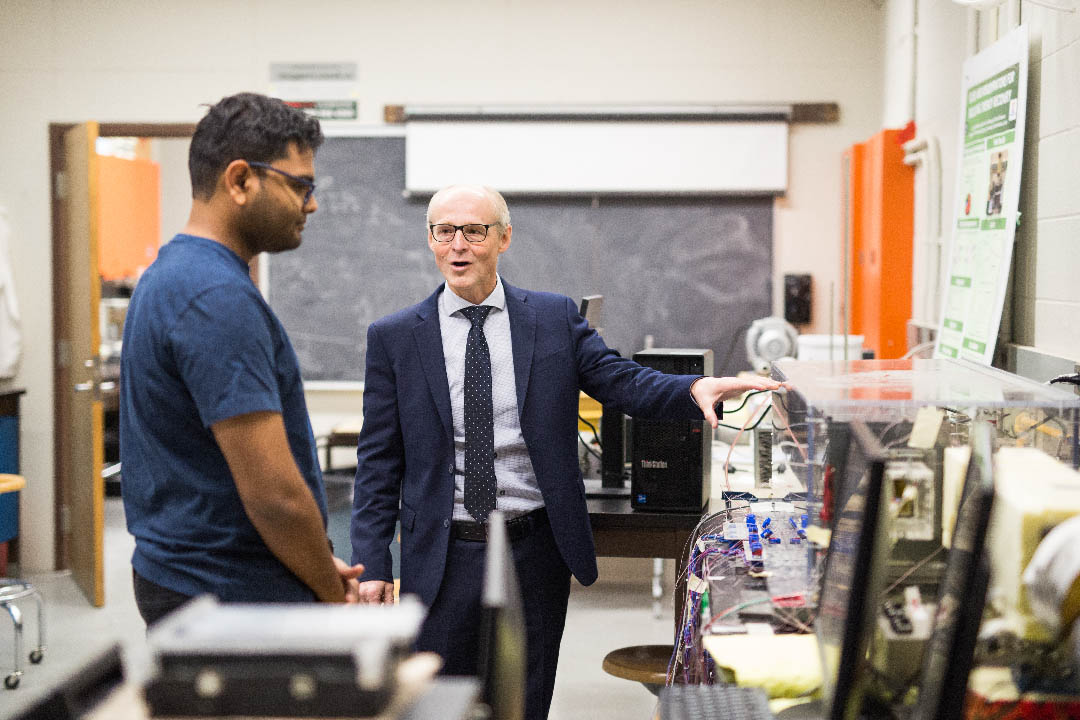
But for Simonson, a Prairie farm boy who has spent a quarter century as a professor at USask, the award isn't for him. It's for all those students, and his family, and his mentors, who have laid the path for what he's doing today.
"The university, in the early 1900s, was already looking at the value of heating and insulation for Prairie homes," Simonson said. "A lot of modern ideas for heating homes came from right here."
Simonson grew up on a Saskatchewan farm and went to school in the small community of Lucky Lake. As a youth, he learned the value of hard work and Prairie resilience. He didn't aspire to be an engineer when he was younger, and certainly not a professor at a university.
But Simonson earned his degree with the highest average of any student in his graduating class and ended up pursuing his graduate and post-graduate degrees at USask.
He met his wife during his time working and completing his graduate degrees. Today, his family includes 11 children and 11 grandchildren and stretches from Saskatchewan to Finland.
Simonson continues to gather accolades for his research and teaching. He is among the top two per cent of most-cited scientists globally in his field, according to a ranking from Stanford University. In 2026 he received the E.K. Campbell Award from the American Society of Heating, Refrigerating and Air-Conditioning Engineers (ASHRAE). The E.K. Campbell Award is the highest honour presented by ASHRAE in recognition of exceptional service in heating, ventilation, air conditioning, and refrigeration education, and Simonson is only the third Canadian ever to receive the award since the award’s inception in the 1950s.
As a mentor, Simonson has watched many students go on to do great things around the world. Simonson helped one of his PhD students become a postdoctoral researcher at the University of California, Berkely, where his work on atmospheric water harvesters helped contribute to Dr. Omar M. Yaghi’s (PhD) 2025 Nobel Prize in Chemistry.
And the LAMEE technology developed at USask has become an integral part of the cooling system in some of the newest data centres around the world. In 2018, Meta —the company that owns Facebook and Instagram —highlighted using StatePoint Liquid Cooling in their data centres as a new and impactful technology. Simonson said that technology is based on LAMEEs.
"It is pretty incredible that something we worked on has evolved so far," he said.
This year, Simonson is teaching an engineering course on heat transfer at USask something he has only done once in 20 years.
When he was lecturing his students, he said that teaching heat transfer was like riding a bike. Then, he corrected himself. Rather than riding a bike, Simonson instead said it was like riding a unicycle.
To emphasize his point for his students, Simonson rode his unicycle, a skill he'd picked up in his youth, to the midterm exam for the heat transfer class to ease some pre-exam tension.
As he puts it, his family and his students have taught him a degree of empathy he didn't have as a young, career-driven researcher. And while the Distinguished Researcher Award recognizes significant individual research achievements, Simonson said the award is for his family and his students more than it is for him.
"I'm teaching them, but I'm learning from them, too," he said.