

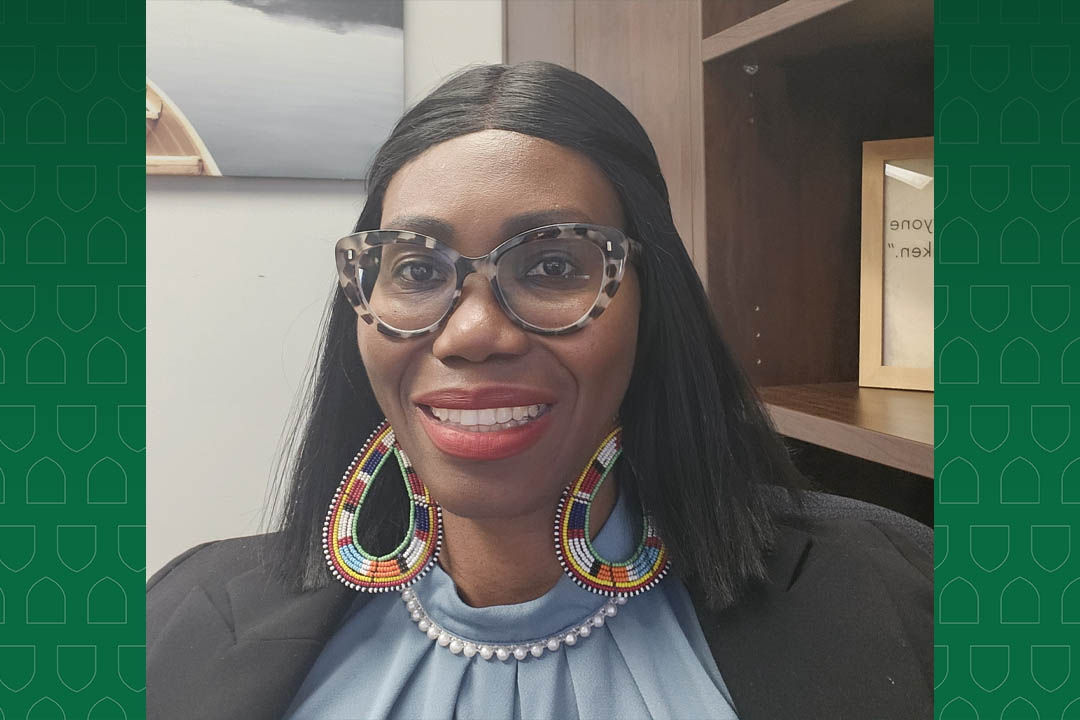
From Kenya to Saskatoon: Education as the key to success
Dr. Isabelle Dena’s doctoral thesis focused on immigrant women and their experiences in receiving prenatal, childbirth, and postpartum care
By AMANDA WORONIUK“Education is the key to success.”
These words have guided Dr. Isabelle Dena (PhD’26) throughout her life. This week, Dena will cross the stage at the University of Saskatchewan (USask) Fall Convocation to receive her Doctor of Philosophy (PhD) degree in community and population health sciences.
Her doctoral thesis, See Us, Understand Us. Exploring Newcomer Mothers’ Experience of Maternity Care in Saskatoon: A Case Study, focused on immigrant women and their experiences in receiving prenatal, childbirth, and postpartum care. Her research also highlights ways to better support families who are new to Canada.
For Dena, her path to earning a PhD represents more than an academic achievement. It reflects years of perseverance and a commitment to impact change on a broader scale. In addition to balancing her studies, Dena worked full-time as a manager of student wellbeing and counselling services at Saskatchewan Polytechnic while also raising her children. For her, earning a PhD was about creating new opportunities for herself and her family.
“When I started my PhD, my children were younger, so I sometimes felt guilty about being in school because it took away from my time with them,” she said. “But once they got older, I explained to them why it was important and they understood. I always tell them that education is the key to success.”
Born and raised in a small community in Kenya, Dena grew up in a family of modest means. At a time when schooling was prioritized for boys, Dena’s mother, a teacher, advocated for her daughter’s education.
“Because of that cultural background, boys were supported to attend school more than girls. My parents, especially my mom, really pushed hard that I also needed to have an education,” said Dena.
While many women in her community were expected to start families after high school, Dena’s parents encouraged her to pursue higher education. Dena earned a bachelor’s degree in community development before moving to North America in the early 2000s, where she completed a Master of Social Work degree from Southern Illinois University-Edwardsville. She later worked in both the United States and Canada, supporting underserved communities as a social worker.
Over time, Dena felt drawn to make an impact beyond the individuals she worked with directly. Inspired by a mentor who had a PhD, Dena began to consider doctoral studies as a way to create meaningful change.
“I didn’t just want a PhD just to have a PhD. I wanted to get involved in community-based research that will actually make a difference,” she said.
The inspiration for her doctoral research came from personal experience.
After the birth of her third child, Dena experienced challenges navigating her postpartum care. This prompted her to investigate whether other immigrant and newcomer women faced similar barriers within the health-care system.
“I did not have a good maternal experience. I didn’t feel listened to by my doctor and the other health-care providers. It was that experience that led me to think, ‘Do other women who look like me, or other immigrant women who are newcomers to Canada, have the same experiences?’ At that time, my children were still young, but I had it at the back of my mind.”
Knowing she wanted to pursue a PhD, Dena researched Canadian universities and intentionally sought a program that aligned with her research interests.
“I came across the University of Saskatchewan and decided to apply. I connected with my (now) supervisor to see if it was a good fit,” she said. “I really wanted to be intentional about which university I attend, who my supervisor was, and what kind of experience and knowledge I will get from that institution. USask was a good fit.”
Dena applied to the PhD program and was accepted. In 2018, she moved her family to Saskatoon to begin her studies in the College of Medicine’s Department of Community Health and Epidemiology.
As a mature student with a social science background, Dena initially wondered where she fit within the department. Gradually, she came to appreciate the unique perspective she brought to the program.
“After a while, through with my professor and attending classes, I saw the value of having a social worker within the College of Medicine and bringing in a mental health focus. My supervisor was really kind to let me explore what I was interested in.”
Working closely with her supervisor, Dr. Nazeem Muhajarine (PhD), Dena narrowed her research focus to immigrant mothers and their maternal health. She built relationships with organizations that serve newcomers, such as the Open Door Society, to better understand the experiences of immigrant women and their families. Through these conversations, she decided to take a community-based approach to her research.
“I was introduced to patient-oriented research, which I wasn’t familiar with, but it aligned with my values of community-based research. I was really excited to attend training regarding patient-oriented research and to really understand the role of patient partners.”
Dena formed a community research advisory group that included newcomer mothers, midwives, settlement counsellors, and another social worker. This group helped guide Dena’s research throughout the research cycle.
“I wanted the research to be owned by the community to make a difference within the community,” she said.
While the pandemic initially delayed data collection, Dena persevered. Over two years, she was able to interview pregnant, newcomer women before and after childbirth. She also interviewed doctors, nurses, and midwives, along with health-care leaders, to get different perspectives on how the system supported the needs of these newcomers.
“It was really exciting to hear from mothers of their experiences of maternity care here in Saskatoon,” she said.
Through her research, Dena learned that many immigrant mothers face challenges in accessing maternal health services. These challenges can include language barriers, cultural differences, issues navigating the health-care system, racism, and social isolation.
The research generated practical recommendations for health-care providers that could be implemented in the province and beyond. The recommendations came directly from the newcomer mothers, said Dena.
“My research has provided practical strategies that our health system can implement. I've had the privilege of sharing the research findings with Saskatchewan Health Authority,” she said. “I shared it here with our research unit and in conferences. It actually resonates with a lot of people and they're able to take away practical things to start implementing in their clinical practice.”
Despite her progress, Dena faced a personal challenge where she nearly gave up her PhD studies altogether. During this time, she leaned heavily on her personal support network, her peers, and mentors inside and outside of the university. She also had positive support from her supervisor.
“I'm really grateful for a wonderful supervisor who not only sees me as a student, but as a mother, as a full-time employee, as a community member—and he really encouraged me not to give up,” said Dena. “He told me, ‘Take your time. I understand that you're going through personal issues. Your committee members will understand,’ and really believed in me more than I believed in myself.”
In addition to her academic work, Dena helped foster a sense of belonging within the department. She helped establish Black History Month celebrations that provide opportunities to acknowledge the contributions of Black people, amplify Black voices, and create space for discussion. What began as a student-led initiative has become a department tradition.
Dena also credits scholarships through the College of Medicine’s graduate program and the Saskatchewan Centre for Patient-Oriented Research for making her PhD journey possible.
“The scholarships really took away a lot of financial stress,” she said “I could focus on my PhD without taking away finances from my kids' needs. I'm so grateful for that.”
As for what’s next, Dena plans to continue her role at Saskatchewan Polytechnic but remains open to opportunities teaching or consulting.
“I will say now that I defended my thesis and am graduating, it’s been more than a PhD. It's taught me endurance and given me a voice. It has helped me find stability and it’s really solidified who I am.”