

USask researchers receive new Canada Research Chairs in environmental sciences, protein sciences
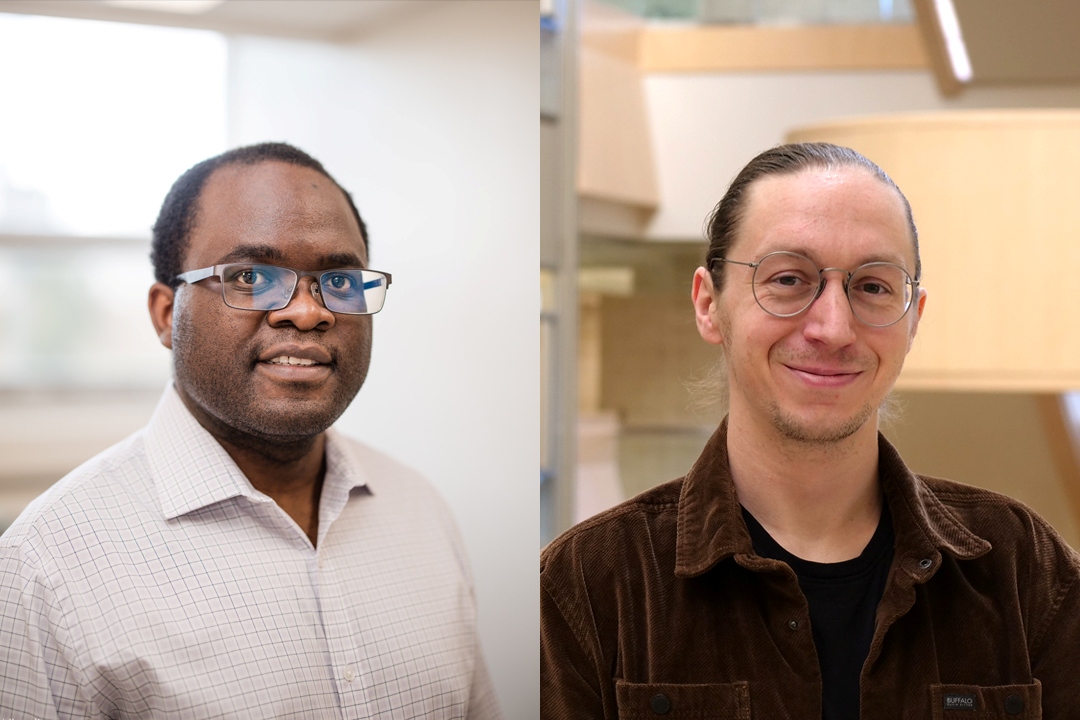
Dr. Michael Wozny (PhD) and Dr. Edmond Sanganyado (PhD) were both named Tier 2 Canada Research Chairs (CRCs), while Dr. Kristina Bidwell (PhD)’s Tier 2 CRC was renewed
By Matt Olson, Research Profile and ImpactTwo University of Saskatchewan (USask) researchers have received new Canada Research Chair (CRC) positions to support their cutting-edge research, while another USask researcher’s position was renewed.
The CRC program invests money to attract and retain leading researchers at Canadian institutions. Researchers who hold CRCs aim to achieve excellence in research across various fields.
Dr. Edmond Sanganyado (PhD) named Tier 2 CRC in environmental sciences
Dr. Edmond Sanganyado (PhD) has moved through numerous areas of science and research in his career — and all of them have contributed to his new Tier 2 CRC in Exposure Science and Environmental Risk.
From applied chemistry, and toxicology, to marine biology and forensic science, Sanganyado utilizes various disciplines in looking for new and sustainable ways to identify and prioritize chemical contaminants in the environment.
"Across all those different disciplines, it comes down to the same question: what are we doing to the environment, what are the problems associated with it, and what can we do about it?” said Sanganyado, an associate professor in USask's School of Environment and Sustainability and a member of the USask Toxicology Centre.
Sanganyado’s research involves developing new polymer-based systems that imitate how animals are exposed to chemical contaminants in the environment. As he explains, one of the common ways to find out whether chemical contaminants in the environment, especially in water, pose a health risk to animals is to test the animals that live there. His goal is to pioneer better next-generation tools that reveal how animals take up complex chemical mixtures, and how their surroundings shape the process, without having to use the animals themselves.
Sanganyado said identifying and dealing with chemicals in an environment is often a reactive approach — going in after an issue has been identified, finding the chemicals, and then devising methods to remove them.
With the support of this new CRC, Sanganyado hopes to create a more holistic and comprehensive approach to dealing with environmental risks — identifying problems proactively and creating tools to address them.
“When it comes to risk assessment, we often look at one chemical at a time,” he said. “In the real world, organisms are exposed to a complex cocktail of contaminants throughout their lives. We need to better understand the risks these cocktails pose, because contaminants interact and cause harm in different ways, and some are more harmful together than alone.”
Dr. Michael Wozny (PhD) named Tier 2 CRC in protein science
How do you examine something too small for a regular microscope to perceive? You can use a microscope that sees with something smaller than a wave of light.
That's the core of how Dr. Michael Wozny (PhD) conducts his research: using electron microscopy to examine and understand the structure of proteins inside of cells.
"This is fundamental research, and I think really critical research. With that fundamental understanding of how these systems work, we can predict how to design drugs and understand how cells respond to pathogens," said Wozny, an assistant professor in the Department of Biology, Microbiology and Immunology in the USask College of Medicine. Wozny received a Tier 2 CRC in Protein Science for Pathogen Defence.
Wozny is a cell biologist. His interest in the area started with plant biology — specifically, how molecules could communicate and interchange through cell membranes. Since then, his work has evolved into human structural biology — how proteins are shaped in cells, and how they interact with each other and with proteins introduced by pathogens such as viruses.
Using electron microscopes — microscopes that use subatomic electrons instead of light to examine an object — in combination with other imaging techniques, Wozny and researchers like him can create a much better picture of how proteins are formed.
“It's kind of like a lock and key — if you knew the shape of a lock, you could design a key to unlock that lock,” he said. “Our bodies are full of proteins that all have important functions, and there are also pathogen proteins from viruses and bacteria that want to attack our bodies. If we knew the structure of our proteins and their proteins, we could block theirs from attacking us.”
Wozny credited his new CRC to the support of the College of Medicine and the Vaccine and Infectious Disease Organization (VIDO) at USask. In addition to the CRC, Wozny was also the recipient of a Canada Foundation for Innovation (CFI) John R. Evans Leaders Fund (JELF) investment to obtain a cryo-electron microscope for use at USask. Wozny described it as world-leading infrastructure for mapping protein structures.
Wozny said the new CRC and the JELF-funded cryo-electron microscope will help train researchers and students on technology and techniques for exploring cellular proteins and developing defenses against viruses and bacteria.
“It's a huge amount of trust and excitement around this technology. Cryo-electron microscopy of purified proteins has been revolutionary for protein structure determination, and people believe that cryo-EM within the cell will be the future for structural biology and protein structure determination,” Wozny said.
Dr. Kristina Bidwell (PhD), a professor in the Department of English in USask’s College of Arts and Science, has received a renewal for her Tier 2 Research Chair in Applied Indigenous Storytelling.
Bidwell's research explores modes of storytelling, specifically how stories interact between communities. Her program examines how stories connect between Indigenous communities, as well as between Indigenous and settler communities. Bidwell is the principal investigator of the “We're Indigenous & Still Here” (WISH) project aiming to reclaim and amplify urban Indigenous histories in Saskatoon and St. John’s, Newfoundland and Labrador, and has co-authored a forthcoming book on Indigenous-led collaborations in the literary arts.