

USask scientists aiming to put Canadian tech in upcoming European space mission
University of Saskatchewan atmospheric sensors have a long and successful history in satellite applications
By Matt Olson, Research Profile and ImpactSaskatchewan and Sweden have a lot in common: They're cold, they have a lot of trees, and both are working on next-generation satellite technology for future space missions.
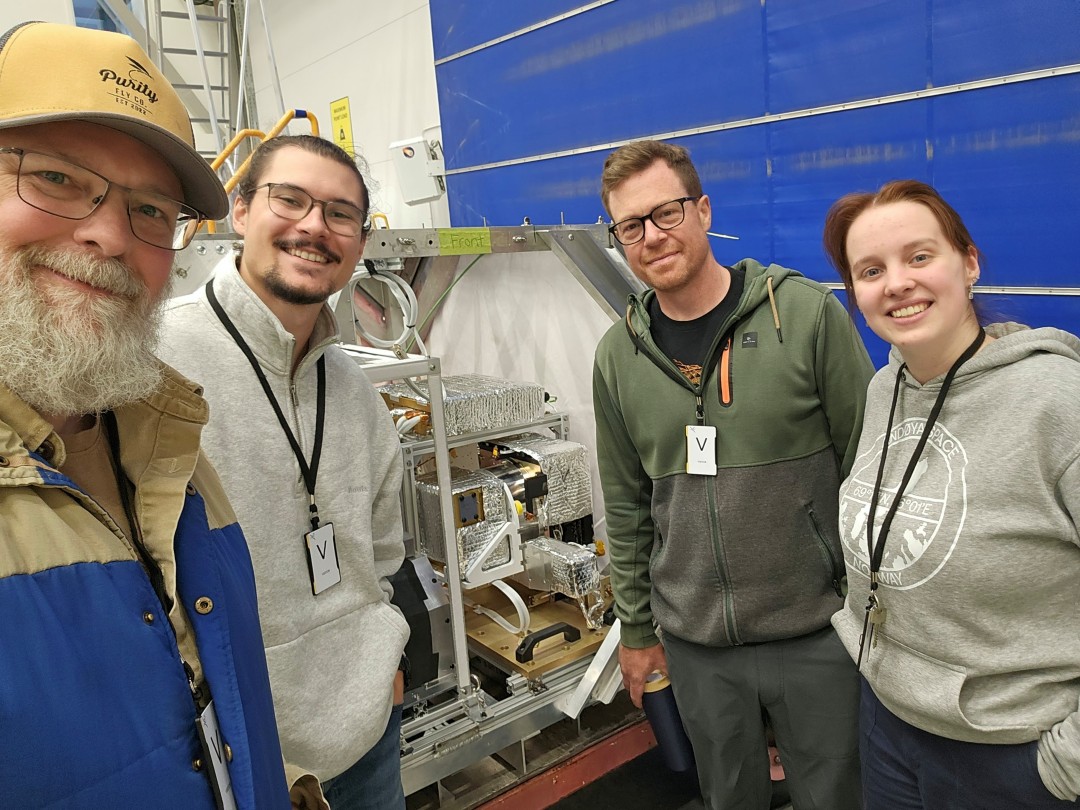
Researchers from the University of Saskatchewan (USask) were recently in Sweden to test a new atmospheric sensor designed and built by members of the Institute of Space and Atmospheric Studies (ISAS) in the College of Arts and Science.
The new spectrometer would give highly specialized measurements of gases in the atmosphere and stratosphere, leading to better understandings of climate and weather changes.
“In our lab, we develop prototypes of what might become new satellite instruments, and then we test them on airplanes or on big balloons,” said Dr. Adam Bourassa (PhD), a professor in USask’s Department of Physics and Engineering Physics and part of the ISAS. “We've taken them to the Arctic, we've taken them to the top of volcanoes in Hawaii — we use many different methods for testing, because putting something into space can be so expensive.”
The satellite instruments from USask are part of a test flight for the Keystone mission, which is a candidate to be part of the European Space Agency’s (ESA) 12th Earth Explorer satellite mission. The Keystone mission is one of three candidates currently in consideration for the next Earth Explorer.
The Earth Explorer research missions are intended to use innovative satellite technology to address the environmental and climate challenges society faces by exploring and unveiling scientific findings about the Earth.
The USask instrument that is part of the Keystone test flight is a more advanced version of the Optical Spectrograph and InfraRed Imaging System (OSIRIS) system that was designed at USask and launched into space more than 20 years ago.
Dr. Doug Degestein (PhD), a professor in USask’s Department of Physics and Engineering Physics and part of the ISAS, was one of the principal investigators for the original OSIRIS project. That sensor, built for analyzing atmospheric gases, was launched on the Swedish Odin satellite in 2001. Intended to last for just two years, the instrument is still operational today — and makes up the backbone of the newly-designed technology for Keystone.
“We measured ozone and stratospheric gases, but we also demonstrated the capacity to do other measurements,” Degenstein said. “The prototype we are developing now has a better capacity to do those measurements, and that is what the ESA mission is looking for — a tweaked-up version to make more, modified measurements.”
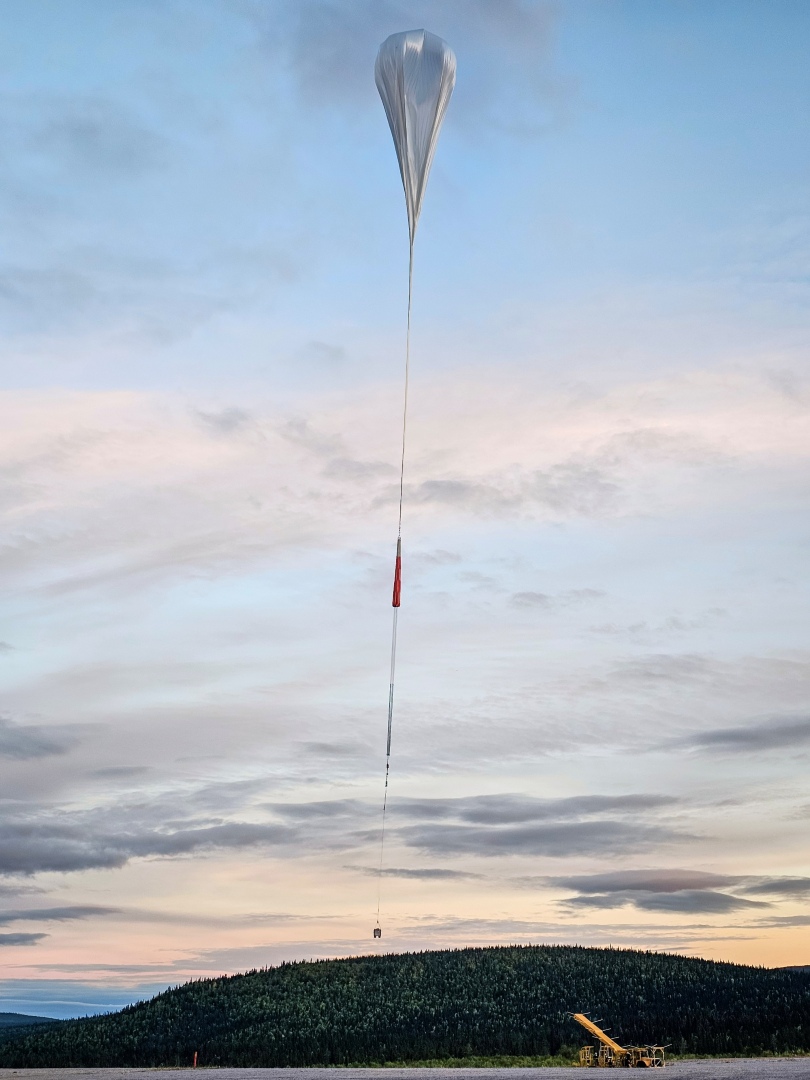
On their most recent trip to Northern Europe, Bourassa said they worked with collaborators from Germany and from Sweden. The scientists attached their instruments to a metal frame and launched them into the stratosphere using a massive high-altitude balloon — nearly 100 metres across.
That balloon floats above the ozone layer for nearly 24 hours, allowing the researchers to test their instruments in those upper-altitude conditions, before it floats back down to be retrieved via helicopter.
The new sensor prototype was designed and built at USask, with the support of companies in the aerospace industry. Degenstein said USask has to ship certain parts back and forth with industry partners to complete the construction process, but the ISAS hopes to be able to handle more of the construction process in-house in the future.
“We are definitely working long-term to build our capacity to fabricate all the parts,” Degenstein said. “Space is becoming more accessible.”
The successful Earth Explorer candidate won’t be selected until 2028, and the mission won’t be launched until the 2030s. But Bourassa and Degenstein said the students, faculty, and technicians in the ISAS were integral to pursuing such large-scale projects — and that the chance to contribute USask tech to the next ESA mission was exciting for the whole team.
“The research staff and graduate students make significant contributions,” Bourassa said. “We’re competing with two different ideas, and they’re all exciting, but we hope they pick ours.”