

Compassionate coaching can help women athletes thrive, USask graduate student’s research shows
Keira Dyck, who earned her Master of Science degree in kinesiology during Fall Convocation on Nov. 10, is now an award-winning doctoral student at USask
By SHANNON BOKLASCHUKAs a coach and a scholar, University of Saskatchewan (USask) graduate student Keira Dyck has learned firsthand how compassionate coaching can make a positive difference in athletes’ lives.
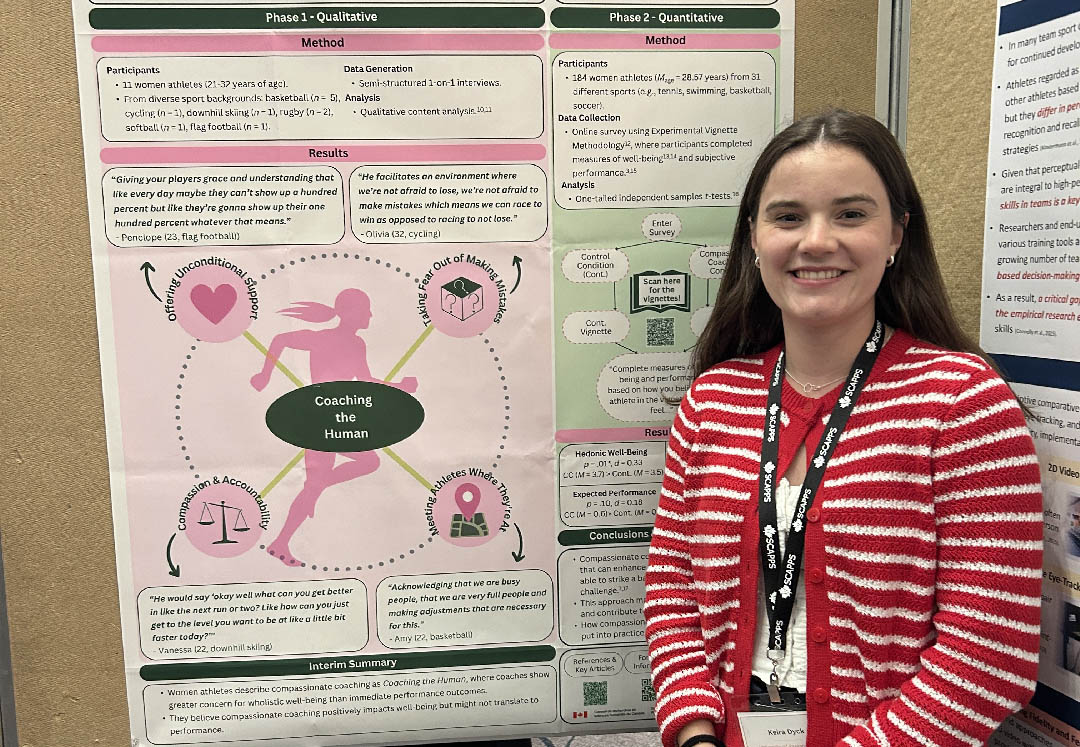
While conducting research as a master’s degree student in the College of Kinesiology, Dyck explored the integration of compassion into women’s sport, with a focus on how coaches can create compassionate environments for women athletes to thrive. Her research demonstrated that compassionate coaching is beneficial; for example, it helps nurture athletes’ overall wellbeing and enables them to better deal with challenges and setbacks.
“What we continue to hear from athletes is this is the best version of coaching for them,” said Dyck. “It includes holding them accountable and making sure that they’re taking responsibility for their mistakes and actions, but it also makes them feel like they can take risks in their performance pursuits—whether that’s in a game or in a practice or in their training sessions.”
On Nov. 10, 2026, during USask’s Fall Convocation, Dyck received her Master of Science degree in kinesiology. While conducting research for her master’s thesis—titled Coaching the human: A mixed methods study of compassionate coaching and women athletes’ thriving—Dyck interviewed 11 women athletes from across Canada about what compassionate coaching means to them and what compassionate coaching looks like, using examples from their day-to-day lives. While some previous literature has suggested that compassionate coaching is not suitable for sport, Dyck’s research results show the opposite is true, she said.
Social norms in sport are also slowly changing, said Dyck, and compassionate coaching is a key part of that shift.
“In the high-performance world, it’s shifting toward showing concern for athlete wellbeing and making sure that you’re creating these psychologically safe spaces for athletes to be vulnerable,” she said. “But there’s still kind of that resistance of ‘Does it fit in sport? Can it be effective?’ So, we’re fighting a bit of an uphill battle, I think.”
Dyck, who grew up in the town of Amherst, Nova Scotia, came to USask for her graduate studies after earning an undergraduate degree in psychology at Mount Allison University in New Brunswick. During her psychology degree, Dyck played women’s basketball for two years until an Anterior Cruciate Ligament (ACL) injury ended her university basketball career as a player. However, she continued to be involved with the team as a member of the coaching staff.
Those playing and coaching experiences, and an impactful sports psychology class that she took as an undergraduate student, led Dyck to explore kinesiology as the area of focus for her graduate studies. Although she had never lived in Western Canada before, she chose to attend USask after doing some research on various universities and connecting with Dr. Leah Ferguson (PhD), a professor and the associate dean, research in USask’s College of Kinesiology.
“From the minute I talked to Leah, I was like, ‘This is the person that I want do my research with,’” said Dyck. “She creates such a welcoming, warm environment to do research in, and that has proven to be true throughout my entire master’s.”
The focus of Ferguson’s research, teaching, and applied work is on sport psychology and Indigenous Peoples’ wellness, and she collaboratively works with athletes, youth, girls, and women to enhance sport experiences and wholistic wellness outcomes. Ferguson will continue to be Dyck’s supervisor throughout her PhD studies, which Dyck began at USask in September.
“Keira is an exceptional student and emerging scholar, but what has stood out to me most is how thoughtfully she approaches her work,” said Ferguson.
“Her master’s research on compassionate coaching in women’s sport combines strong scholarship with a focus on questions that really matter: what does compassion look like in coaching, and what might it mean for the experiences of people in sport? Keira brings both intellectual curiosity and a genuine commitment to making a difference through her research. It has been incredibly rewarding to supervise her, and I’m very excited to continue working with her as she carries these ideas forward into her PhD.”
As with her master’s degree, Dyck’s PhD research will also explore compassion in sport, but she plans to examine compassion in the broader sports system rather than specifically in the coach-athlete relationship. During her master’s degree, Dyck received funding through the Social Sciences and Humanities Research Council (SSHRC). For her PhD, Dyck was awarded a Dean’s Doctoral Scholarship through USask’s College of Graduate and Postdoctoral Studies.
Dyck is pleased to be able to continue her studies at the College of Kinesiology as a doctoral student, working alongside outstanding researchers such as Ferguson, Dr. Kent Kowalski (PhD), and other colleagues who are part of the KINpassion Lab.
“The overall grad student culture in the college is very positive and supportive and collaborative,” Dyck said.