

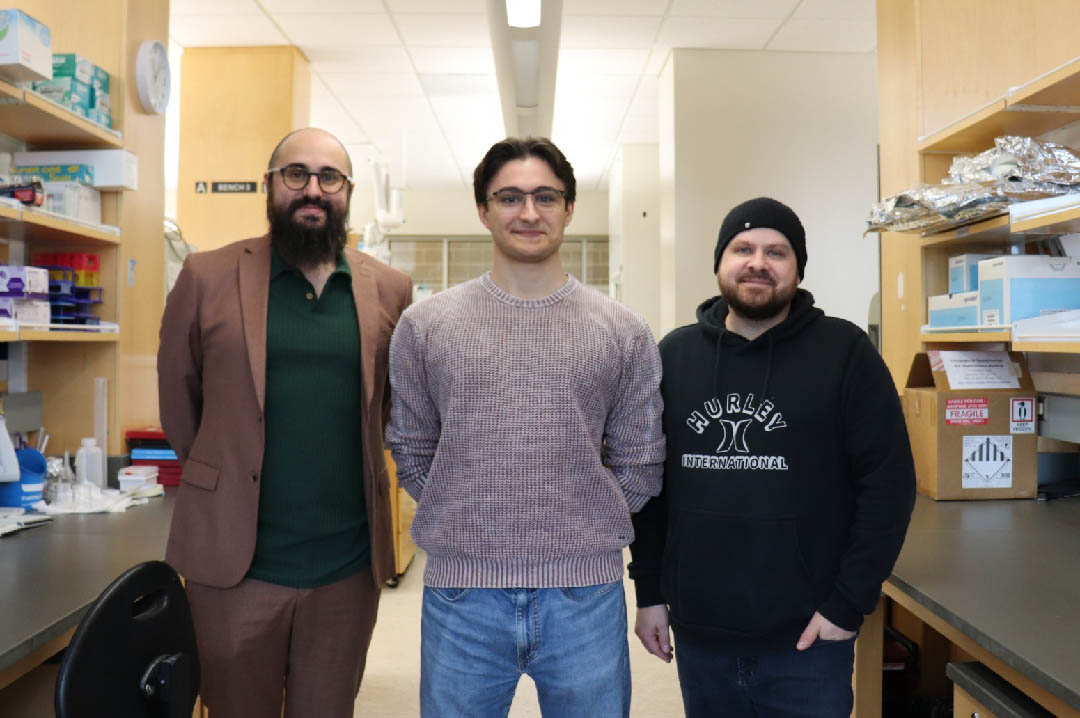
USask graduate student examines cannabis derivatives as a treatment option for epilepsy
Theodor Zaharia, who earned an undergraduate award at USask’s Fall Convocation, is now pursuing a master’s degree in the College of Pharmacy and Nutrition
By SHANNON BOKLASCHUKA University of Saskatchewan (USask) graduate student is exploring how activating a cannabinoid receptor in the brain may play a key role in reducing the seizures associated with temporal lobe epilepsy.
Theodor Zaharia, , and around one-third of those people are unlikely to respond to current anti-seizure medications. That means finding other treatments is important for many patients.
“Having seen firsthand the prevalence of this condition and how it has affected some of my peers’ quality of life, I am motivated to help make a difference,” Zaharia said.
On Nov. 10, during USask’s Fall Convocation, Zaharia received his Bachelor of Science (honours) degree in biomedical sciences, with high honours in cellular, physiological, and pharmacological sciences. He was also awarded the University Medal in the BSc Biomedical Science Degree at Convocation by USask’s College of Arts and Science. The biomedical science program is jointly offered by the College of Arts and Science and USask’s College of Medicine.
“I am very grateful to be receiving this award and hope that I am able to live up to it going forward,” he said. “I am thankful for my peers and for how far their support has carried me.”
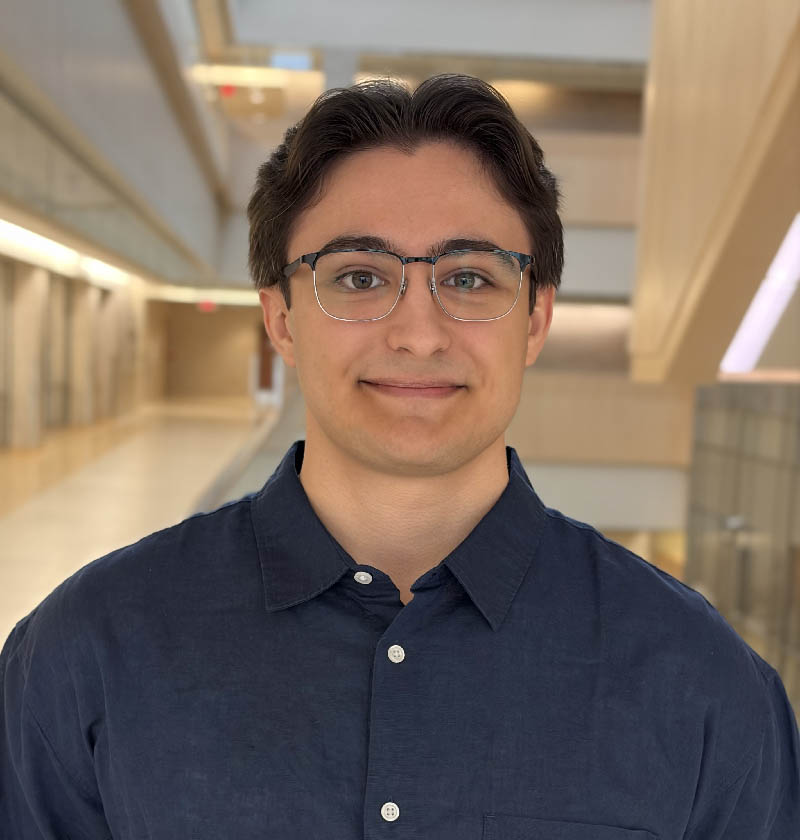
Zaharia, who was born and raised in Saskatoon, came to USask after graduating from Bishop James Mahoney High School. His hometown university has proven to be a great fit.
“Aside from having the privilege of living in the same city as the university, USask offers a wide variety of health science-related undergraduate degrees, along with strong professional and graduate-level programs beyond that,” he said. “The biomedical sciences degree appealed the most to me as a starting point knowing that I wanted to create a career in this field.”
Zaharia excelled throughout the biomedical sciences (BMSC) program, culminating in being honoured with the award during Fall Convocation. It was not the first time his outstanding work was recognized; through his undergraduate BMSC honours degree project, he achieved first-place poster prizes at the 2026 Protein Structure Function and Malfunction (PSFaM) Conference and the 2026 Western Canadian Medicinal Chemistry Workshop (WCMCW) Conference, both held in Saskatoon.
Zaharia said he chose to study cellular, physiological, and pharmacological sciences at USask because the major offered “a good breadth and depth of knowledge into human anatomy and physiology, and with it a good understanding of the body as a whole.”
“However, after being fortunate enough to do a summer project following my second year with Dr. Robert Laprairie on the pharmacodynamics of β-caryophyllene derivatives, I developed a strong interest in the field of pharmacology,” he added. “Thankfully, the courses set in my major made the best of both worlds and compelled my curiosity further.”
Today, Zaharia is pursuing a master’s degree in the College of Pharmacy and Nutrition and is co-supervised by Dr. Robert Laprairie (PhD) of the College of Pharmacy and Nutrition and Dr. Justin Botterill (PhD) of the College of Medicine.
Laprairie is the GlaxoSmithKline-Saskatchewan Chair in Drug Discovery and Development, an Epilepsy Canada board member, and a member of the Pharmaceutical and Nutritional Sciences Research Group (PNSRG). He is also the director of education for the Canadian Consortium for the Investigators of Cannabinoids (CCIC) and previously served as Zaharia’s supervisor for his undergraduate honours degree project.
Zaharia is pleased to be able to continue working with Laprairie as he pursues his Master of Science degree.
“Following an impactful undergraduate research experience, I am lucky to have the opportunity to apply the knowledge and overarching concepts from my honours project at a graduate level,” Zaharia said. “When I began pitching ideas with Robert during my fourth year on what a graduate project might look like, I was given a good degree of freedom regarding the avenues I might steer the foundational work towards. Having confidence in the impact of my project and the liberty of curiosity towards what ways it may be applied helped drive my passion for research as to continue at a graduate level. Above all, knowing that you’re going into it with fantastic supervisors makes a big difference.”
Zaharia’s master’s thesis will focus on the pharmacology of positive allosteric modulators (PAMs) of the type 1 cannabinoid receptor (CB1R) and their application in mouse models of temporal lobe epilepsy. CB1R is the receptor that is activated by THC (delta-9-tetrahydrocannabinol), a psychoactive compound found in cannabis that normally helps to regulate the activity of neurons, he said.
“CB1R is considered a promising target for the treatment of epilepsies, and currently one-third of epilepsy patients do not benefit from their existing medications. PAMs are compounds that tune up the activity of the receptor to a degree that should produce therapeutic benefit, though not so strong as to cause the 'high' or dependency effects we associate with cannabis use,” Zaharia said.
“Our goals are to determine how these PAMs alter behaviour, are metabolized, and reduce seizure activity. In doing so, we aim to also characterize cannabinoid-related neuronal pathways that may be changed in temporal lobe epilepsy.”
For his master’s degree work, Zaharia has also sought guidance from Dr. Justin Botterill, a systems neuroscientist in the College of Medicine. The Botterill laboratory studies cells and circuits that contribute to health and disease, with a focus on the neurobiological mechanisms of temporal lobe epilepsy. The Botterill and Laprairie laboratories have a longstanding collaboration on testing new drugs for their anti-seizure potential.
“Wanting to properly address both the pharmacology and neuroscience aspects of this project, we sought Dr. Botterill as a co-supervisor for his expertise on epilepsy and its CB1R-related interactions,” Zaharia said. “Having been fortunately taken on, I began working in Justin’s lab this summer to learn electrophysiological techniques and the principles behind them for their application in my research.”
The primary function of cannabinoids in the nervous system is to help restore system balance, or homeostasis, through supporting the signalling between neurons, Zaharia said. His research project proposes that this activity may have an important role in states of brain dysfunction, such as temporal lobe epilepsy.
Zaharia’s interest in this topic began as an undergraduate student at USask.
“While cannabinoids play different roles in various areas throughout the body, we see their highest level of activity in the nervous system. Driven by this connection, I took neuroanatomy and general neuroscience courses as electives in my fourth year to help expand my knowledge,” he said.
“I quickly developed a strong interest in the field and in the ways I was able to apply it to my research and studies. Doing a master’s program has allowed me to dive even deeper into this equally complex and interesting realm of thought, and for that I am grateful. While I started my degree geared towards cellular, physiological, and pharmacological sciences and eventually ended up shifting towards neuroscience, I find that having experienced both has really broadened my horizons.”
Zaharia said the biomedical sciences program prepared him well to engage in research at the graduate student level. Participating in research as an undergraduate student and taking on an honours project also helped to make his undergraduate experience well-rounded and special. He encourages others to consider the BMSC program as a result.
“I appreciated not only the diversity of subjects in the curriculum but also the variety of professors brought in to teach the material,” he said. “Learning from academics who had both a strong understanding of the fundamentals and their higher-level applications, paired with interesting hands-on experiences, provided a rich learning environment. Seeing professors get passionate about their work made it all the more inspiring as well. Whether I was measuring the stretch created in a rat ileum or differentiating immune cells on a histology sample, I felt I was immersed in the learning experience at all times.”
As an undergraduate student, Zaharia saw the biggest improvements in his academic performance when he actively collaborated “with those who were similarly driven for success.” Looking to the future, Zaharia plans to continue his learning journey at USask and become a physician.
“Following my master’s degree I aim to enter an MD program—ideally at USask—with my long-term career goal being to engage with both preclinical and clinical aspects of health care, working at benchtop and bedside,” he said.