

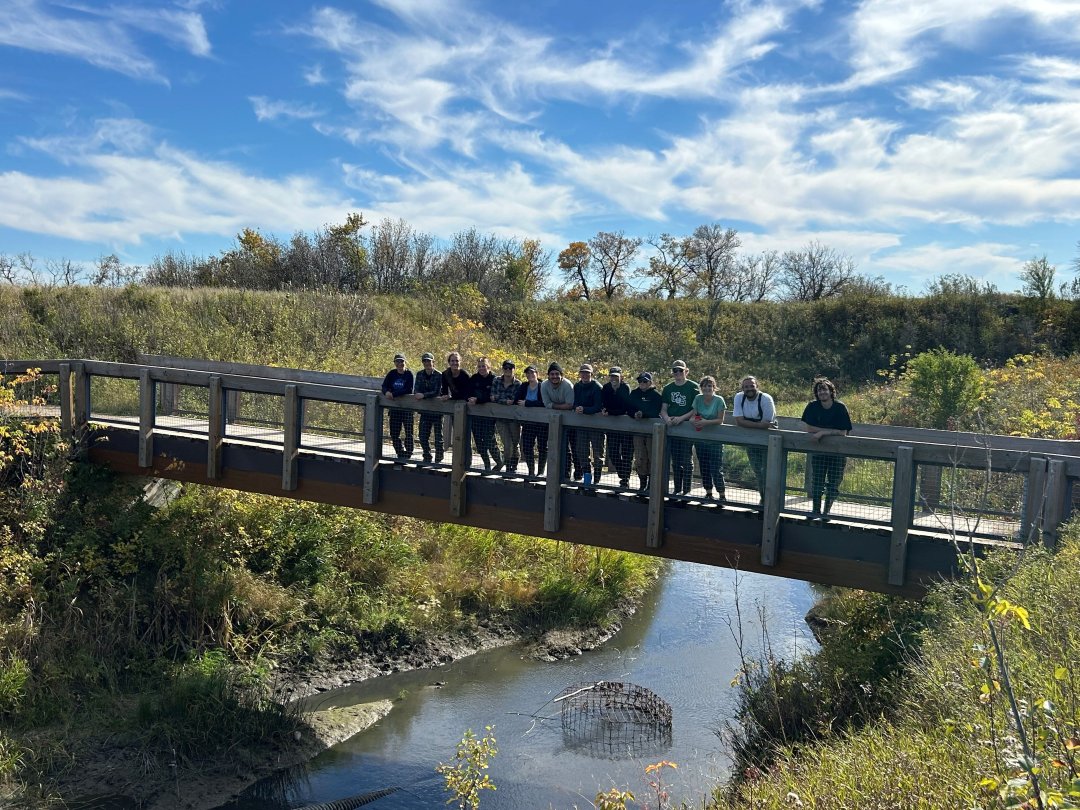
USask soil science class partners with Wanuskewin on restoration project
Students built a beaver dam analog in the opimihāw Creek to assist with controlled flooding, which can help remove invasive species
By Shannon Boklaschuk“Become the beaver.”
That was Jessica Gunn’s mantra when she put on waders and climbed chest-deep into the cool water of the opimihāw Creek at Wanuskewin Heritage Park in mid-September. Gunn was there with a group of University of Saskatchewan (USask) students who were engaging in a unique learning experience: constructing a beaver dam analog (BDA) in the creek.
“A big part of why I wanted to do this course is because it’s so hands-on,” said Gunn, a third-year renewable resource management student who enrolled in SLSC 450.3: Practical and Applied Restoration, a soil science course taught by Dr. Katherine Stewart (PhD), an associate professor in USask’s College of Agriculture and Bioresources.
For Gunn, the day at Wanuskewin was unlike any other school day she had experienced.
“We had a great time as a class,” she said. “I feel like we learned so much.”
The students were invited to Wanuskewin to help the park build a BDA — essentially a “starter” dam that beavers can take over and use to construct their own dam overtop. BDAs are important because they encourage beavers to engage in damming at specific locations. BDAs also assist with controlled flooding, which can help remove invasive species and support additional riparian and aquatic plantings that help provide an optimal habitat for creatures that depend on the creek for their survival, such as arthropods, fish, muskrats, minks, herons, and shrikes.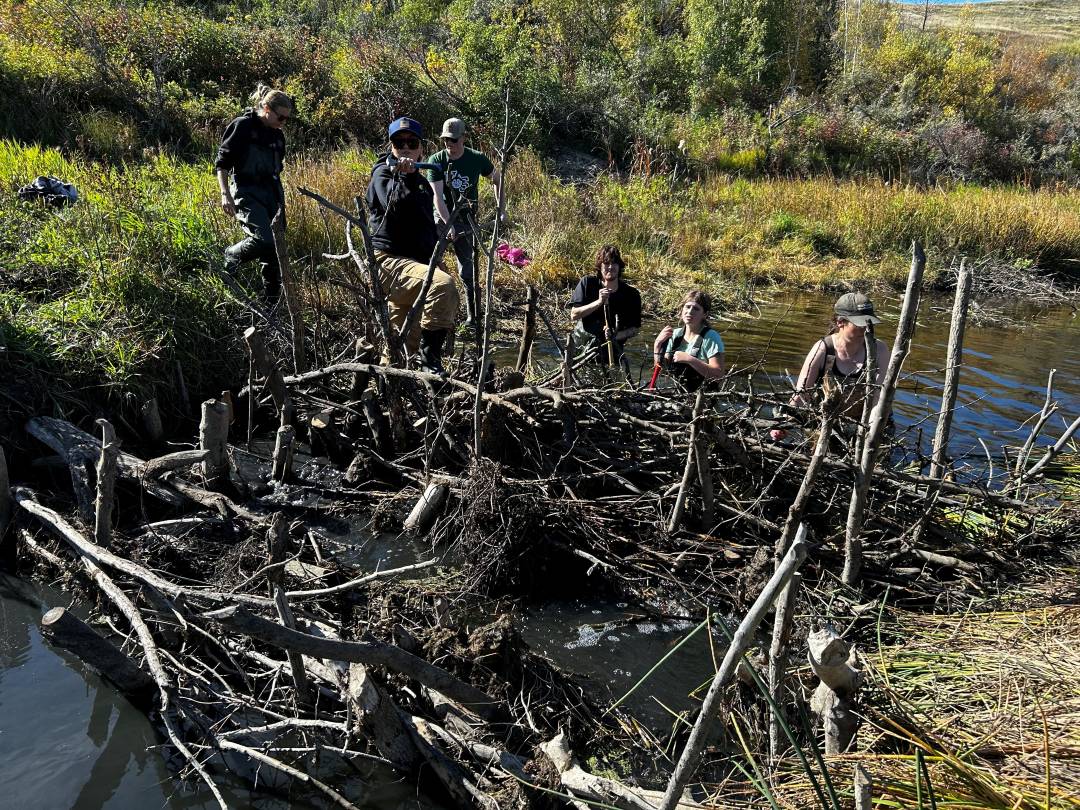
Stewart said the goal of the BDA project was to support ongoing restoration work at Wanuskewin while also providing a valuable experiential learning opportunity for USask students. Stewart said her SLSC 450 class has had a partnership with Wanuskewin for several years; last fall, for example, her students visited Wanuskewin to help collect, process, and plant buffaloberry and hawthorn shrubs, as part of a larger project seeking to enhance habitat within the park for threatened species such as Loggerhead Shrike.
This year, Ian Hnatowich, the natural resources manager at Wanuskewin, brought forward the idea of the SLSC 450 students working on the BDA project. Stewart was intrigued, and she knew the students would be on board.
“Everybody was so excited,” said Stewart, who noted that Hnatowich manages a huge area with complex restoration and land management considerations.
“So being able to bring a class of 12 students and say, ‘Here’s labour for 12 people for a day’ makes a good opportunity for him, too,” she added.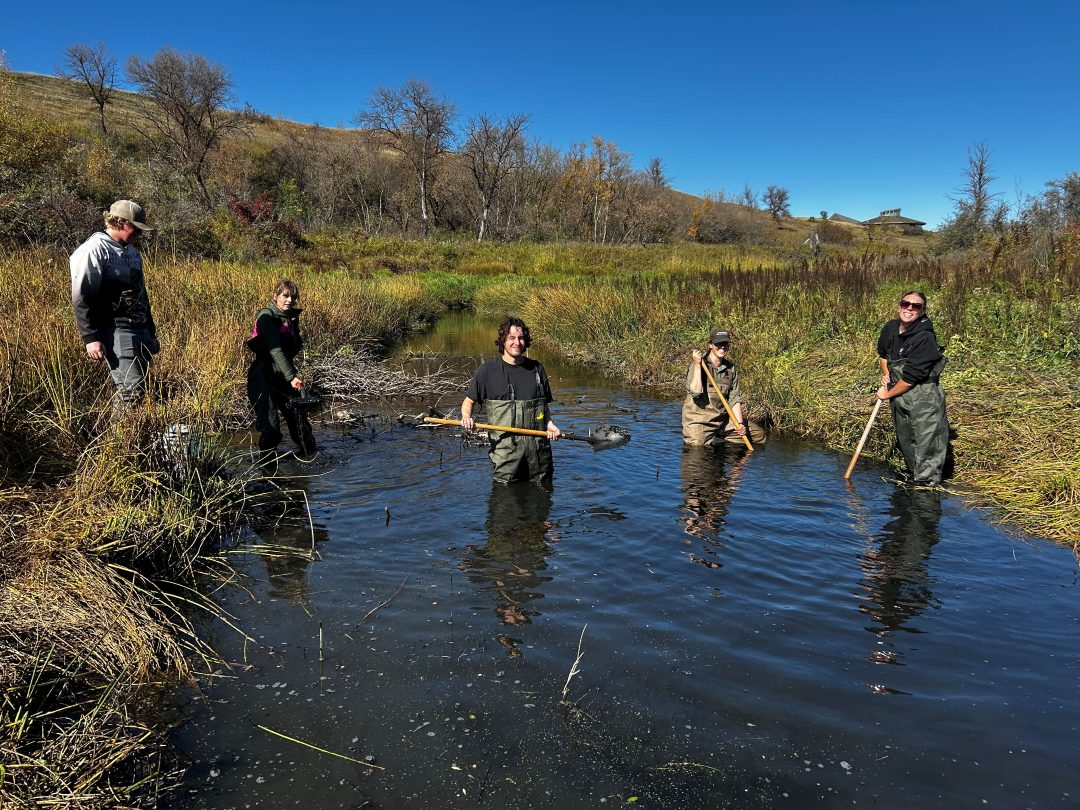
Hnatowich is personally familiar with the SLSC 450 course as a USask graduate and as Stewart’s former student, so partnering with Stewart and her students was a natural fit for him. He lauded the professionalism, enthusiasm, and expertise that USask researchers and students have to offer.
“Prof. Stewart was my master’s supervisor during my time at the University of Saskatchewan. She had reached out to me to see if there were any interesting projects that her students may be able to assist with, for both the benefit of Wanuskewin and the benefit of her students to actively work on a real-world restoration project,” Hnatowich said. “As I am deeply grateful to both Prof. Stewart and to USask for my experiences and knowledge derived from my time as a student, how could I possibly refuse the help of a dozen eager students ready to spend a day in the creek.”
Over the past few years, Wanuskewin has been home to a substantial beaver population. Hnatowich said the beavers’ retaining ponds were creating positive benefits to the local environment, but they were also causing difficulties at the park through impacts to the park’s infrastructure — particularly its trails and bridges. To find a more harmonious balance with the beavers, Wanuskewin previously installed three pond levellers within critical sections of the opimihāw Creek to reduce the likelihood of significant flooding. To ensure those pond levellers would settle into the beaver dams without issue, Wanuskewin also hired a local trapper to come to the site to help reduce the beaver population.
“While initially a huge success, with trapped beavers used for both a traditional beaver processing workshop at Wanuskewin and gifted to local Indigenous artists, the spring rains and subsequent rushing creek from this spring resulted in most of the major beaver dams breaking apart under the higher-than-expected flows,” Hnatowich explained.
“With only a small population of beavers remaining on site, this subsequently resulted in several acres of previously flooded ground now exposed, and prime ground for invasive annual species to take over. Recognizing that other methods of control — such as manual or chemical removal — would either take far too much time away from dealing with other issues in the park, or simply non-feasible due to the proximity to open water, we decided that if the beavers had caused the flooding before, they would surely be able to do it again,” he added.
“By installing the beaver dam analog, we hope that beavers emerging in the spring to find their own territories may stumble across the BDA and the abandoned lodge nearby and decide it to be a perfect place to set up shop.”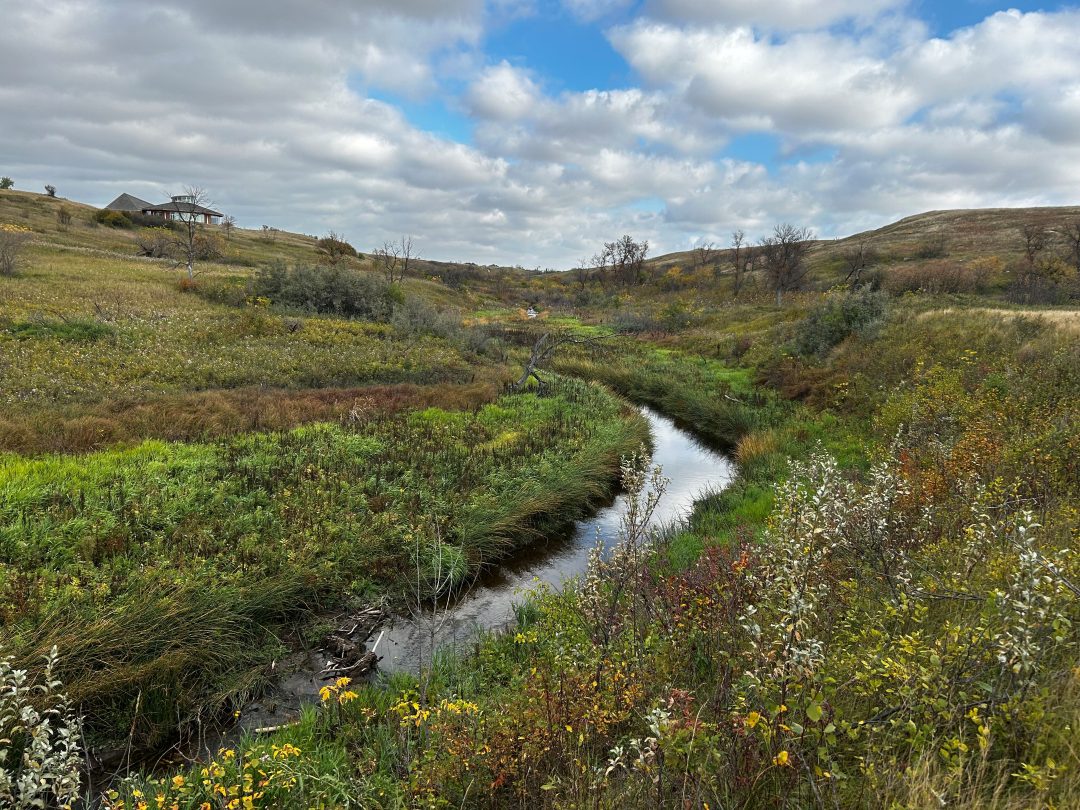
Owen Larocque, a third-year USask environmental science student, likened the BDA work to building a fence in the river, and weaving branches and reeds through it.
Larocque had decided to enroll in the SLSC 450 class after completing Stewart’s SLSC 350.3: Terrestrial Restoration course last year. The hands-on learning activities featured in SLSC 450 appealed to Larocque, who is interested in working on restoration projects in the future.
“So, it’d be right up my alley, and that’s kind of the field that I was interested in as well,” he said.
At Wanuskewin, both Gunn and Larocque were fascinated by Hnatowich’s vast knowledge of the land and the beavers there, and they were interested in the ways that Wanuskewin incorporates Indigenous world views and advice from Elders into its restoration projects. Students also had the opportunity to learn more about Indigenous cultural protocols during their visit to Wanuskewin, including taking part in a tobacco offering, which was a meaningful experience for them.
“It was really, really inspiring in multiple ways,” Gunn said of the trip to Wanuskewin.
Stewart sees the SLSC 450 course as an opportunity for USask to engage with, learn from, and give back to community partners. Wanuskewin has been a sacred site and gathering place for more than 6,400 years, and Stewart said it’s a wonderful location for USask students to continue learning as part of their reconciliation journeys. The students were very engaged in the learning and knowledge transfer at Wanuskewin, and they were also able to envision themselves working in a career like Hnatowich’s in the future, Stewart said.
“I think the students walked away thinking some bigger thoughts about how some of these things work, having a context for it, and then even just being like, ‘Well, I could do this,’ ” she added.
Larocque said he was appreciative of the learning experience, and he has since vowed to return to Wanuskewin in the future.
“I know most people know it's there, but to go there and really kind of immerse yourself in its importance is something that I would encourage,” he said.