

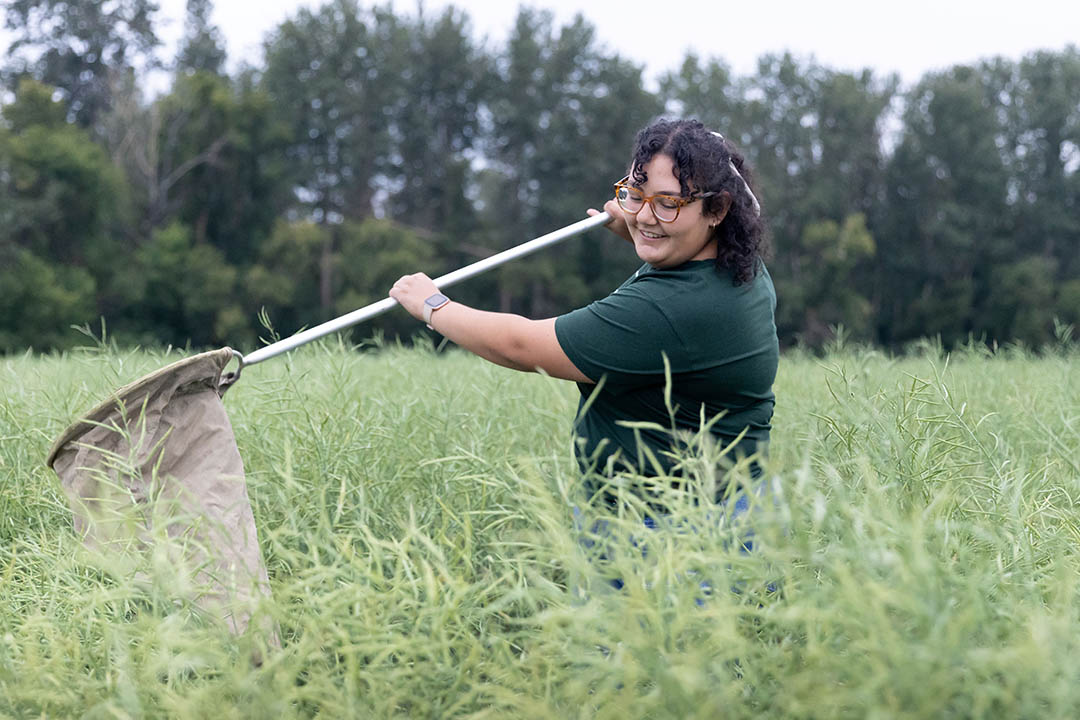
USask student thrives in first generation university experience
Emily Sebastian honoured for academic achievement during Indigenous Achievement Week.
By Brett Makulowich“Receiving this Indigenous Achievement Award is so meaningful because it represents so much more than just academic achievement,” said Emily Sebastian. “I am the first person in my family to attend university. Coming from a small town of approximately 500 people, university felt so big to me, and I felt so small in it. To realize that my efforts and hard work have been noticed is just so surreal to me. This award represents my growth throughout university.”
Indigenous Achievement Week (IAW) is an annual University of Saskatchewan (USask) event that celebrates Métis, First Nations and Inuit students, staff, faculty and alumni success. This year’s IAW is March 9-13.
Sebastian is from Montmartre, Sask., and is a member of Métis Nation—Saskatchewan. She is pursuing a Bachelor of Science in Agriculture degree (Crop Science major, Agribusiness minor) and a Precision Agriculture Certificate in the College of Agriculture and Bioresources (AgBio) at USask.
“I chose the University of Saskatchewan because it has one of the best agricultural colleges in Canada,” said Sebastian. “I like the diversity of programs within the College of Agriculture and Bioresources, allowing you to pick from just about any area of interest.”
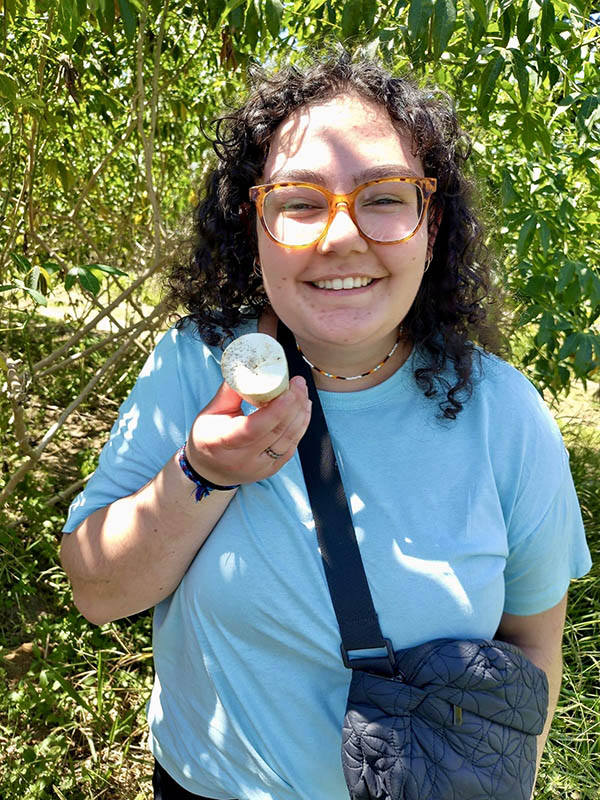
Sebastian seized the opportunities that AgBio offers, including participating in a vast number of extracurricular activities, completing an undergraduate thesis, and studying abroad.
“I’m grateful that I decided to step out of my comfort zone and join student clubs in my early years of university because it made the transition to university easier through making lasting connections and friendships,” said Sebastian.
Sebastian continued to step outside her comfort zone by participating in the PLSC 444: South American Study Tour taught by Dr. Randy Kutcher (PhD), when she travelled to Brazil. Students toured across the state of Minas Gerais and city of Rio de Janeiro and observed Brazilian field and horticultural crop production. They also visited two Brazilian universities where both the USask and Brazilian students presented on agriculture practises and engaged in discussion.
“The opportunity to go abroad to learn about agriculture was incredible,” said Sebastian. “Being enrolled in this course and travelling to Brazil was the coolest and most impactful experience I’ve had at the University of Saskatchewan. Although we were from two very different parts of the world, we found that agriculture united us and the Brazilian students. We found common ground in the fact that agriculture is our way of life, and it was just so interesting hearing about some of their agricultural practices that we don’t see as much in Canada.”
Sebastian is majoring in crop science at USask and says, “growing up on a farm, I always knew I wanted to pursue a post-secondary education and future career in agriculture.”
“Understanding the genetic causes of a plant’s behaviour, in response to differing environmental conditions, helps a lot when diagnosing issues in the field and selecting cultivars for production,” Sebastian said about the crop science major. “I’m also very interested in agronomy and, through my summer work experiences, have developed a strong love and passion for being out in the field, making recommendations, diagnosing issues, and working directly with growers.”
Sebastian linked her summer work experience at Ag Grow Consulting Ltd., to her undergraduate thesis, which is supervised by Dr. Maryse Bourgault (PhD). She completed the in-field portion of her research project with the research trials the company runs. Her thesis is focused on top-dressing in wheat. Top-dressing in wheat describes the foliar application of nitrogen fertilizer to the plant when it is at the tillering stage—development of side shoots (tillers) from the plant’s base that contribute to the crop’s yield.
“By determining whether top-dressing is agronomically feasible, my research will hopefully provide producers with another strategy to improve the nitrogen-use efficiency of their crop,” said Sebastian. “In doing so, improved economic return and reduced environmental impact should be observed through improved yields and reduced nitrogen losses.”
Sebastian is set to graduate this spring and will begin her career as a scouting agronomist with Ag Grow Consulting Ltd.
“I’m not sure where I see myself long-term, it would be nice to one day return to the family farm, but only time can tell what will happen,” said Sebastian. “For now, I am just happy to live in the moment and see where my career takes me.”