

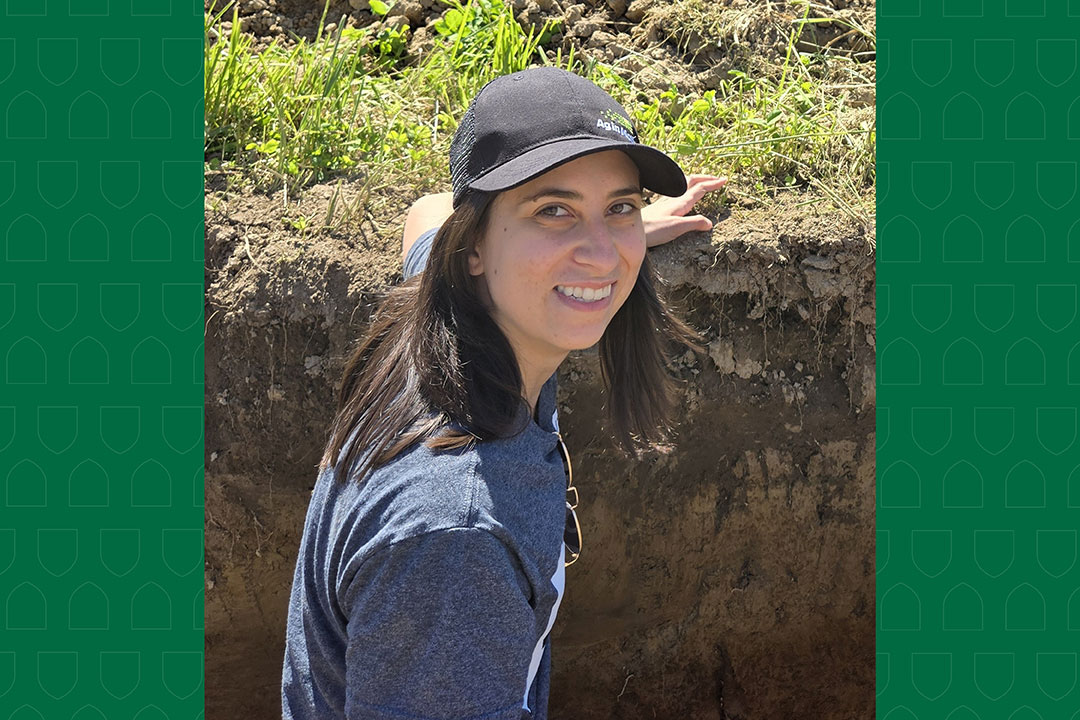
Celebrating World Soil Day: Q & A with USask’s Dr. Chantel Chizen
Effective soil management is crucial to resolving many environmental issues, including food and water shortages and climate change.
By AgBio CommunicationsUniversity of Saskatchewan (USask) researcher Dr. Chantel Chizen (PhD) is using digital technologies like remote sensing and digital soil mapping to provide sustainable management practices for farmers and land managers.
Chizen joined USask’s College of Agriculture and Bioresources as an assistant professor in the Department of Soil Science in January 2025. Through her research program, Chizen prioritizes interdisciplinary partnerships with farmers, researchers, and collaborators to ensure that her work meets the needs of the agricultural sector and enhances soil stewardship.
Each year, the United Nations recognizes December 5 as World Soil Day to highlight the importance of healthy soil and sustainable soil management. To celebrate World Soil Day at USask, we asked Chizen to discuss her research and what inspired her to pursue a career in soil science.
What does your research focus on?
My research focuses on understanding the connections between soils, landscapes, and how we manage them. I lead the Data-driven Innovations with Geospatial Soil Science (DIGSS) research group where we conduct field research and use tools such as digital soil mapping to support management decision-making. Our goal is to translate soil variability into actionable insights for producers and land managers to support productivity while taking care of the environment.
There is a growing recognition that soils are incredibly diverse, even within a single field, and that this variability matters for both agricultural productivity and environmental outcomes. What’s unique about our research is that we’re not just mapping these differences; we’re using data-driven approaches to understand why they occur and how to turn that knowledge into practical management strategies.
How did you develop an interest in soil science?
I was introduced to soil science during my undergraduate degree and was fascinated by the complexity of soils as they are connected to so many aspects of our world, from agriculture and the environment to climate and sustainability. Before starting university, I didn’t know about soil science and ended up changing majors so that I could study it further. My favourite parts of soil science are the hands-on field courses and working with interdisciplinary collaborators. I grew up in Central Alberta and completed a BSc in Applied Biology (Plant and Soil Sciences) and an MSc in Soil Science at the University of British Columbia. I later pursued my PhD in Soil Science at USask, focusing on wetland soil carbon in agricultural landscapes across the Prairie Pothole Region.
Why did you choose to come to USask?
I chose USask because of the strong reputation of its soil science department, with the high-calibre research and the collaborative community of researchers. These aspects drew me here as a PhD student, and I’m excited to continue contributing to the department as a faculty member.
What research are you working on?
With the DIGSS team, we have several projects underway. One project is exploring the soil properties that drive marginal crop yields and how the patterns in marginality vary across a field. Another project is assessing how satellite imagery and soil classification for prairie pothole wetlands can be used to support decisions around how they are managed. We are also examining soil health and how we measure it, recognizing that a healthy soil may look different depending on the soil and its context. By uncovering patterns in soils and landscapes, we transform complex data and observations into actionable insights for those working with the land.
What inspires you in your work and research?
What inspires me most in my work is bridging research and extension to create meaningful change. While advancing scientific understanding is important, what truly motivates me is translating that knowledge into practical solutions that farmers, land managers, and communities can use. Soil science offers a unique opportunity to connect fundamental research with applied practices that improve sustainability, enhance resilience, and mitigate climate impacts. Seeing research move beyond controlled experiments and into real-world applications where it can guide decisions and drive positive outcomes, gives my work purpose and keeps me passionate about what I do.
What’s an interesting aspect of your research that people might not know about?
Soil management is not one-size-fits-all, so strategies need to be adapted to each landscape and context. Exploring a new soil is like solving a puzzle, the soil horizons and properties reveal what it has experienced in the past and how it functions today. Each action we implement on the soil leaves a lasting imprint, becoming the legacy that we pass on to future generations.