

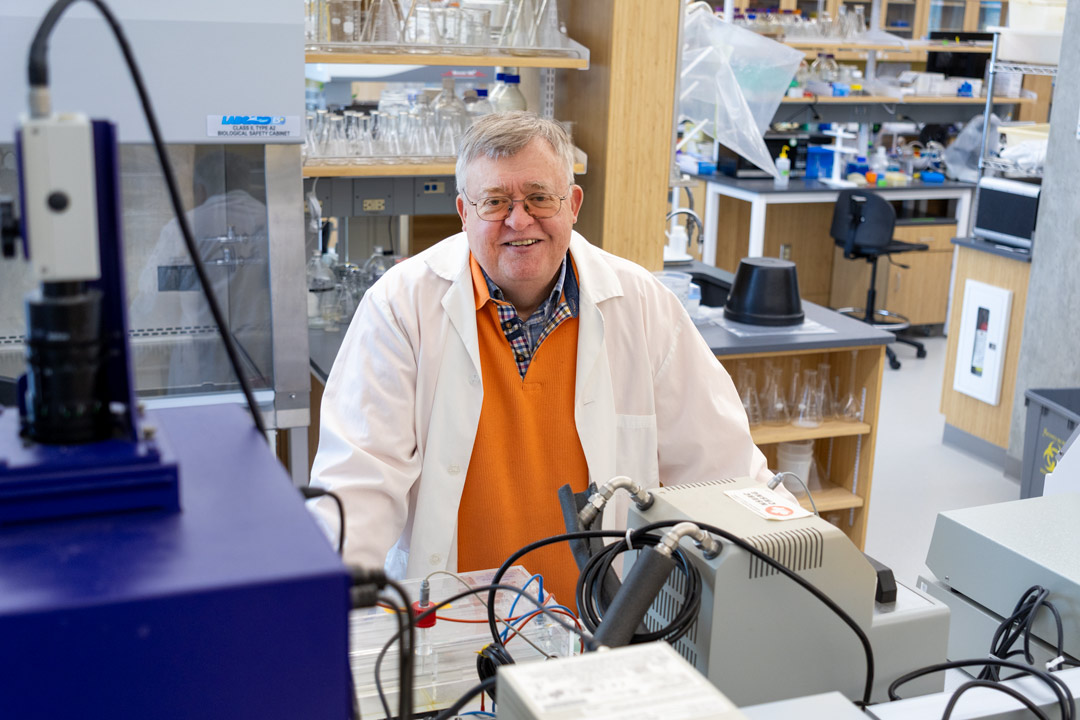
For Neil Chilton, teaching starts with having faith in students
The USask parasitologist’s distinguished research and teaching career started because he had something to prove.
By Chris PutnamWhen Dr. Neil Chilton (PhD) first entered university, his peers and professors were quick to write him off.
University was “uncharted territory” for Chilton, who was the first in his family to complete high school. He had no role models in higher education, and his lack of confidence didn’t inspire confidence in others.
“I wasn’t an overachiever, for a start,” said Chilton.
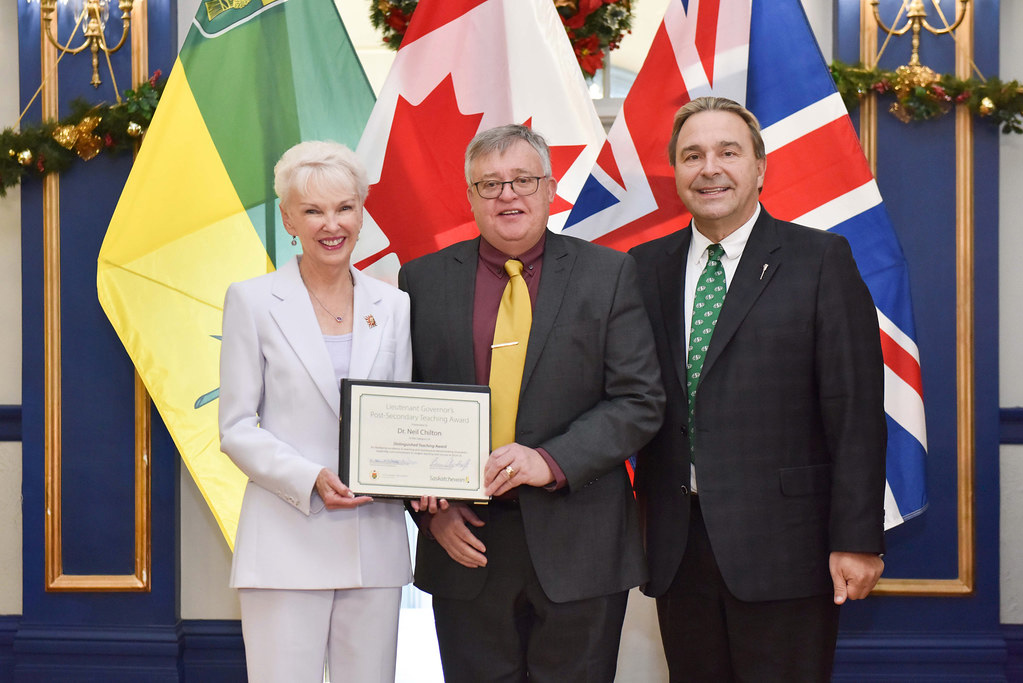
The professor in the University of Saskatchewan (USask) Department of Biology is now an internationally recognized researcher of parasites and one of USask’s most decorated teachers. Last fall, he accepted the Lieutenant Governor’s Post-Secondary Teaching Award in the distinguished teaching category—Saskatchewan's top post-secondary teaching honour.
Chilton, who today is world-renowned for his work on the molecular identification and population genetics of parasites, failed his first genetics class. He remembers his professor walking by as Chilton tried to draw a chromosome in a lab.
“That’s not a chromosome,” the prof told him. “Your diagram looks like a spaceship.”
Although he was no star student at the University of Adelaide, most of the headwinds he faced were because of other people’s prejudgments. Chilton grew up in Australia in an era of rigid class divisions, graduating in the 1970s from a working-class high school whose students were not expected to go on to university.
“So I suppose early on, I was out to prove people wrong,” he said.
That underdog experience made Chilton the teacher and scientist he is today. He is cautious of making assumptions about others and has a distinct perspective on hardship.
“I prefer (my graduate students) to have difficulties in their research projects,” Chilton said. “You need a challenge during your graduate work. Everything shouldn’t go smooth. You should have a bump in the road somewhere to make you think, ‘Well, how do I solve that?’ Because if you go out into a research position or a teaching position, there’s always problems. And if you’ve got a bit of skill with tackling that, I think you’ll be more successful.”
The turning point for Chilton was finding work he was passionate about. That moment came while he was working as a research assistant for a geneticist and an ecologist, chasing lizards in the semi-arid zone of Australia and examining the ticks they carried.
“I found something that I was good at, that I enjoyed, and thought, ‘I want to see where I can go with this.’”
Now he knew his direction, but doubts from others followed him into his graduate studies. While he prepared for an examination that would let him transfer from a master’s to a PhD program at Flinders University, one of the faculty examiners bluntly told him, “You’re not going to pass.”
Chilton did pass, and won an award for best student presentation at a scientific conference that year. He got an apology from the professor and a confirmation that he belonged exactly where he was. He was not to be underestimated.
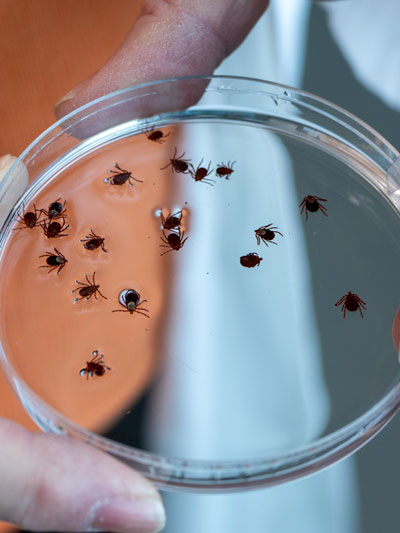
Animal parasites—ticks, fleas, roundworms and other unpleasant critters—have been the backbone of Chilton’s storied research career.
While most people prefer to think about parasites as little as possible, Chilton is captivated by their significance to life on Earth. About 50–70 per cent of the world’s animal species are parasites. They cause immeasurable harm to health and the economy through the diseases they carry: from malaria in humans to anaplasmosis in cows.
Other damage is indirect. Young moose in Saskatchewan and Alberta, for instance, sometimes freeze to death because of the fur they lose by scratching at large numbers of itchy ticks.
“Parasites just have a major impact on the world. So my perspective is that we need to understand the fundamental aspects of the lifecycles of these things: where they live, what stages are infecting animals. That’s a fascinating world,” Chilton said.
Chilton studies parasites at scales all the way from molecules to whole populations. Some of his most celebrated work has involved developing new tools to identify parasites and the bacteria they carry.
Some of those bacteria negatively affect human health, like the bacterium that carries Lyme disease. Others are beneficial to the parasite or even protect it from carrying pathogens harmful to humans.
“A lot of people work on the bacterial pathogens. I’m more interested in the non-pathogens, because I think understanding what they do will have a greater impact on understanding how pathogens get transmitted,” said Chilton.
Hosts, parasites and bacteria are part of an intricate web. Chilton—whose international research recognitions include an honorary doctorate from the University of Melbourne, where he worked for 12 years before moving to Canada—was doing One Health research before One Health had a name.
Discovering his scientific niche gave Chilton the confidence and drive he’d been missing when he first entered university. Now he strives to help students find their own path to believing in themselves.
“People can succeed if you give them confidence. If you can show them, ‘OK, you know how to do that,’ a lot of the rest is just common sense,” said Chilton, who has won all of USask’s major teaching awards, including the Distinguished Teacher Award.
Even in Chilton’s first-year biology courses of 500 students, he insists “the back row is not a hiding place” and calls on everyone to speak up. In a course he helped design for Indigenous Student Achievement Pathways in the College of Arts and Science, students are asked to teach each other the course material, giving them a chance to prove their mastery.
And when students are struggling, Chilton insists they come to see him. He understands better than most.
Many of his professors didn’t believe in him, but Chilton always believes in his students.
“I think I show that I care, that I want them to be successful. And I think they appreciate that.”