

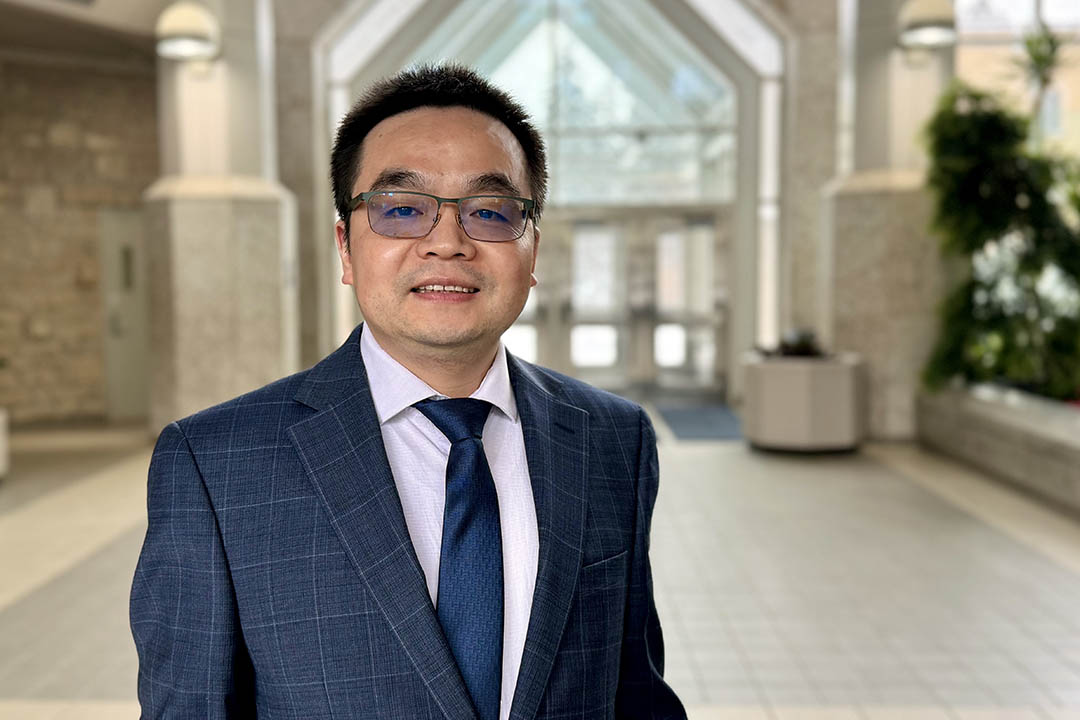
From Fujian province to Saskatchewan: USask researcher rooted in agriculture
Meet researcher Dr. Yongfeng Ai, as the University of Saskatchewan (USask) celebrates Asian Heritage Month.
By Joanne PaulsonYou could say Dr. Yongfeng Ai (PhD) was born to be a food scientist.
Originally from a farm in Fujian province, China, he has uprooted three times, but always to regions with important agricultural economies.
His first move was not terribly far — to the China Agricultural University’s College of Food Science and Nutritional Engineering in Beijing, where he took a Bachelor of Engineering degree. Immediately thereafter, though, the United States beckoned.
There, he completed his PhD in Food Science and Technology at Iowa State University’s Department of Food Science and Human Nutrition in 2013.
“Where I lived in Ames, Iowa, there was a corn field like next door. I was very surprised,” he said.
A stint at Michigan State University followed, where in 2014-15 he was a post-doctoral research associate working in value-added processing of cereal grains and pulses.
“Then one professor and friend forwarded me the job posting of my current position at USask,” Ai said. “The department was basically looking for two important qualifications: carbohydrate chemistry and value-added processing of pulses and cereals.”
With his carbohydrate chemistry and nutrition training at Iowa and value-added processing experience at Michigan, he thought he was a good fit. He applied, and made his first trip to Canada on March 22, 2015 for the interview, a date he will always remember.
“A few months later, the university offered me the position,” he said. “I started my current job in January 2016.”
That position is associate professor in the College of Agriculture and Bioresources, as well as Ministry of Agriculture Endowed Research Chair in Carbohydrate Quality and Utilization.
“I have always been based at universities in agriculturally focused provinces or states, and I plan to work here for many years to come,” he said. “I never changed my major. I have always been passionate about food science.”
“I’ve lived in three big countries, in three great countries. I am happy with my life in Saskatchewan, at USask.”
Research, both fundamental and applied
As a research chair on campus, Ai said he enjoys a good balance of fundamental and applied research.
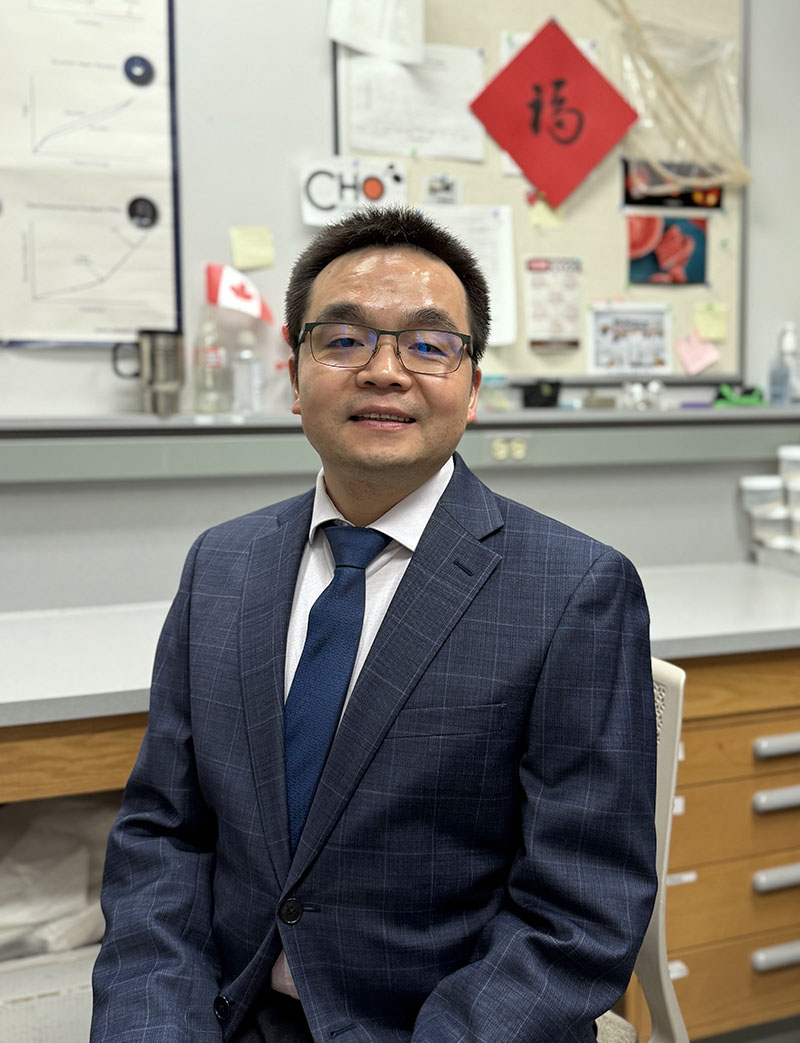
“I work closely with companies in the agri-food sector in Saskatchewan, Canada and North America. That’s one thing I really like,” he said. “I support research and development efforts of those companies.
“I really enjoy exploring how carbohydrates from Saskatchewan crops, in particular pulses and cereals, can be converted into high-value ingredients or raw materials for food and non-food applications.”
For example, he and his team are working on converting starch into biogels for nutraceutical and sensor applications, as well as into bioplastics.
Pulse starches from crops like peas, lentils, faba beans, and dry beans are very good at forming gels, he explained. One of these is a pea-starch based cryogel, which has many tiny pores potentially useful for holding and controlling the release of bioactive compounds and drugs.
The second is a hydrogel that can conduct electricity, which can be used in sensors for health monitoring, tracking human movement, soft robotics, and tools that connect people and machines.
There are also environmental upsides to these novel biomaterials, he noted.
“This will reduce the need for petroleum-based plastics and they are biorenewable and biodegradable,” he said.
In addition, he wants to develop healthier carbohydrates for living beings.
“With the rising prevalence of diabetes, obesity, cardiovascular disease, and other chronic conditions, there is a growing demand for healthier carbohydrate options,” he said. “Promising examples include resistant starch, resistant dextrin, dietary fibre, and low-glycemic food products. My research program applies diverse processing methods to develop health-promoting carbohydrates from Saskatchewan crops, such as pulses, oats, wheat, and barley. In collaboration with nutritionists across Canada, we examine the health benefits of these carbohydrates in humans, companion animals, and livestock.”
Another bonus to being part of the USask community is the proximity of the Canadian Light Source (CLS), proving to be extremely helpful in his research. In the past three months, six of his graduate students have been supported at the CLS to advance their thesis research.
“We are next door. There is no better location for us to make use of the advanced facilities at the Canadian Light Source.”
Why Saskatchewan?
Ai’s main reason for wanting to come to Saskatchewan was its wide agricultural sector and large farmland area.
“I had my roots in agriculture,” he said. “Food science has its roots in agriculture. We have a very strong agriculture and agri-food sector, and that was the main reason I moved to Saskatchewan one decade ago.”
That said, he noted, Canadian people also have a reputation for being nice.
But he also wanted to stay in the academic realm.
“We are one of the world’s leading universities in agricultural science, and choosing to be here is a decision I have never regretted.”
He does, however, enjoy the contact with a variety of private companies, as well as the opportunities to collaborate with other researchers across various disciplines such as plant breeders and scientists, animal nutritionists, engineers, veterinary academics, and other food scientists.
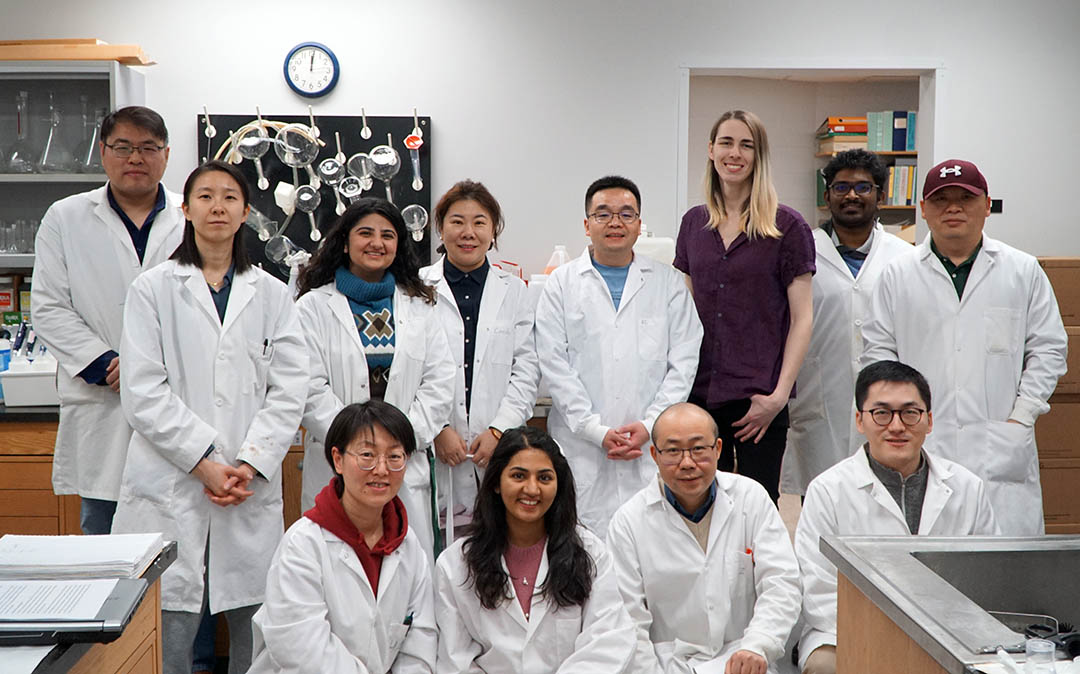
In his own lab, there is considerable diversity as well — both in disciplines and cultures.
“In the first 10 years, I’ve had students from more than 10 countries. Every year, we organize a summer party as a group-building activity. Everyone brings authentic food from their home country to share.”
On the very personal side, “I met my wife on campus, and our relationship grew from there until we eventually married. We live in a lovely home in the city with our two dogs,” which they enjoy walking on the numerous trails in Saskatoon.
Ai and his wife, Leilei Sun from the College of Pharmacy and Nutrition, also enjoy travel; but they do find they can also journey to different cultures right here at home.
“We enjoy the cultural diversity here,” he said. “That’s especially true when it comes to the variety of food and local restaurants.”