

Honouring the sacrifices of those who served
Memorial ribbons in USask’s Peter MacKinnon Building were painted by First World War veteran Harry Accleton
By Bill Waiser, USask Distinguished Professor EmeritusThis story was first published in The Globe and Mail on Nov. 7, 2026.
Dorian Accleton grew up knowing that his great grandfather Harry had served in the Great War (1914-18). His medals and other war memorabilia are proudly displayed in his family home in Saskatoon.
But it wasn’t until September 2013, after Dorian’s first day with the maintenance department at the University of Saskatchewan (USask), that his grandmother told him that Harry had also worked for the university as a decorator/glazier for almost half a century. In fact, Harry was so good at what he did that, at the request of the university, he worked five years beyond his official retirement age.
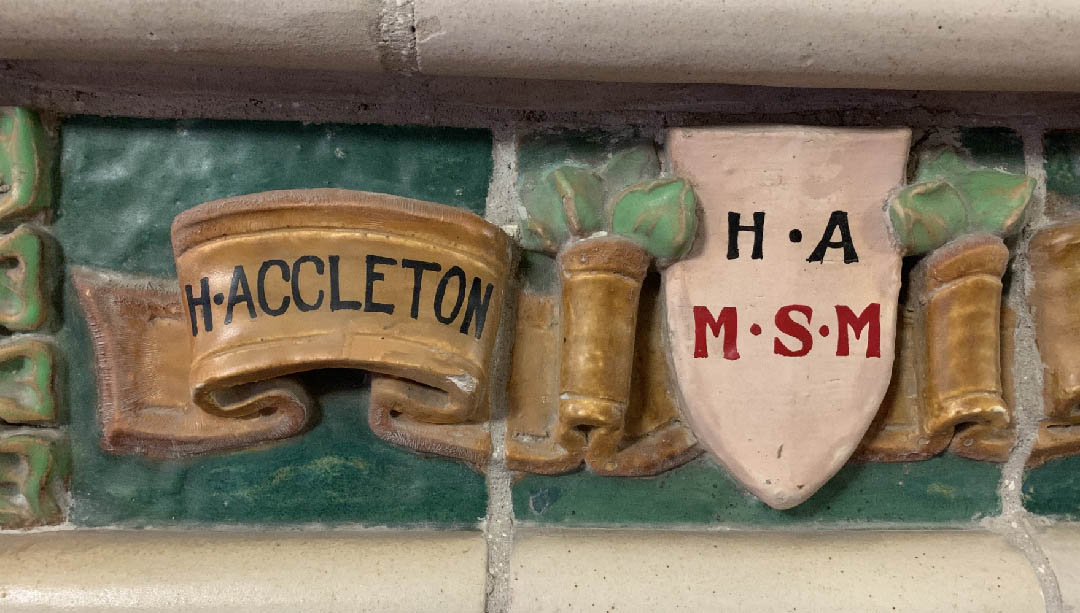
Dorian also learned, to his surprise, that Harry had painted the names of the university men who served in the Great War on the memorial ribbon tiles in the College Building (now the Peter MacKinnon Building). Among them was Harry’s own name.
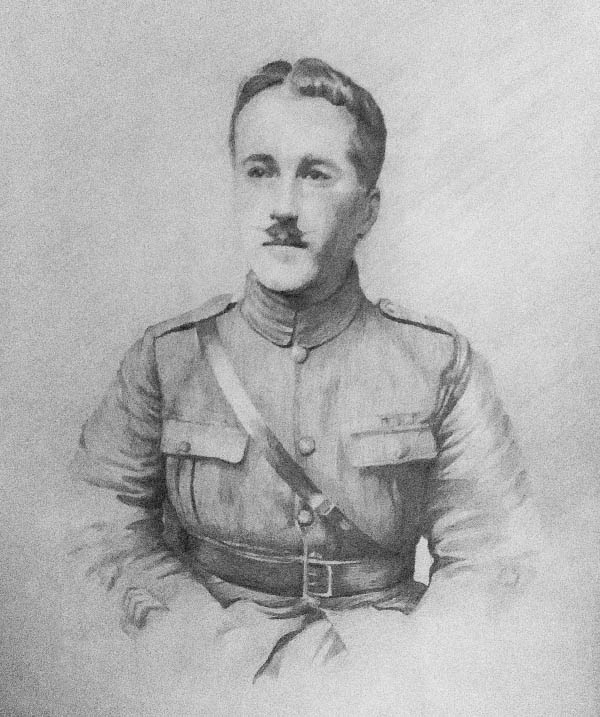
Harry Accleton was born in Cobham, Kent, England, on Oct. 28, 1888. After Grade 8, Harry completed a four-year apprenticeship as a commercial painter. He then enlisted in the British Army in 1908 and served as “Painter 3rd Class” at Aldershot. Harry was discharged in 1911 on the understanding that he remained on reserve status and could be called up at any time.
Harry left for Canada in September 1911. There was a new provincial university being built in Saskatoon, and he had a line on a job as a foreman painter. He started work on the University of Saskatchewan campus in May 1912, just as the first greystone buildings were being constructed.
Riding about campus, with a special rack on his bicycle for carrying glass, Harry performed a variety of painting jobs: names on the frosted glass of office doors, campus signs, labels for technical drawings for agricultural engineering courses, even lines on the basketball court.
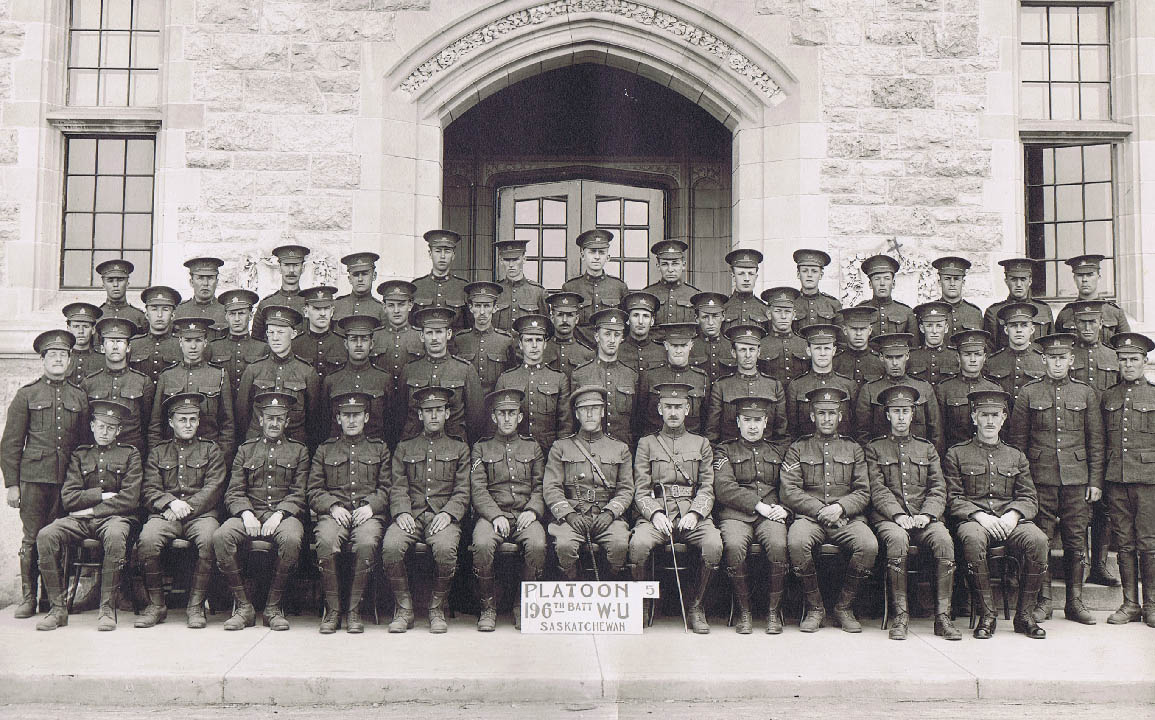
This busy campus life was upended with the coming of war in August 1914. As a British Army Reservist, Harry returned immediately to England to fight for King and country. He wasn’t alone: 330 university men—students, faculty, and staff—left for the war front.
For the first years of the Great War, the University of Saskatchewan struggled to offer its programs. But it was forced to close the College of Engineering for the 1916-17 academic year when the student body and faculty enlisted en masse. Enrolment in C.J. Mackenzie’s course in civil engineering, for example, had steadily declined until there was no one left, including the instructor.
The first university casualty was reported in July 1915. Thereafter, the death count steadily climbed as Canadian soldiers found themselves at the sharp end in many of the war’s major battles. Sixty-seven from the university died in the war (one in five), while more than 100 were wounded. President Walter Murray would openly weep as he read the names of the war dead at university Convocation.
Harry Accleton was among the lucky. As a clerk with the Army Ordinance Corps, he was posted to the shipping port of Le Havre, France, where he ensured that supplies, including ammunition, were quickly dispatched to the front lines.
Harry earned the Meritorious Service Medal for his service. It was not his only honour. The university also wanted to recognize Harry’s sacrifice and those of others, especially those who did not return home from the war.
In 1916, two years before the end of the conflict, the Board of Governors decided that “the names of all students and all others connected with the University who have enlisted, [be] painted on the ‘ribbons’ in the corridors” of the College Building.
The scroll-like ribbons, interspersed with small shields—all made of ceramic tile—formed a decorative frieze that ran along the corridor walls of the first and second floors of the university’s centrepiece building. Over 570 feet in length, the wainscoting of glazed terracotta tile was part of the original building fabric and predated the start of the war. The hand-scribing of soldier names on them turned them into memorial ribbons.
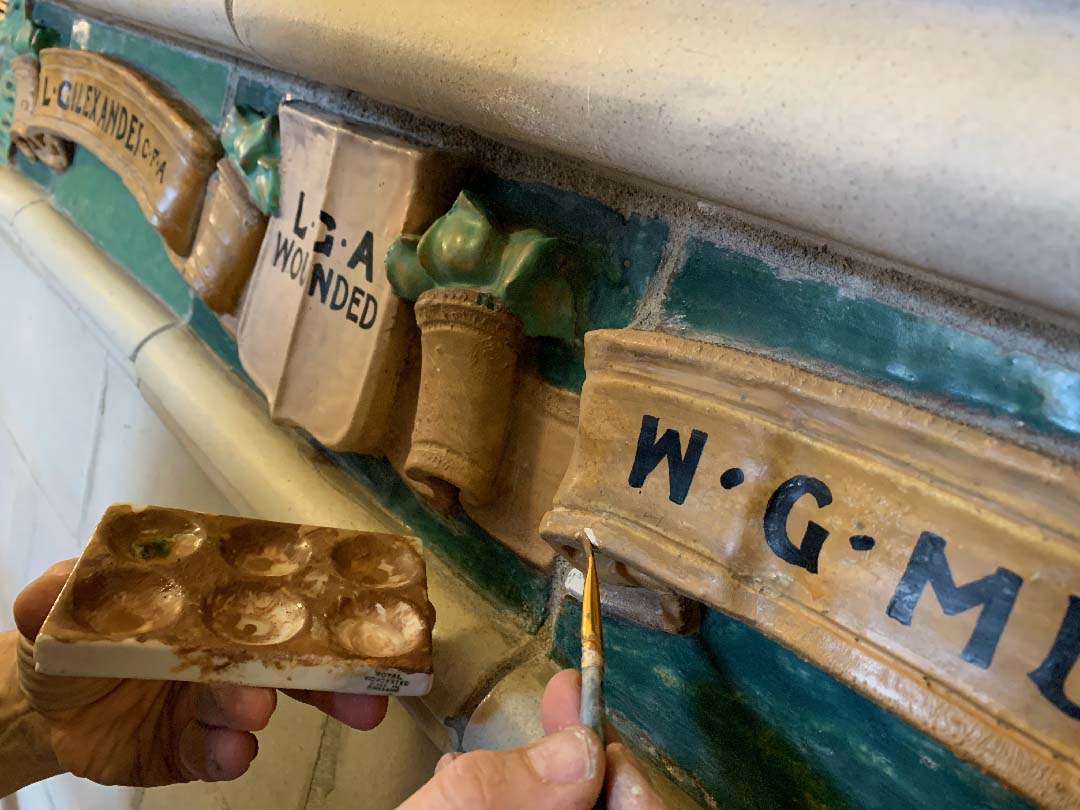
It’s not known when the first names were painted on the ribbons. Nor is it known how many had been done, if any, before Harry returned to his job at the university in 1919. But the solemn assignment fell to him, a Great War veteran. He painted more than 300.
All the names were arranged randomly, neither alphabetically nor by unit and rank. The only exception was Reginald Batemen, whose name is found directly across from the building entrance, immediately to the upper right of the doors to Convocation Hall. The first professor of English at the university, Bateman signed up for three tours of duty, the last time taking a demotion to serve. He was killed instantly by a direct shell hit in October 1918.
Among the others honoured were USask student and future Conservative Prime Minister John Diefenbaker and history professor Frank Underhill, who would draft the 1933 Regina Manifesto, the founding document of the Co-operative Commonwealth Federation party (forerunner of the NDP).
Harry’s name appears to the left of the Convocation Hall doors.
The memorial ribbons or scrolls, as they are called interchangeably, quickly became one of the defining heritage features of the College Building.
That’s why workers tried to protect them from possible damage when the building was effectively gutted, including the removal of the floors between the walls, during a major renovation from 2003-05.
The condition of the ribbons, though, had steadily deteriorated over the 20th century. The memorials were dirty, some cracked, others mottled. Perhaps worst of all, the names, painted in black on the decorative ribbons, had worn away in places.
A Department of Canadian Heritage grant offered the opportunity to maintain the commemorative integrity of the memorial ribbons. So too, ironically, did the COVID-19 pandemic.
With the university closed, Sharon and Diana Deason, expert conservators, worked undisturbed in the locked building. That was no small deal, especially when scaffolding had to be put up to reach the scrolls that sat atop a stone dado seven feet above the floor. The quiet corridors also lent reverence to the work.
Foreign matter—dirt, paint, plaster, graffiti, etcetera—was first removed, sometimes with a dental tool. Then, the surfaces were gently cleaned. Filling cracks was time-consuming and took considerable skill and patience. In-painting required constant colour-matching because of the variation from ribbon to ribbon. Names and other information about the soldier were also in-painted using a black reversible paint. The last step was the application of two coats of clear conservator’s wax to brighten the finish and offer some protection.
The restoration project restored dignity to the Great War memorial.
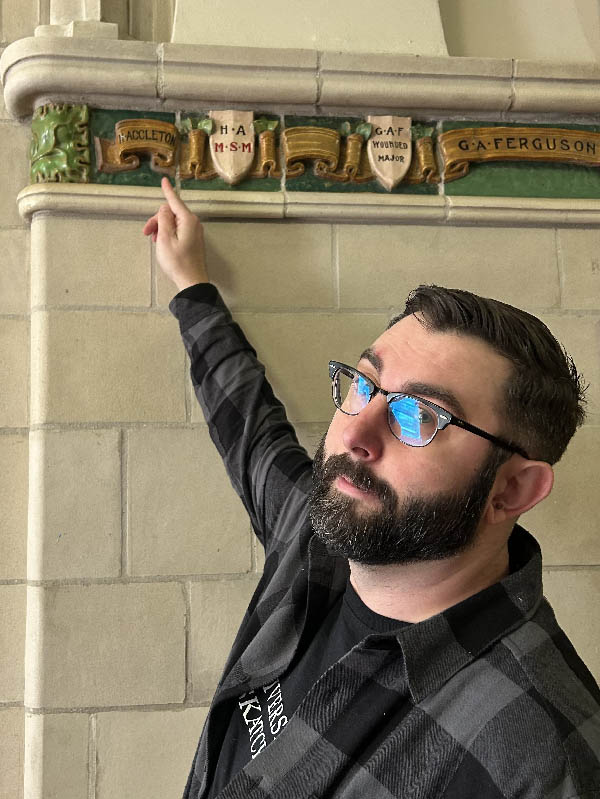
Harry Accleton would have walked by the memorial scrolls on a regular basis during his campus rounds. He probably knew some of the men honoured on the walls of the College Building and thought about his days as a soldier.
His great grandson Dorian, working in the same department, certainly feels a special connection. He proudly tells people about Harry and his role in the university memorial.
Whenever he walks through the Peter MacKinnon Building, Dorian nods at his great grandfather’s name. And if there’s no one in the corridor, Dorian reaches up and gently touches Harry’s memorial ribbon, followed by a moment of silence.
Like his great grandfather, Dorian knows that the men are more than names on the walls of the building. They occupy a place of honour. And they deserve to be remembered.
(About the author: Historian Dr. Bill Waiser (PhD) is a University of Saskatchewan Distinguished Professor Emeritus and the author of more than 20 books. His father Ted, a member of the British Columbia Regiment, fought through western Europe in a tank in 1944-45.)