

Canadian Centre for Rural and Agricultural Health celebrates milestone 40th anniversary
Over the decades, the size and scope of the centre have grown immensely
By Matt Olson, Research Profile and ImpactThe Canadian Centre for Rural and Agricultural Health (CCRAH) began more than four decades ago for a simple reason: to support the health and safety of rural and agricultural people in Saskatchewan.
“Saskatchewan is the breadbasket of Canada. Agriculture and rural are what make Saskatchewan,” said Dr. Shelley Kirychuk (PhD), the current director of CCRAH. “We are rural, we represent agriculture, and we support the people that bring food to the world.”
Where it started
In the 1970s and ’80s, a phenomenon was noticed by Dr. James Dosman (MD), the eventual founding director of CCRAH. People who worked in grain elevators were reporting lung health issues due to grain dust exposure.
These findings led to an International Symposium on Grain Dust and Health in the late ’70s, which eventually led to the development of a national grain dust medical surveillance program for Canada.
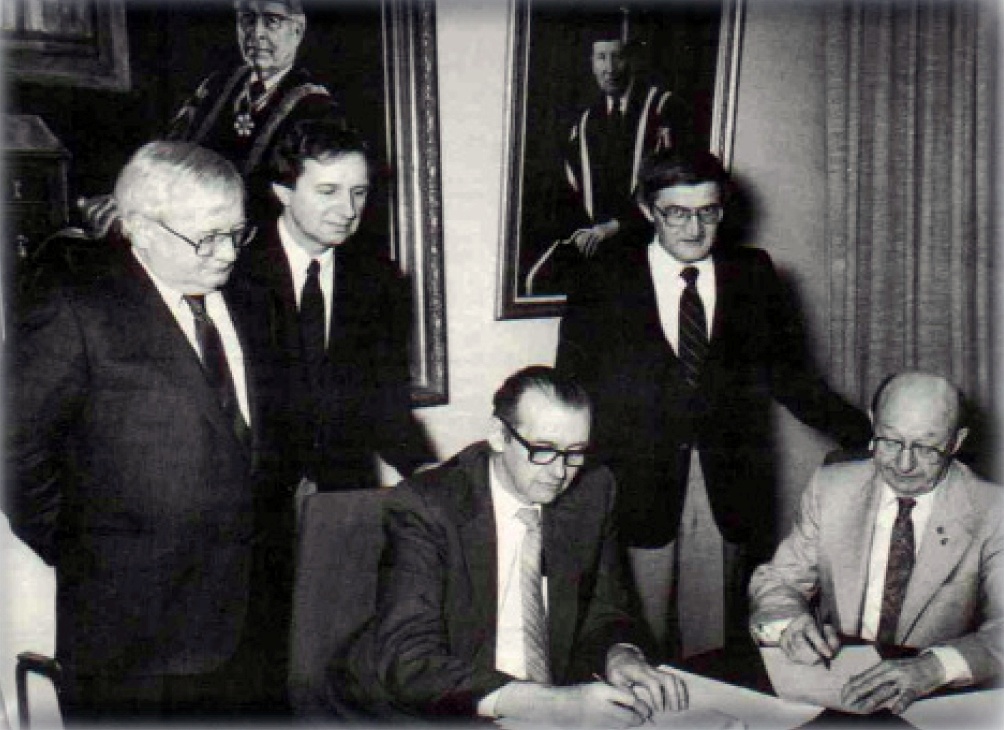
From there, USask and the Saskatchewan Lung Association established the Centre for Agricultural Medicine in January 1986, which would be renamed the Canadian Centre for Rural and Agricultural Health in 2023.
In a video for the 40th anniversary celebration, Dosman said the establishment of the CCRAH and other agricultural health and safety initiatives led by the centre have made USask a Canadian hub for rural and agricultural health research and knowledge mobilization. “We held seven international symposia on health and safety in agriculture. The world came to Saskatoon to study the issues,” Dosman said.
Rooted in community
Over the decades, the size and scope of the CCRAH have grown immensely. The centre works at the grassroots, with community, to establish the research directions and to move the research into resources, programs, and services to address health for rural people.
The CCRAH brings together people from across USask, Canada, and globally to undertake research, training, service, and knowledge mobilization and has received support from the federal and provincial governments, as well as numerous agricultural, industry, and community organizations, including the Saskatchewan Association of Rural Municipalities (SARM). The CCRAH’s Agricultural Health and Safety Network has partnered with Saskatchewan rural municipalities for 38 years to improve farmers’ health. Currently, 210 rural municipalities are members and receive the benefits of the network.
Kirychuk pointed to the Canada Foundation for Innovation (CFI) funding in 2007 for the establishment of the CCRAH laboratories for rural research, education, and knowledge translation as the turning point in the overall scope of the CCRAH.
The facilities located in the USask Health Sciences Building would become the new home of the CCRAH and create a hub for agricultural health and safety research and outreach for Canada and the world.
USask researchers from 16 colleges and schools across campus, 19 Canadian universities, and 21 international universities and organizations are involved with the centre, making it a unique multidisciplinary hub for rural and agricultural health research and outreach.
But more than that, Kirychuk said the centre works to explore research, training, and knowledge mobilization that impacts the people living and working in rural and agricultural settings.
“Having researchers here finding the evidence, and then a knowledge translation and communications team move that evidence into resources, products, and services that others can pick up is very important. But just as important is our scientific evaluation of those programs,” Kirychuk said. “We make it available across the country and around the world, so others don't have to recreate the wheel. It can be adapted to the local context.”

Celebrating 40 years strong
The centre is continuing to leave its mark after four decades. From innovative work with the Rural and Remote Memory Clinics supporting diagnosis and treatment of dementias for rural people, to Canadian Institutes of Health Research (CIHR)-funded studies into movement and function post-surgical treatment of breast cancer, to partnering with rural municipalities, communities, and First Nations to address health impacts of living and working in rural areas, the CCRAH’s reach is ever widening.
The CCRAH celebrated its 40th anniversary by bringing in current and former researchers, founding members, students, government, industry partners, community partners, and donors to celebrate the incredible milestone.
The previous directors of the CCRAH, Dr. James Dosman (MD), Dr. John Gordon (PhD), and Dr. Niels Koehncke (MD), were all in attendance. As Kirychuk put it, people who have affected, or who have been affected by, the centre’s work over the years travelled from countries around the world to come back and be part of the celebration.
Seeing the kind of wide-reaching, local-to-global impact that the CCRAH has had in its history makes Kirychuk excited for the future. “We’ve had great impact over our 40 years,” she said. “I look forward to a world where the people living and working in rural have the same health and access benefits as people living in urban areas.”