

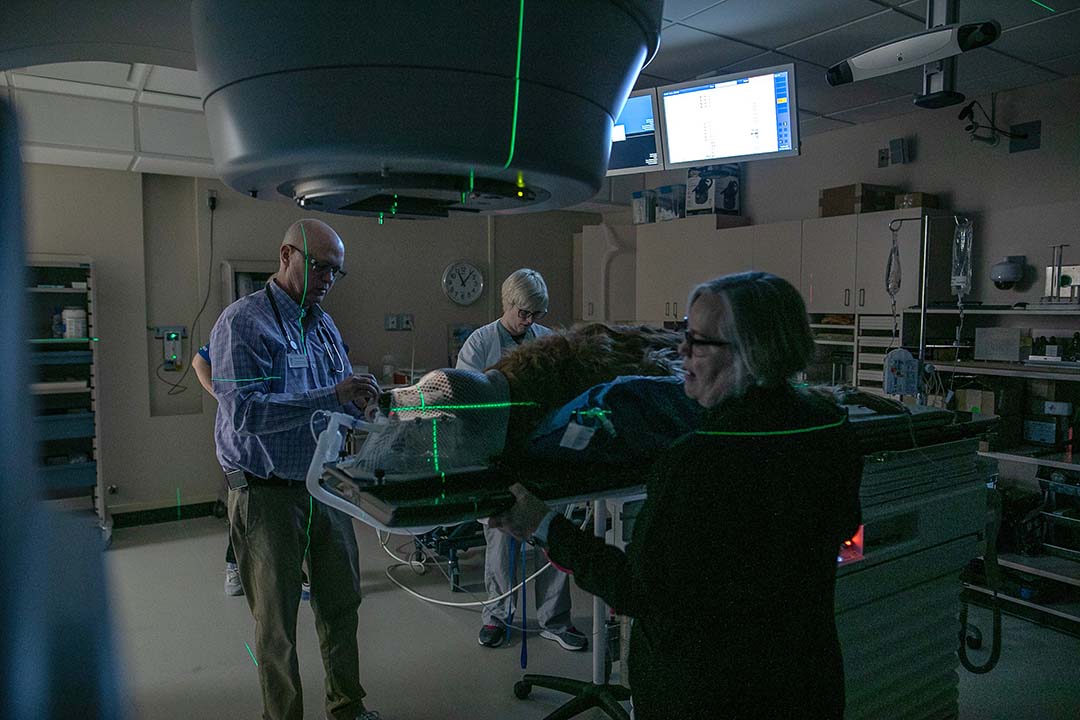
New radiation oncologist and equipment strengthen Veterinary Medical Centre
With a new radiation oncology specialist and a new linear accelerator in place, the Western College of Veterinary Medicine’s (WCVM) Veterinary Medical Centre (VMC) on the University of Saskatchewan (USask) campus has resumed offering a full range of veterinary oncology services—including radiation oncology—to its patients and their families.
By Caelan Beard, for WCVMThe new linear accelerator optimizes image-guided radiotherapy and provides high-speed radiation treatment for treating pets with cancer. The advanced technology was installed last August and became fully operational in late 2025. Another addition is the WCVM’s new magnetic resonance imaging (MRI) machine, which began operating in fall 2025.
With these machines in place, the VMC now offers a comprehensive range of veterinary oncology services to its patients and their families—including medical oncology, radiation oncology and surgery services.
To maximize the linear accelerator’s use for treating cancer patients at the veterinary teaching hospital, the VMC created a new clinical-focused role and hired Dr. Eric Walther (DVM), a board-certified specialist in veterinary radiation oncology. These resources are allowing the VMC to expand its oncology services for all western Canadian animal owners and veterinarians—working toward the goal of building the most advanced pet cancer therapy centre in the country.
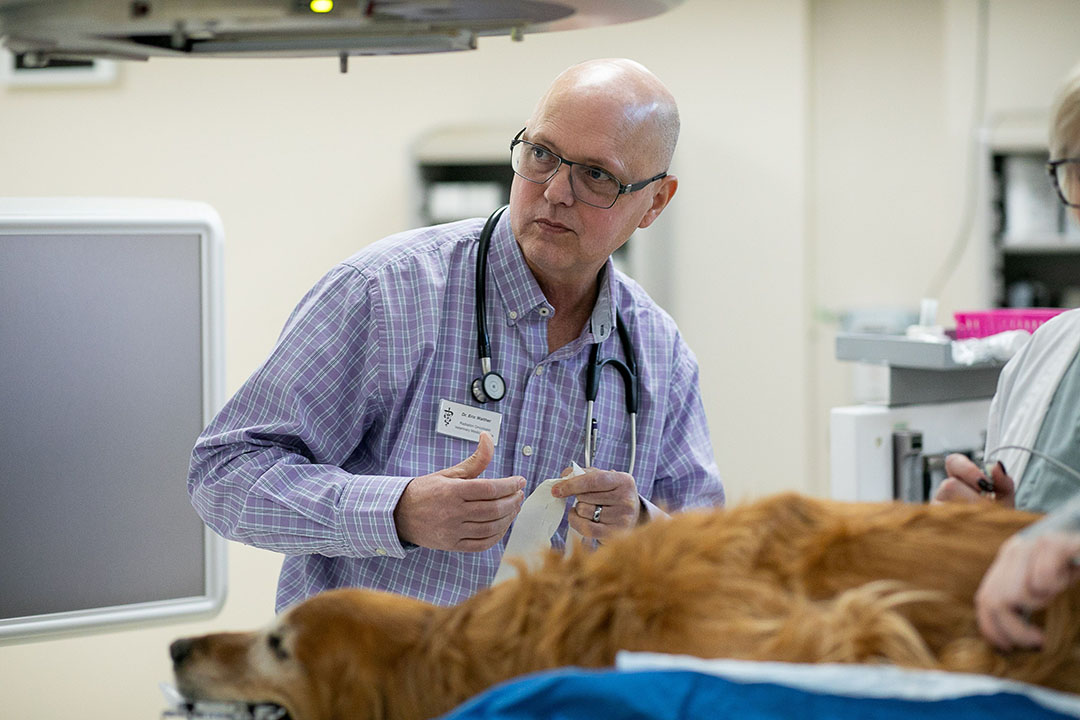
Veterinary care is a second career for Walther, who previously worked as a computer programmer for about 18 years. In 2014, he decided to return to his passion for veterinary medicine, earning his Doctor of Veterinary Medicine (DVM) at Oklahoma State University.
He remembers the first time he saw a veterinary radiation oncologist at work, treating a cat with a large tumour. After a few radiation treatments, the cat’s tumour began to quickly shrink.
“That fast response with radiation therapy treatments just made me think, ‘Wow, we can help pets really quickly with this form of treatment,’” said Walther, who was also intrigued by the computer skills and physics involved with radiation oncology.
Walther’s extensive training included a radiation oncology internship at Texas A&M University, followed by a combined Master of Science-radiation oncology residency at the WCVM. He went on to complete a two-year clinical residency at Arizona Veterinary Oncology in Gilbert, Ariz.
In December 2025, Walther drove the 2,800-kilometre trek between Arizona and Saskatchewan to begin his new role at the WCVM. After spending several years of his training at the veterinary college, Walther said he’s excited to be back and see so many familiar faces in the halls.
“It was like coming home,” he said.
He’s also excited to be working with the new, top-of-the-line linear accelerator that was purchased with significant financial support from the WCVM’s generous donors. The machine replaces the VMC’s original linear accelerator, which was permanently shut down in 2023 due to age-related mechanical issues.
“Most veterinary practices get second-hand machines from [human] hospitals when they don’t want them anymore,” said Walther. “This is exactly the same kind of machine that you would see in human hospitals. It is a really high-end treatment machine.”
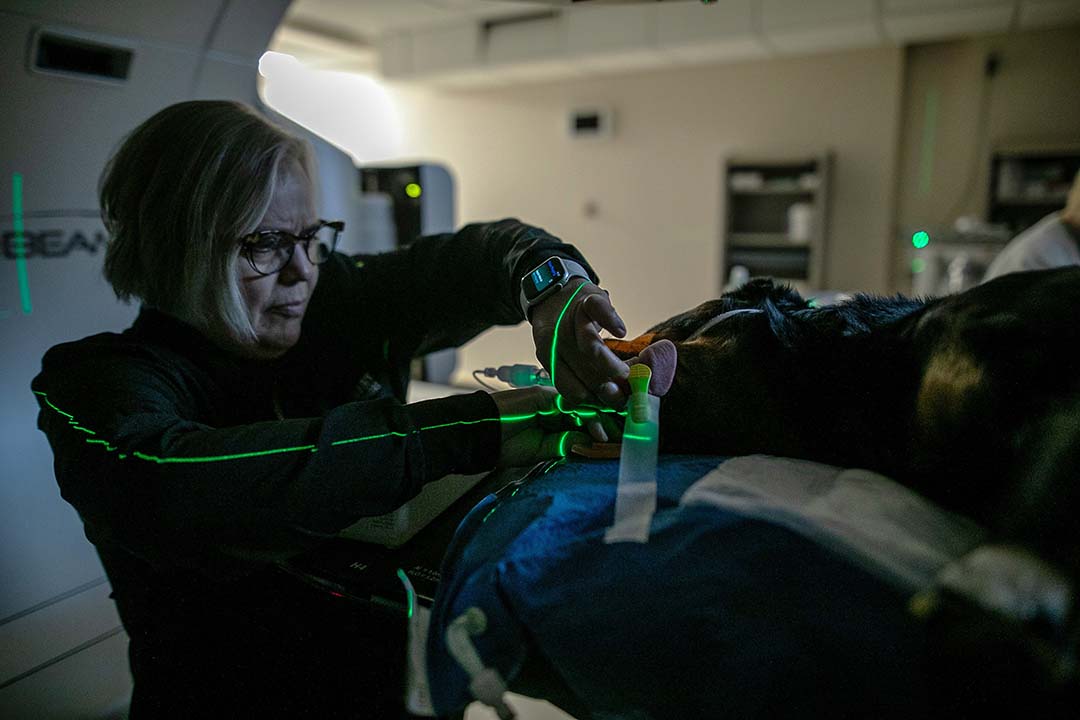
The WCVM now has two veterinary radiation oncologists on site. Dr. Monique Mayer (DVM), a longtime professor in the college’s Department of Small Animal Clinical Sciences, is leading collaborative radiation oncology research studies using the linear accelerator. She was also Walther’s supervisor during his graduate program.
The linear accelerator enables the VMC clinical team to conduct computerized radiation treatment planning. This capability means the machine’s radiation beams specifically target cancerous tumours well within an animal’s body while having minimal impact on the healthy tissue surrounding the tumour.
Walther said the VMC’s oncology team can offer both conventional radiation, which is given over several weeks, as well as stereotactic radiation, which can sometimes be done through one single treatment using the linear accelerator.
Most of all, Walther is excited to make a difference in the lives of animals coming to the VMC for specialized care.
“I am just really excited to get this service restarted and start treating patients,” he said. “We have the potential to really help a lot of dogs and cats and … exotic patients as well.”
When the VMC was forced to shut down its old linear accelerator several years ago, families of cancer patients had to travel to other medical centres in Calgary, Montana, Colorado and Ontario for radiation oncology services.
“Those [centres] are quite far away, so this will be really nice to be able to treat our patients from Saskatchewan and Manitoba and the rest of Western Canada,” said Karen Davis, a radiation therapist who operates the VMC’s linear accelerator.
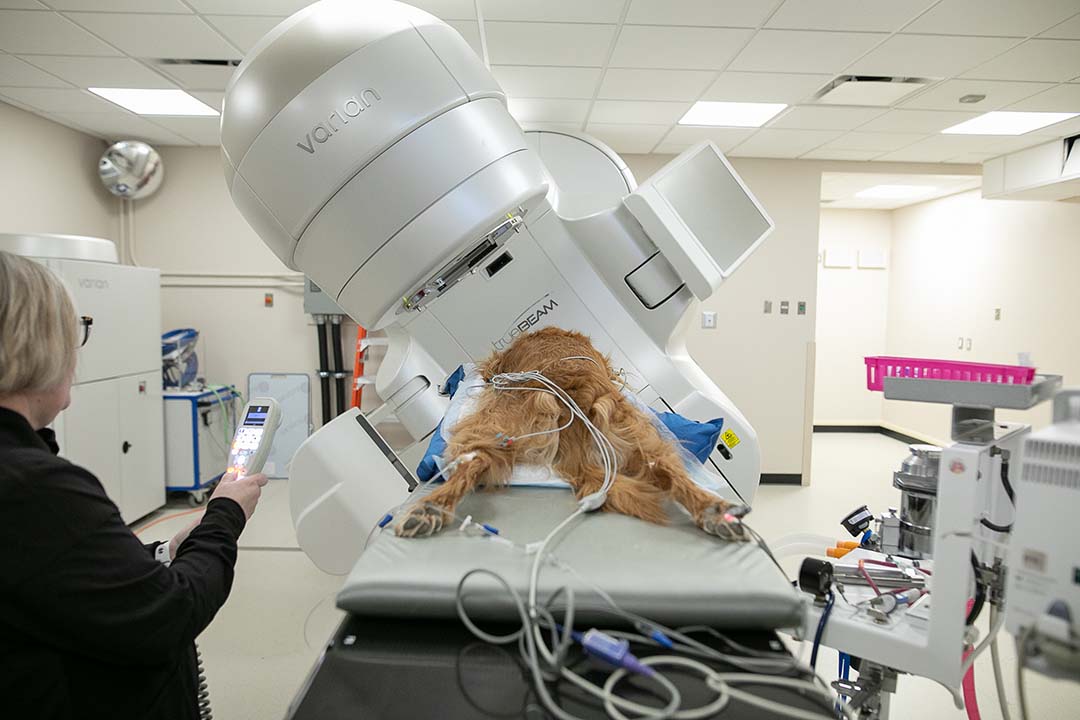
She added that the new machine will cut down the length of patients’ treatment times by about a third compared to the old linear accelerator, enabling the VMC to treat even more cancer patients per day.
Having a clinical-focused radiation oncologist on staff also allows the VMC to further maximize the availability of its radiation oncology services. While Walther will still mentor fourth-year veterinary students on clinical rotations, most of his time is focused on clinical care.
Referrals for the VMC’s radiation oncology services reopened in early December, and the new linear accelerator is fully operating.
“When I got here, there were a number of patients that needed radiation therapy treatment. There are a lot of types of tumours where radiation is really the only option that they have,” said Walther.
Walther looks forward to helping as many patients gain access to radiation treatments, which can extend the animals’ lives and give them more time with their families.
“And that’s really what it’s all about. It’s helping these pets have a good quality of life for just as long as we can.”