

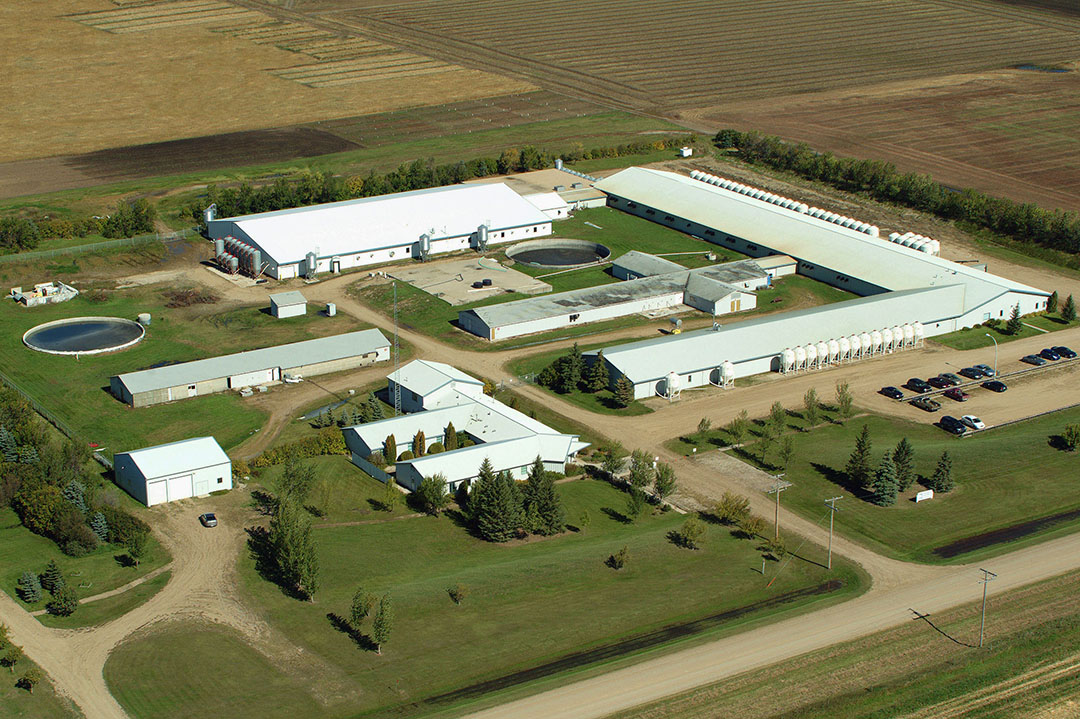
Prairie Swine Centre celebrates 35 years of driving innovation
This year marks a landmark milestone for the Prairie Swine Centre (PSC) as it celebrates its 35th anniversary since being formally established as a non-profit corporation in 1991.
By Prairie Swine CentreOver that time, the centre has evolved into one of Canada's premier swine research facilities, delivering practical, industry-focused research that strengthens the financial position of pork producers while advancing animal welfare and environmental sustainability across the Saskatchewan and Canadian pork industries.
A foundation built on industry partnership
The PSC story began in 1980 when the University of Saskatchewan (USask) built the facility for its swine research and teaching program. The original operation consisted of two 100-sow and one 50-sow farrow-to-wean units, a 240-head feeder barn, and a small office and service building. However, it was in 1991 that PSC transformed into the organization it is today.
In 1987, USask and the Saskatchewan Hog Marketing Commission partnered to review the centre’s operations. An advisory board including industry representatives from across Western Canada identified two critical needs: increased emphasis on grower-finisher research, and a closer collaboration with the commercial pork industry. This vision became reality in 1991 when the PSC was formed as a non-profit corporation with its own budget, management, Board of Directors, mandate, and expanded research facility.
The early financial commitment from Saskatchewan’s pork producers was critical to the establishment of the PSC. Support soon followed from the federal government (Western Economic Diversification Program) and the provincial government (Agricultural Development Fund), making the industry’s dream a reality.
World-class research focused on producer sustainability
Today, the PSC operates a highly productive 300-sow farrow-to-finish swine research facility. This includes a 300-sow unit that opened in 2008, which provided an opportunity to consolidate the original sow facilities and make the move to group sow housing.
The centre’s research programs continue to specialize in four core disciplines — nutrition, engineering, ethology, and contract research — over the years focusing on methods to increase the overall sustainability (economic, animal, environmental) of the Saskatchewan and Canadian pork industries. Whether focused on speaking directly to pork producers, the pork value chain, or the research community, the PSC’s research programs have remained relevant by addressing issues that are timely and matter to the pork industry.
The centre’s research continues to deliver measurable economic impact. Over the past 35 years, PSC research programs have contributed an average return on investment of more than $3.80 per pig per year to the Saskatchewan industry. CEO Dr. Murray Pettitt (PhD) estimated the annual value of research to Saskatchewan’s industry at $3.5 million, based on the province’s hog marketing numbers and a research adoption rate of approximately 40 to 50 percent.
A culture of applied science
A major reason the centre has remained relevant for 35 years is its multidisciplinary approach. Nutrition, engineering, ethology, contract research, and production economics all operate together, which allows the PSC to tackle complex problems that do not fit neatly into one discipline. That integrated approach is especially valuable in pork production, where performance, welfare, health, facilities, and economics are tightly linked.
The centre’s work has also adapted as the industry changes. In the early years, much of the focus was on production efficiency and cost control. As the years passed, research programs broadened to include welfare, transport, feed management, environment, energy efficiency and housing systems. The PSC helped lead discussions on group sow housing conversion, transport effects, nutritional strategies and other issues that were becoming increasingly important to producers and consumers alike.
Knowledge transfer strength
Knowledge transfer (KT) has been central to PSC’s identity since 1991. A truly unique idea 35 years ago, it is central to the centre’s mission and success. PSC recognized early on that delivering results to producers was just as important as generating them, which led to a dedicated KT program and a communications model built around print, personal and digital channels, as well as demonstrations. PSC’s publications, newsletters, website, producer events, and on-farm demonstrations are all part of a system designed to efficiently provide usable information in the hands of pork producers and the pork value chain.
Value to the University of Saskatchewan
For USask, the PSC represents a proud partnership demonstrating the institution’s commitment to applied agricultural research. The centre enhances the university’s reputation as a leader in swine research, providing hands-on research facilities for students and faculty, and attracts significant external research funding to the institution.
PSC’s collaborations with the College of Agriculture and Bioresources, Western College of Veterinary Medicine (WCVM), College of Engineering, College of Medicine, and the Vaccine and Infectious Disease Organization strengthens USask’s position as a center of excellence in practical, industry-relevant agricultural research and graduate student training.
PSC driving collaboration
The PSC’s long term funding support from provincial producer boards (Sask Pork, Manitoba Pork, Alberta Pork), government agencies (Saskatchewan Ministry of Agriculture, Agriculture Development Fund) and university partners (College of Agriculture and Bioresources, WCVM) are essential. It allows the centre to pursue long-term questions, hire talented people, and maintain the scientific capacity needed to address future challenges. These do not happen by accident; they are built through partnerships, persistence and a shared commitment to progress.
People have always been central to that progress. The centre’s history includes many scientists, staff members, students, and industry advisors who contributed to its growth. As the centre expanded, it became not only a research hub but a training environment where undergraduate and graduate students could learn how to connect science with commercial production. That human capital has been one of the centre’s significant contributions, ensuring that knowledge continues to flow into the industry through new generations of experts.
Looking forward: Sustaining excellence for the next 35 years
As the PSC enters its 35th year, the centre remains true to its founding mission: providing practical solutions to practical problems for the Canadian pork value chain. Core program funding received from Saskatchewan’s Agriculture Development Fund along with long-sustained base funding from Sask Pork, Alberta Pork, Manitoba Pork, and USask ensures the centre will continue its mission for the next 35 years. The centre’s ongoing relationships with USask’s colleges and research faculty will continue to provide the industry highly trained personnel and contribute to the university’s research programs.
The PSC’s success is centred around a simple key concept: organize research around the needs of the industry you serve, measure success in practical terms, keep close communication with the industry, and collaborate with USask. This unique place the PSC holds in the Canadian pork industry and research community has enabled PSC to significantly contribute to the success of all stakeholders.