

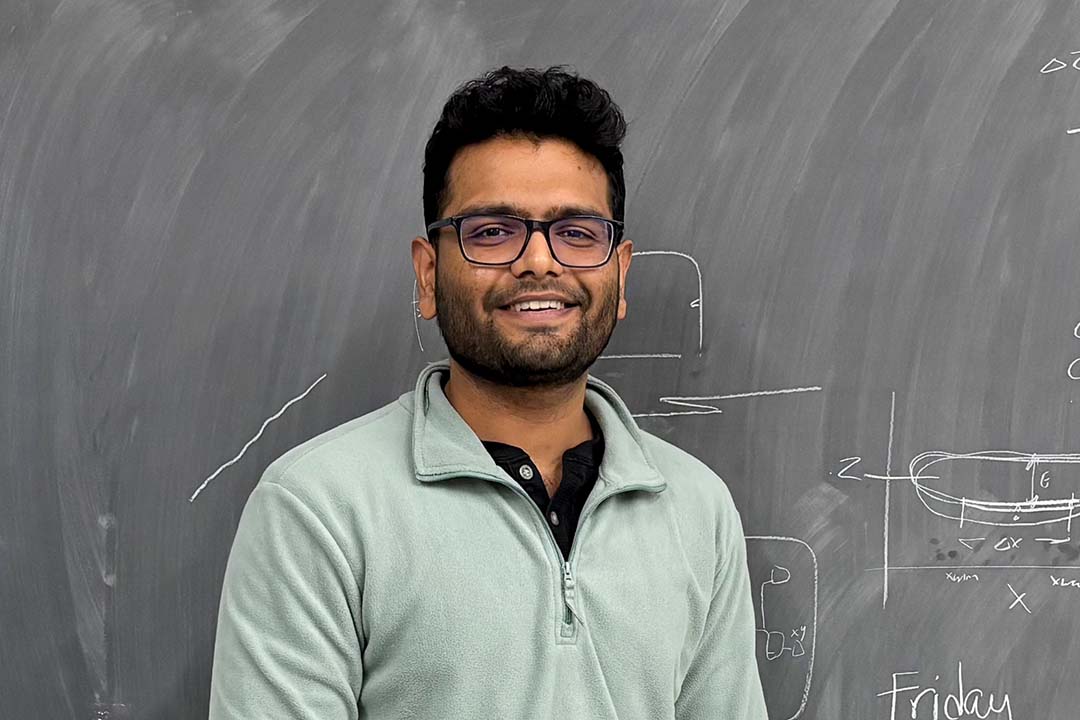
Young Innovators: USask researcher discovering frost-free heating solutions
When the polar vortex blankets Saskatchewan and temperatures drop to negative double digits, thermostats across the province are cranked to the max, putting natural gas furnaces into overdrive.
By Erin Matthews, Research Profile and ImpactWhile high efficiency furnaces may be better for the environment than their predecessors, they still burn fossil fuels and fall short of other technologies like air-source heat pumps (ASHPs). One graduate student at the University of Saskatchewan (USask) is working with his team to help develop ASHPs that can withstand the severe weather and low temperatures of even the harshest Canadian winters.
“Most buildings in Saskatchewan and over half of the buildings in Canada are heated by burning fuels like natural gas. Air source heat pumps are electric devices that can both heat and cool a home without burning fuel, which makes them cleaner, but they don’t hold up in cold weather due to a frosting problem that occurs when moisture freezes in the air between 6 degrees Celsius (C) and -15C To combat this our research team is developing frost-free ASHPs.” said Siddhartha Gollamudi, a PhD student in the College of Engineering.
Frost-free ASHPs would allow for a more reliable and efficient heating method in cold climates. Gollamudi is at the helm of the project’s computational programing. Using computational models, he has run countless scenarios to find ways to prevent heat pumps from freezing in cold weather. These heat pumps are using a liquid-to-air membrane energy exchanger (LAMEE) that was created at USask by Gollamudi’s supervisor Dr. Carey Simonson (PhD) and his team. Working closely with lab member and graduate student Amirreza Mahmoudi, Gollamudi helped illustrate that the system can operate in cold conditions while cutting emissions and saving money. This new frost-free system is known as a LAMEE Heat Pump (LAMEE-HP).
“I ran the newly developed LAMEE-HP system through all kinds of winter conditions on the computer to see what would keep it frost-free. And between a lot of long days and many wrong turns and more coffee breaks than I am willing to admit, I learned how to work with frost,” said Gollamudi.
Gollamudi says that his initial computational design and simulations show that LAMEE-HPs can successfully heat buildings without frosting even in Saskatchewan’s climate.
The team has filed two provisional patents on this new design.
“We saw on average a 50 percent increase in heating efficiency compared to the current ASHPs on the market,” said Gollamudi, “The new system can also humidify indoor spaces, keeping homes more comfortable during the winter.”
The simulation also showed a 10 to 35 percent reduction in annual energy use compared to a standard heat pump, which means both lower emissions and lower heating bills.
The HVAC research group at USask College of Engineering inspired Gollamudi to move to Saskatchewan to pursue his graduate work in heat and mass transfer. He wanted to understand why ASHPs adoption was limited in Canada and by exploring the challenges of winter conditions he was able to discover that these limitations are something that can be solved through careful engineering.
“The opportunity to work on rigorous applied research with clear relevance to real engineering challenges was the key reason I chose USask,” said Gollamudi. “And given the climate here in Saskatoon, I felt that it was an ideal place to work on heating systems for cold regions.”
After completing his PhD, Gollamudi plans to continue his work in heating and cooling technologies for buildings using the skills he gained at USask to improve the performance and efficiency of thermal energy systems. He says that continuously finding practical solutions that deliver measurable impact is what drives him forward.
“Seeing how technical decisions translate to real world results really drives my work. I am inspired by engineering that is both rigorous and ultimately useful beyond the lab,” said Gollamudi.