

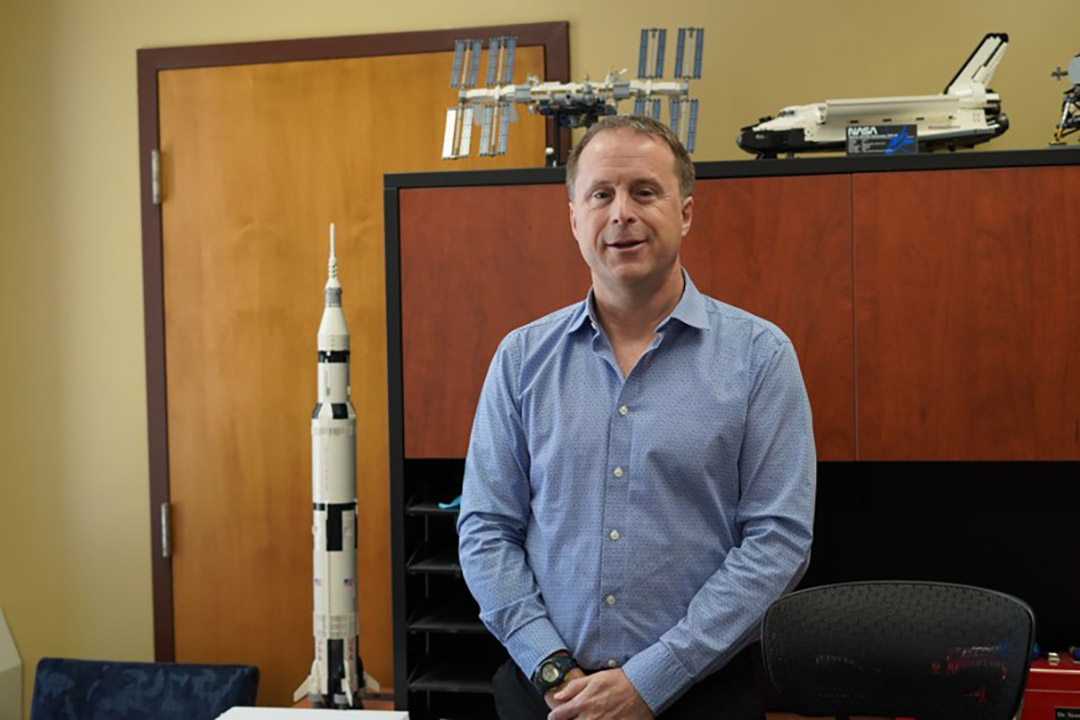
Signature Series research podcast: The physics of curling with Dr. Sean Maw
Why does a curling rock curl?
By Matt Olson, Research Profile and ImpactIf you’re unfamiliar with the sport of curling, it’s fairly straightforward: two teams slide granite rocks from one end of a sheet of ice to the other, trying to get as many of their rocks closest to the centre of the rings on each end as possible. And true to its name, the rocks are rotated so they “curl” across the sheet and around other rocks.
Curling is also one of Canada’s biggest sports. Canada is the world leader in curling gold medals and overall medals in the Olympics, and the vast majority of the world’s curlers are from Canada.
Though curling might look like a simple game, there is a slew of science and engineering that goes into understanding how the sport works. Dr. Sean Maw (PhD), an associate professor with the University of Saskatchewan (USask) College of Engineering in the Ron and Jane Graham School of Professional Development and the Jerry G. Huff Chair in Innovative Teaching, is an expert in winter sliding sports.
Maw’s research explores the complexities of curling—how the rocks move across the ice, the effects of sweeping a rock and so much more—in an effort to better understand and expand our knowledge of this nationally and internationally celebrated game.
On this episode of the USask Signature Series podcast, we answer the question “How does a curling rock curl?”
Listen to the episode to learn more!