

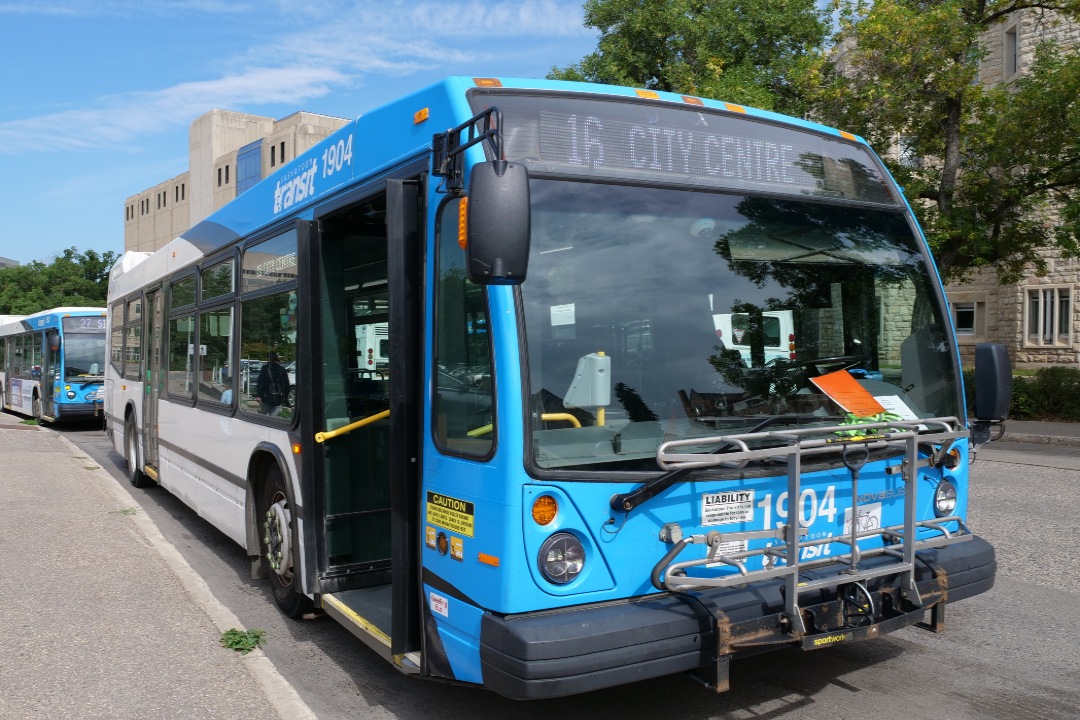
USask researcher explores health benefits of public transit
Can your daily commute positively impact your health?
By Matt Olson, Research Profile and ImpactA research project co-led by the University of Saskatchewan (USask) aims to determine how using public transit affects our physical and mental health, with findings that could potentially change how cities plan and implement transit systems.
"We're trying to learn how new urban things in our environment influence people's physical activity, their social connectedness, and their well-being," said Dr. Daniel Fuller (PhD), associate professor in the Department of Community Health and Epidemiology in USask's College of Medicine. "Public transit is not a health system idea, it's a public transportation intervention ... that could have health impacts."
Fuller is the lead investigator on a research project evaluating the health impacts of Saskatoon’s bus system. He said there is already evidence to suggest taking the bus can increase the overall physical activity of a community, and that adding just five minutes of physical activity a day for those who are rarely active – such as walking to and from the bus – can have significant impacts on the health of the community when it comes to factors such as heart disease.
While there is some previous research into the impacts on physical activity, there is less evidence regarding how public transit influences a person's social and mental health. Through the use of surveys and an app to collect data from Saskatoon transit riders over the higher-traffic public transit period of September through to the end of the calendar year, the research team hopes to gain an understanding of how the simple actions of interacting with others in the community through taking the bus might improve people’s wellbeing and feeling of connectedness with their community and city.
By collecting data before and after the implementation of the new Link bus rapid transit system, Fuller and his team will gain data-driven insights into the health and wellbeing benefits of the new system.
"We collect data every two years at the same time of year, and we can account for weather and seasonal things," said Fuller. "You're trying to capture regular transit and commuting behaviour, not during the slow seasons."
The study is part of the cross-Canadian INTerventions, Equity, Research, and Action in Cities Team (INTERACT) initiative. INTERACT is a cross-Canadian network of researchers, community partners and city officials who are involved in studying the design and impacts of healthy cities. The INTERACT program and this research project received support from a Canadian Institutes of Health Research (CIHR) Project Grant, which will support the project for years to come and allow Fuller's team to collect data for a period of time after the Link system begins.
While the data collection for this project will take multiple years, Fuller said one of the team's ultimate goals is to create a tool for municipalities to use to objectively measure the long-term public health outcomes of city-led projects like these.
“One of our main goals is building this tool where anyone can use it and be able to answer the question, what's the benefit of this in five years or 10 years?" said Fuller.
Fuller has been part of the INTERACT group since its inception more than a decade ago. The initial project aimed to study transit in four Canadian cities: Saskatoon, Victoria, Vancouver, and Montreal.
With the new funding from CIHR, Fuller said the project will expand its scope in Saskatoon and add Ottawa as one of the cities being studied by INTERACT.
Fuller lauded the interdisciplinary nature of the research team, and the support they had received from CIHR and USask's College of Medicine. With researchers from the College of Medicine, College of Kinesiology, the Departments of Computer Science and Geography and Planning in the College of Arts and Science, and more, the project draws on expertise across USask to have an impact on the local community.
The following USask projects also received CIHR funding in this most recent round of Project Grants:
- Arinjay Banerjee (PhD), Vaccine and Infectious Disease Organization (VIDO) - An interdisciplinary and collaborative One Health approach to investigate coronavirus infection, persistence, shedding, and antiviral immunity using wild-caught and captive bat models in the Americas.
- Heather Foulds (PhD), College of Kinesiology (one-year Bridge Funding) - neemiwin peekishkwaywin awn Michif: Dancing and speaking in Michif.
- Robert Laprairie (PhD), College of Pharmacy and Nutrition - Advancing CB1R cannabinoid receptor positive allosteric modulators for novel therapies in temporal lobe epilepsy.
- Stacey Lovo (PhD), School of Rehabilitation Science - A First Nation and Métis community-directed approach to culturally responsive virtual rehabilitation for hip and knee total joint replacements.
- Bryce Warner (PhD), VIDO - Studies into improved broadly reactive and protective vaccination strategies for high consequence Bunyaviruses.