

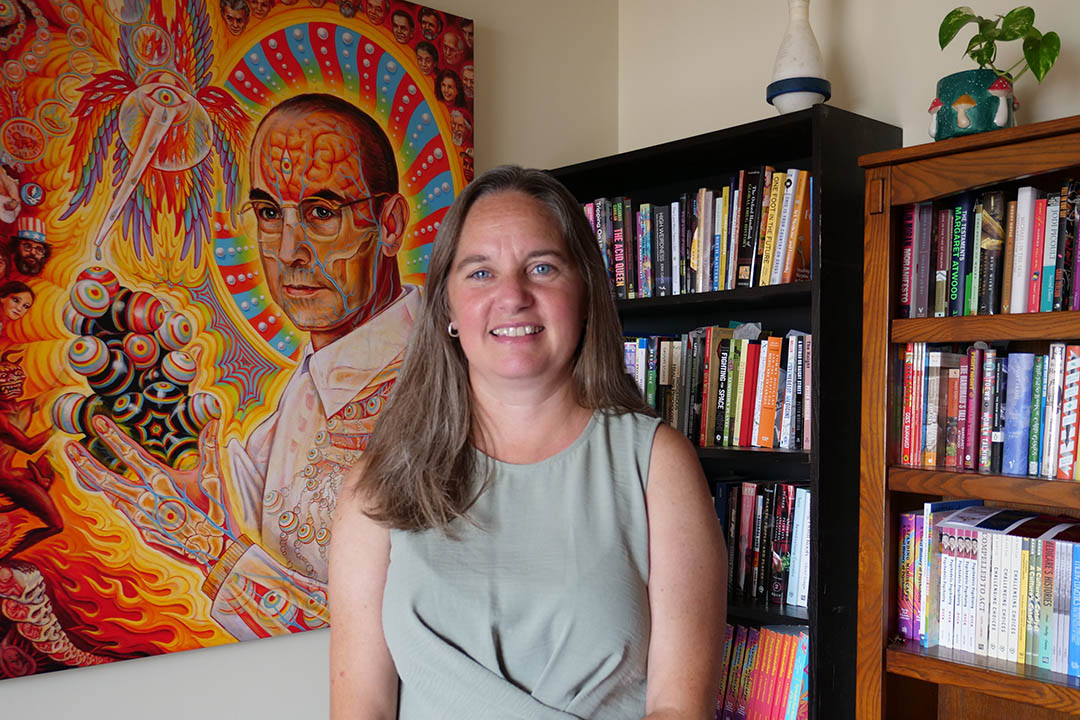
USask researcher maps cultural landscape of psychedelics
What do you think of when you think of psychedelics?
By Erin Matthews, Research Profile and ImpactOur minds might conjure up a kaleidoscope of images. Maybe you think of music festivals like Woodstock. Or posters with neon colours swirling and melting into new shapes. Or maybe you think of a medical facility with doctors administering medication that can help ease anxiety and depression.
Dr. Erika Dyck (PhD) of the University of Saskatchewan (USask) has been studying the history of psychedelics for more than two decades and has seen conversations around the drugs morph over the years.
“The current story is driven by clinical experimentation and medical applications of psychedelics but as a historian working in this space, there are all sorts of other ways that people come to know psychedelics, and the cultural aspects are definitely contributing to shaping what we know about them but also what we fear about them,” said Dyck, a professor in the Department of History in the College of Arts and Science and Canada Research Chair in the History of Health and Social Justice.
With 25 years of expertise in the field, Dyck is exploring the cultural landscape of psychedelics with a new project funded by the Social Science and Humanities Research Council (SSHRC) that focuses on a unique facet of this landscape — psychedelic festivals.
Focusing on two case studies, Dyck and her colleagues will travel to two legal festival sites, one in Europe and one in Canada, to study both the risk-taking behaviours and harm reduction behaviours — which aim to reduce the negative effect of drugs — of festival attendees and volunteers.
“When people go to these festivals there is an expectation that they are taking psychedelics recreationally and that is something different from what we expect in a clinical space where you are using psychedelics to treat pathological conditions,” said Dyck. “We want to see what we can learn from these recreational spaces, about how people are engaging in psychedelic use but may be doing so in a harm-reducing way.”
Dyck said that psychedelics in festival spaces have a lot of lore surrounding them within popular culture, but historically these environments foster a sense of community, with harm reduction being implemented by festival organizers and festival goers.
According to Dyck, the archival record from festivals like Woodstock and bands like the Grateful Dead, shows that harm reduction behaviours have been a part of festival organizational efforts for a long time. For example, at concerts, spotters were often implemented to scan the crowd and assist anyone who looked distressed or dehydrated. Dyck’s project looks to expand this archival record by collecting contemporary oral histories and interviews with festival goers and volunteers like nurses who have worked in recreational harm reduction.
“We find that in the current conversation on psychedelics leaves out a lot of people and so we want to create this archival collection that allows us to accumulate evidence drawn from these festival spaces to show that recreational users have something to offer in a conversation about risk and benefits,” said Dyck.
Dyck believes that the social sciences and humanities have a lot to offer when it comes to the questions around harm reduction and how clinical research gets translated into communities and socials settings.
“It's really exciting to see SSHRC supporting this kind of project where we can really make a difference using these kinds of methods to contribute to a more sustainable drug literacy in Canada,” said Dyck.