

USask signs MOU for community, environmental, sustainability research and education
The University of Saskatchewan (USask) is home to world-leading environmental and sustainability research, and the formalizing of an exciting partnership in Saskatchewan will help grow that work in the province and around the world.
By Matt Olson, Research Profile and ImpactUSask and the Redberry Lake Biosphere Region (RLBR) have signed a Memorandum of Understanding (MOU) to promote research and education initiatives at the only United Nations Educational, Scientific and Cultural Organization (UNESCO)-designated biosphere region in Saskatchewan.
The UNESCO designation means the region is considered a “living laboratory” for bringing communities and ecosystems together to jointly explore ideas of both conservation and sustainable development.
“Having an MOU with an important community partner such as the UNESCO biosphere region at Redberry Lake helps support transdisciplinary research, builds community outreach, and conserves the unique ecosystems found in our local places and spaces,” said Dr. Dawn Wallin (PhD), USask associate vice-president research (engagement).
USask has long had a history with the RLBR, with researchers from across campus visiting the site for research projects ranging from tracking migratory bird health to environmental and sustainability impact assessments for the region.
Established in 2000, the RLBR is an important ecological hub in Saskatchewan. It is home to a large saltwater lake, a conservation site for numerous bird species and diverse ecosystems of plant and wildlife.
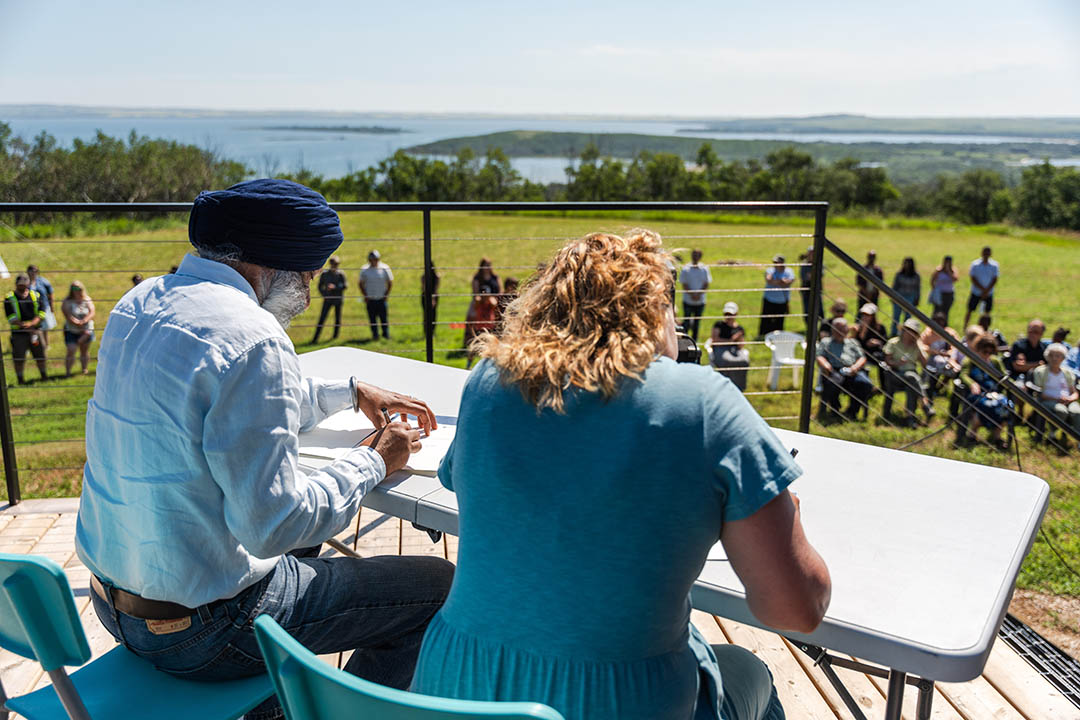
The MOU, signed on July 18 by RLBR board chair Jody Coller, and USask Vice-President Research Baljit Singh, formalizes a connection between RLBR and USask, with linkages to the surrounding community that has existed for many years already.
Terry Gagne, the executive director of the RLBR, said the support of USask — from faculty and students to the administration — was critical to the continued success of the region.
“We’ve always had a close relationship with the university, but it means a lot for us to solidify this partnership,” Gagne said. “We’ve had so many research projects done here through USask, and we’re excited to see more.”
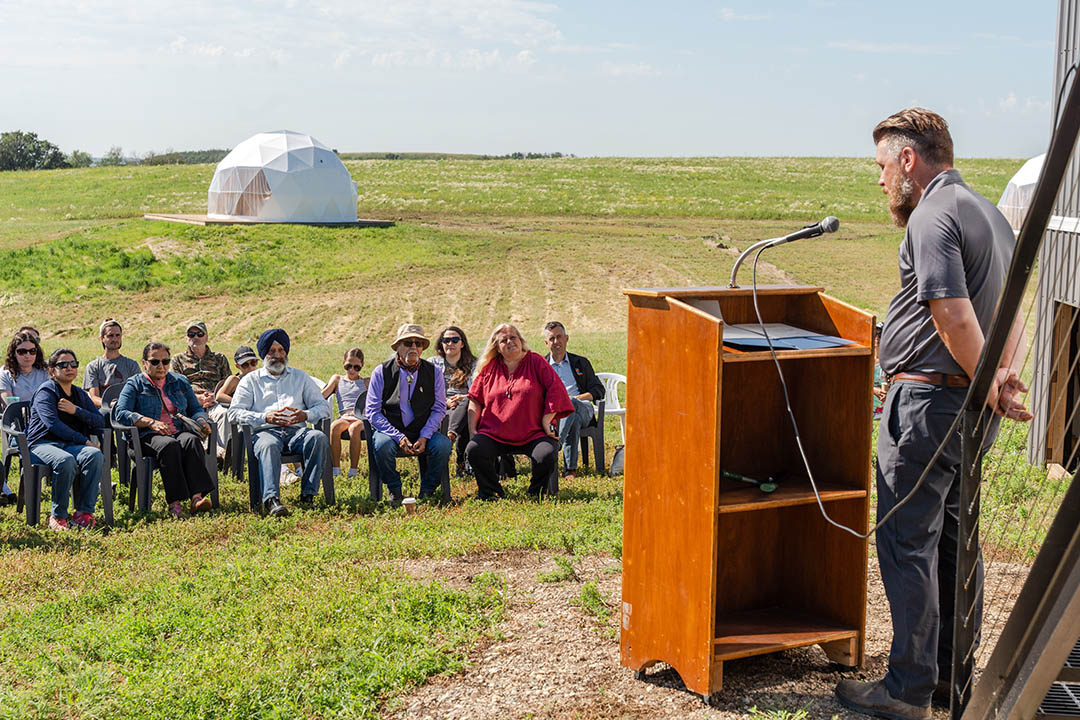
The MOU signing also heralded the opening of the new RLBR Interpretive Site and Research Centre in the RLBR’s 26th year. The new centre will include resources for visitors to come and learn more about the site, as well as facilities for researchers.
Included in the new facilities are dormitory rooms for visiting researchers, an upgraded bird-banding centre for monitoring and tracking various bird species, and geodesic domes to house research and educational initiatives in the biosphere region.
Gagne lauded the hard work of RLBR and USask staff who have helped get the biosphere region to this point, including founder and original executive director John Kindrachuk, who led the RLBR for the first 25 years before Gagne took over last year.
As Gagne puts it, the RLBR is excited to recognize the past successes of the RLBR while the new interpretive centre and MOU with USask positions it more strongly in the community for years to come.
“The site is meant to be a living demonstration of what is possible when you bring nature and people together where we can coexist,” Gagne said. “I want to bring school groups out here to see what USask students and researchers are doing ... to see what’s possible and inspire them.”
Much of the research conducted by university faculty at the RLBR is supported by the Shyluk Nature’s Health Fund, which specifically supports research and teaching projects focused in and on the ecosystems in the Krydor-Redberry Lake regions of the province. The fund was established with support from former Saskatchewan resident and researcher Dr. Walter Shyluk (PhD).
Nearby community members have helped shape the research initiatives that take place at the RLBR, and Wallin said building those relationships was vital for USask’s continued research and educational successes.
Wallin said she was “very proud” for USask to connect with the RLBR more deeply during a time of growth for the region and emphasized the importance of community-led research taking place here in Saskatchewan.
She noted that working with a UNESCO-designated biosphere region not only gives USask faculty and students unique opportunities in their work but also positions local USask research to have global impacts.
“Sometimes we aren’t recognizing the power we have to change community, change the world by working with our community partners,” Wallin said. “This is how we live that local-to-global ideal.”