

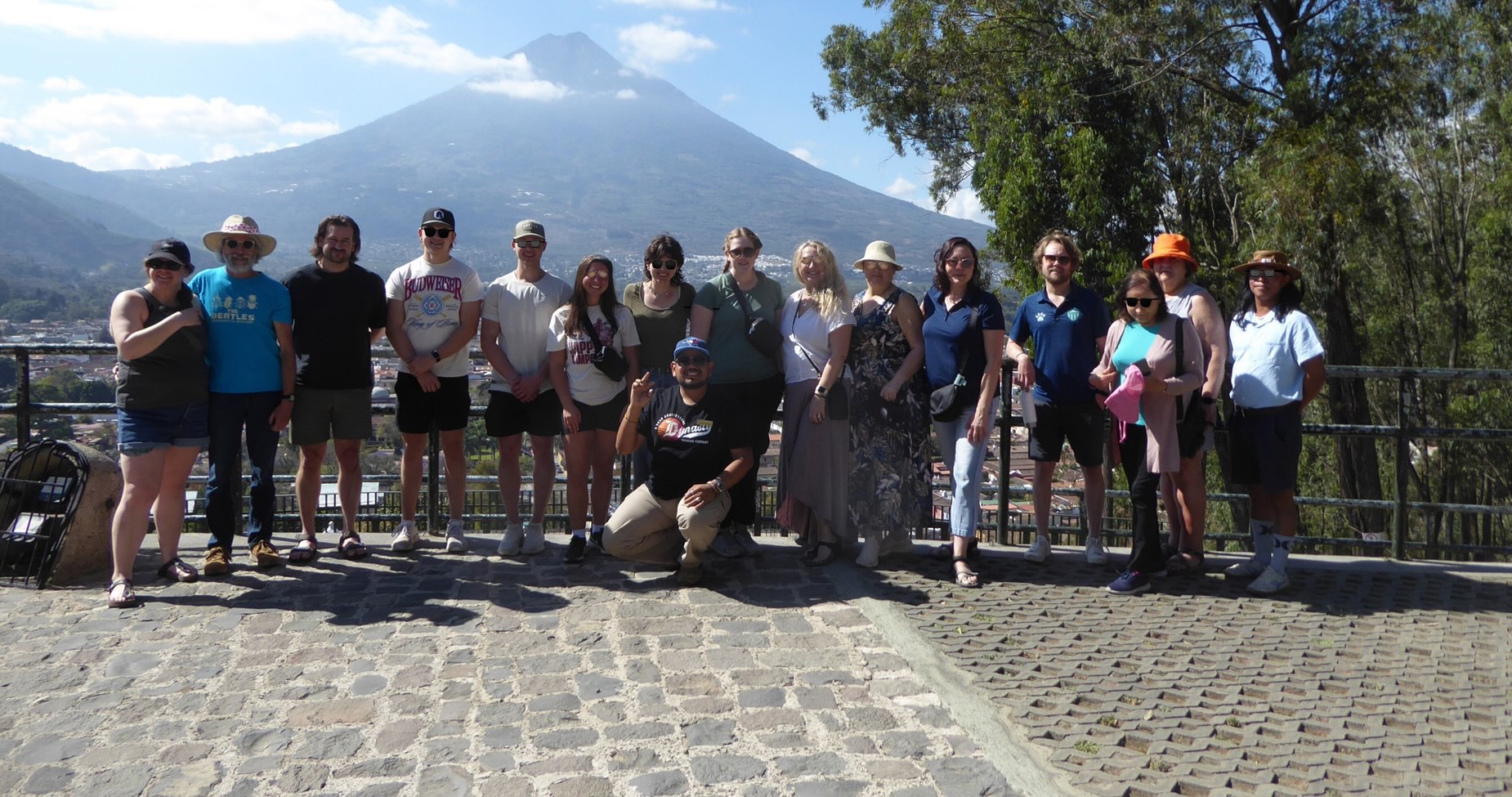
Education and Agriculture collaborate for interdisciplinary study abroad course
Students and faculty from the College of Education and College of Agriculture and Bioresources visited Guatemala in February 2026 to learn about the history of colonialism, its impact on the environment, and agriculture.
By Connor JayThe 10-day study abroad program explored how agricultural practices, crops, culture, politics, land tenure, and environmental sustainability intersect in North and Central American contexts.
Both with a passion and understanding of the benefits of experiential learning, Dr. Luke Heidebrecht (PhD), assistant professor in Educational Foundations and Dr. Randy Kutcher (PhD), professor in Agriculture, combined their respective undergraduate and graduate students to travel to Central America in what was USask’s first interdisciplinary approach to study abroad.
The opportunity to coordinate a joint course was established through Dr. Geraldine Balzer (PhD), associate professor, Curriculum Studies, and Megan Fillatre, Graduate Programs and Internationalization Specialist long-term connections with community partners in Guatemala.
Heidebrecht’s educational foundations course investigated the political, cultural, and ecological dimensions of citizenship education while Kutcher’s plant science course introduced the agricultural, cultural, and ecological dimensions of the region.
“This course was designed with the intention of creating opportunities for graduate students to weave together what they learn in Guatemala with their existing research questions,” Heidebrecht said. “Participating in a real-world classroom facilitates a different kind of learning that invites one to consider reciprocity. There are many more layers to consider and when students encounter culture, history, and parallel experience in another context it provides a new perspective on old, or existing, questions and wonders.”
As someone who has had the experience of travelling and working abroad, Kutcher understands the unique benefits of study abroad courses. However, this was the first time he had organized a course with both undergraduate and graduate students, which provided both the opportunity to learn through expanded lenses.
“We were really excited to plan the courses together,” Kutcher said. “The Education graduate students had a lot more life experience than many of the Agriculture and Bioresource undergraduate students. It was a good mix oflearning between both the people of Guatemala as well as each other.”
Nadia Maqbool, a PhD candidate in the Department of Educational Administration, has been researching reconciliation between immigrants, particularly first-generation immigrants and Indigenous Peoples of Canada. When the opportunity to learn about reconciliation beyond a North American lens was presented, she and her supervisor agreed the course would enhance her studies.
“I had already completed my data collection before going to Guatemala, but the experiential learning provided deeper analysis,” Maqbool said. “I presented at a few conferences across Canada and was able to bring in discussion and other perspectives that engaged the audience.”
For third-year Agriculture and Bioresource student Jaina Moebis, she knew she couldn’t pass up this study abroad course. Already interested in learning about international economies, climates, cultures, and production, she could easily relate her studies to course outcomes.
“This type of class is a once-in-a-university career experience,” Moebis said. “After attending the information seminar, I just thought there was no better time than the present to broaden my understanding of global agriculture. The course expanded my knowledge of agriculture and introduced me to people and places that I really wouldn't have experienced otherwise.”
The study abroad course was recognized with a Regional Centres of Expertise (RCE) Saskatchewan award in May for its efforts in fostering cross-cultural understanding and community engagement through experiential learning. RCE Saskatchewan awards celebrate achievement in education for the United Nation’s 17 Sustainable Development Goals (SDG).
A primary goal of the course was to advance sustainability by linking global and local approaches to environmental stewardship and integrating Indigenous and local knowledges into educational and agricultural practices.
“Sustainability is at the heart of this experience,” Heidebrecht said. “We are attempting to build something that is sustainable when we are collaborating, seeking out interdisciplinarity, and taking the risk of engaging with complexity because the world isn't siloed. I loved seeing the intergenerational and cross-disciplinary dynamic play out between our respective students as they moved outside of their typical ways of seeing and considered different perspective, not only through the shift in context, but because of their newfound peers.”
Kutcher notes that, while the geographical and socioeconomic situations may look different between Canada (Saskatchewan) and Guatemala, there are many similarities between them and that sustainability is a core challenge both nations face.
“Guatemalan farming systems and environments are quite different than Canadian,” Kutcher said. “But the concerns such as how to maintain production with less inputs and reduced impact on the environment are similar.” “The benefit of collaborating with our Education colleagues was that we were invited into a more holistic view of agricultural production in Guatemala and how it impacts society.”
With both colleges planning to offer more study abroad courses for students, Maqbool encourages anyone considering the opportunity to learn as much as they can about the region prior to travel.
“If you have prior knowledge coming into the course,you are going to deepen your experiential learning and be able to make lots of connections,” Maqbool said.
Moebis agrees that experiential learning cannot be replicated in a textbook or through lecture. As she reflected on the course, the feeling and lessons are what will be remembered most.
“Not only did we learn about agriculture, but we also had experiences with the people and places in Guatemala,” Moebis said. “Being there and being present helped me become a more well-rounded individual.”
Article re-posted on .
View original article.