

Graduating USask student excited to educate future generations
Kaitlin Proudfoot is reflecting on her time at the University of Saskatchewan (USask) as she prepares to begin her teaching career.
By Connor JayAfter moving from Scotland to Brandon, Man., at age five, Proudfoot discovered her love of learning and caring for others through positive role models and formative experiences.
Accepting an offer to study at the College of Education brought her to Saskatoon, where she made the most of her undergraduate experience. Alongside her studies, she held several roles on the Education Student Society (ESS) executive, including president, advocating for students and building community through social and professional development events.
What was your favourite memory from your time at USask?
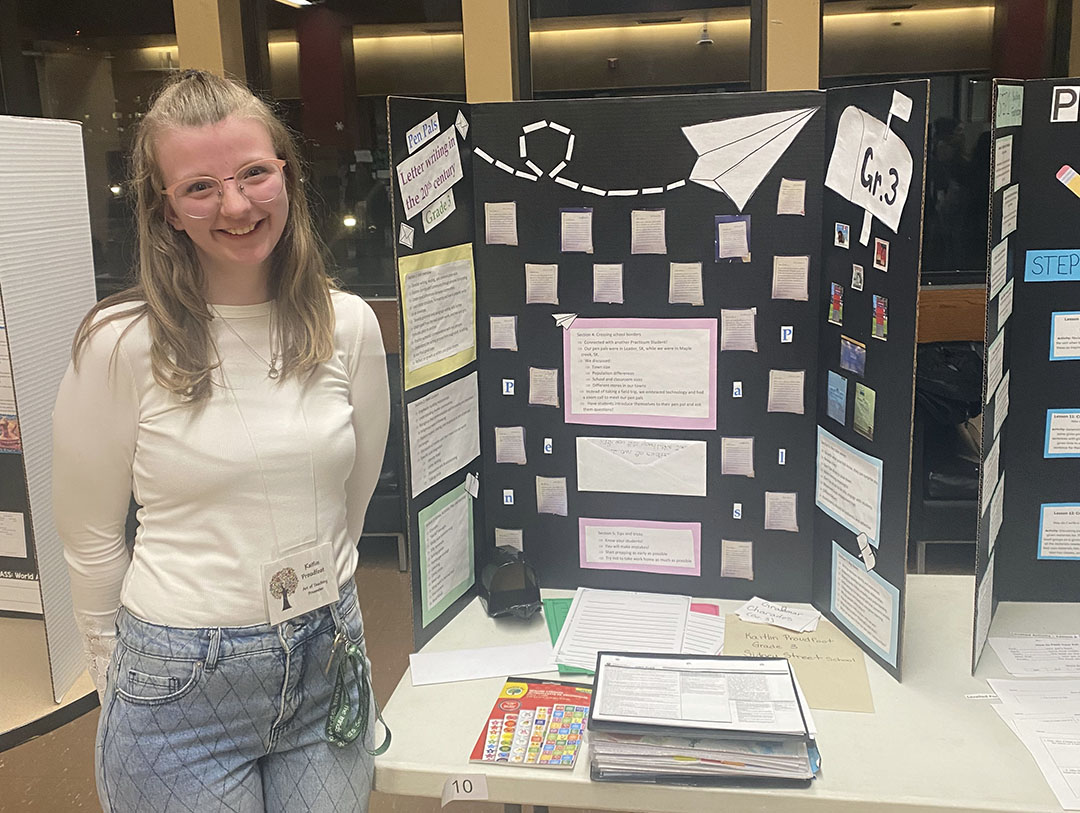
My extended practicum stands out because it was the culmination of everything I learned and did in the college. I learned, struggled and grew a lot, and I will never forget the students I taught during my practicum at Sidney Street School in Maple Creek, Sask. The staff were very supportive as I entered the community. I had a lot of independence and experienced what it was like to be the main teacher in a classroom, while still receiving guidance from my co-operating teacher.
Another highlight was joining the ESS in my first year. It was intimidating to put myself out there, but it became one of the best experiences of my university career. I connected with teachers, professors, the dean, peers and staff who make the college what it is. Being involved with like-minded students who want to advocate, support each other and create opportunities beyond academics was special. One memorable experience was travelling to Edmonton for the annual hockey trip, where we met members of the Edmonton Oilers and went on the ice. It was a once-in-a-lifetime experience.
What are your teaching areas?
I’m in the elementary early years program, with teaching areas in English and social sciences. I also focus on psychology because I’m passionate about mental health and educational psychology. My extended practicum was in a Grade 3 classroom in Maple Creek, which was very different from my earlier placements in kindergarten and Grade 1.
I enjoy the energy of younger grades, so teaching Grade 3 required some adjustment. The students were more independent and the classroom was quieter, which was a change. But I really enjoyed teaching Grade 3. They’re at an age where they are excited to be at school while becoming more independent. Watching their growth over four months was very rewarding.
Who inspired you to pursue an education degree?
My parents have always been supportive of anything I wanted to pursue. I started babysitting at 12, then taught dance classes, and I quickly realized how much I love working with children. I also worked at summer camps in high school, which reinforced that passion.
What really solidified my decision was my Grade 12 teacher, Ms. Devlin. She was incredibly supportive and a strong advocate for mental health. She was the first person to notice when I was struggling and helped me find support. That played a significant role in where I am today. Seeing the impact a teacher can have made me want to be someone who notices when students need support and helps them feel they belong.
Everyone deserves to feel included in education, regardless of who they are or any diagnoses they may have. Ms. Devlin continues to check in with former students, and she’s the kind of teacher I aspire to be.
What ESS accomplishment are you most proud of?
The ESS faced challenges after the pandemic. In my first two years, we had a small council, with some members away on practicum. I’m proud that we rebuilt to a full council in my final two years and increased awareness of who we are and what we do. Having a stronger presence at orientation, college events, and through extended office hours helped students see ESS as a support system.
As president, I focused on student advocacy and ensuring student voices were heard. I wanted students to know we could communicate their concerns to faculty and staff. I had the opportunity to meet with Dean Dr. Julia Paulson (PhD) and Associate Dean Dr. Shaun Murphy (PhD). It was encouraging to see how seriously student concerns are taken. I was able to help bridge communication between students and leadership, and I hope that continues. It’s important for faculty to hear directly from students about what is and isn’t working.
What would you tell future education students?
My biggest takeaway is to enjoy your time in the college. It’s easy to get caught up in assignments, grades and studying, which are important. But it’s also important to take time to appreciate the experience because it goes by quickly, especially in the final years. I was very involved, but I would still encourage students to take time to breathe and enjoy their university experience.