


USask graduate thrives in Food Industry Management degree
Joyeta Das Gupta combines food science and agribusiness for success in multidisciplinary program.
By Brett Makulowich“The Food Industry Management degree stood out to me because it felt like it could open many doors for my future,” said Joyeta Das Gupta. “I was looking for a multidisciplinary program that could lead to different job opportunities.”
Gupta will officially receive her Bachelor of Science in Food Industry Management at the University of Saskatchewan’s (USask) Spring Convocation on June 3.
The BSc in Food Industry Management is offered by the USask College of Agriculture and Bioresources (AgBio). This degree meets the industry demand for graduates with interdisciplinary training in food science, agribusiness, and marketing. Students learn advanced knowledge of food science, agri-food economics, food management practices, and food industry policy to prepare them for jobs in the booming agri-food sector.
As an international student from Sreemangal, Sylhet, Bangladesh, Gupta started her USask education in a different college. She transferred to AgBio in her second year.
“I chose to study Food Industry Management because I saw that it combined food science and agribusiness,” said Gupta. “You learn how the agri-food sector works from raw materials all the way to the final product. That is what makes this degree so valuable. It gives you a broad understanding of the industry and prepares you for a variety of jobs.”
Gupta benefited not only academically, but also socially when she transferred to AgBio.
“I truly loved being part of the College of Agriculture and Bioresources,” said Gupta. “As an international student, I was lonely in my first year of university. In Bangladesh I was used to being surrounded by a big group of friends, so the change was hard. But after coming to AgBio, I met some really good friends and amazing professors. I felt like my presence mattered in the college. Even now, as I’m about to graduate, I don’t feel like I went unnoticed. I feel like I was seen, supported, and valued.”
Gupta made time to give back to the USask community as a volunteer at the University of Saskatchewan Students’ Union (USSU) Food Centre and events such as Open House and the Career Fair. She also excelled academically and received 11 scholarships and two bursaries as a USask student.
Gupta credits the hands-on lab experiences she received in her USask courses to connecting what she was learning to the food industry.
“It helped me during job interviews because I could talk about lab experience that was directly relevant,” she said.
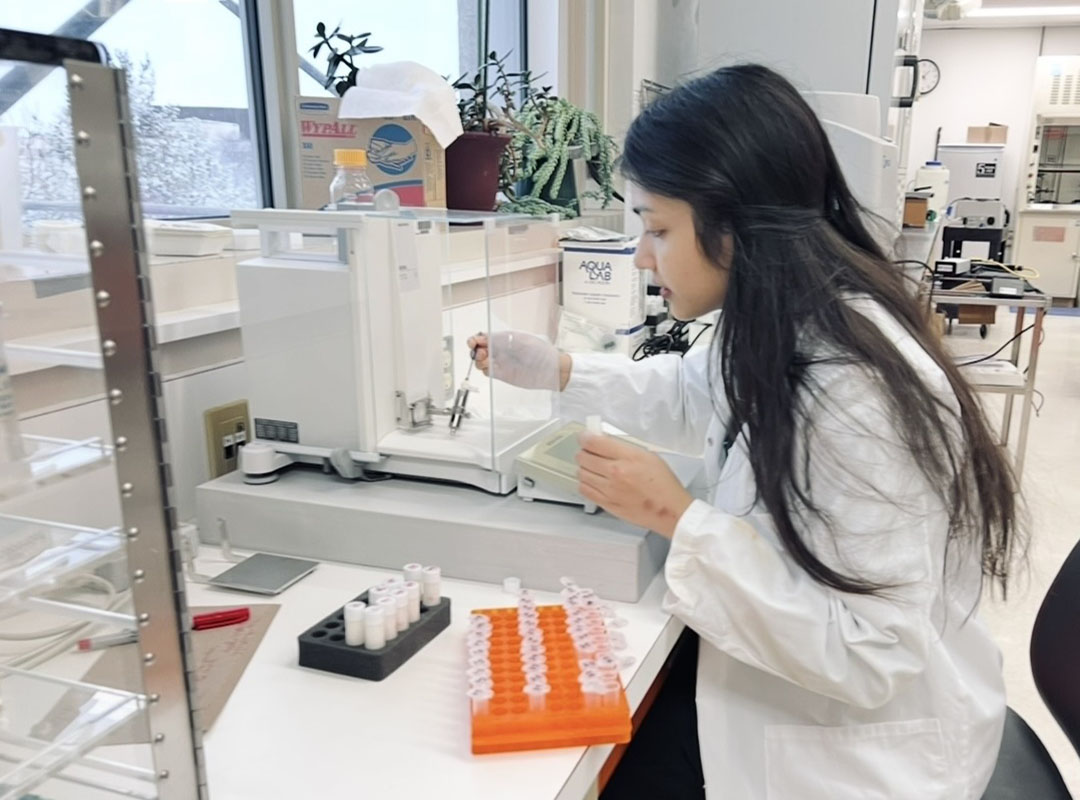
A standout course for her was FABS 375.3 A Practical Approach to Seed Processing taught by Dr. Martin Reaney (PhD) and Dr. Edgar Martinez (PhD), in which she conducted lab work at the USask Bioprocessing Plant.
“This course introduced me to seed processing techniques,” said Gupta. “I learned how to extract canola oil from canola seed, bleach it, make biodiesel from it, extract lignan from flaxseed, and make tofu from soybeans. Getting to do all of that myself was very exciting and made what I was learning feel real.”
Gupta connected her USask education to paid work experience during her degree. She worked as a student at Agriculture and Agri-Food Canada where she assisted with chickpea and faba bean research in Dr. Brendan O’Leary’s (PhD) lab.
“It feels rewarding to be part of research that has a practical impact in the food industry,” said Gupta. “Pulses are an important crop in Saskatchewan and there is growing interest in using them in convenience foods like roasted snacks. The connection between crop science and real food products made the research feel very meaningful.”
In the future, Gupta is interested in pursuing a career in food industry management, with a focus on food science. She would also like to complete a master’s degree related to nutrition, health, and food.
“One of the biggest advantages of the Food Industry Management degree is that it opens many doors,” said Gupta. “If someone doesn’t want to work only in agribusiness, they can also move into the food sector. You can lean more toward food science or more toward agribusiness, depending on what interests you most. I think that flexibility is one of the best parts of the program.”