

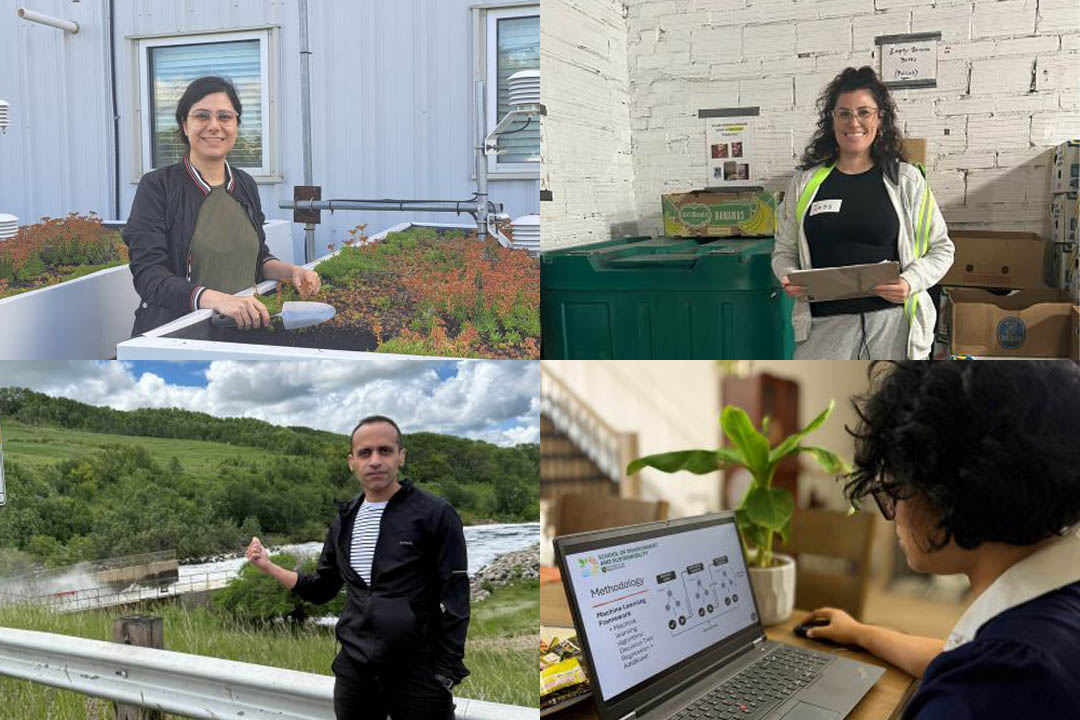
SENS celebrates graduate student excellence in environment and sustainability
Four graduate students from the University of Saskatchewan (USask) School of Environment and Sustainability (SENS) have been recognized for their achievements and professionalism in graduate research
By Amy JanzenEach year, the University of Saskatchewan (USask) School of Environment and Sustainability (SENS) recognizes outstanding graduate students through its Excellence in Environment and Sustainability Graduate Award. The award celebrates students whose academic work, professional contributions, and collaborative approaches reflect the school's values and commitment to addressing complex environmental and sustainability challenges.
This year's recipients are bringing fresh perspectives to a range of important issues, from community food security and green roof design to flood prediction and water management.
The 2026 recipients are Jessica Litman, Master of Sustainability (MSs) in Regenerative Sustainability; Ananya Kowshal, Master of Environment and Sustainability (MES); and Arezou Askarian Abyaneh, Master of Water Security (MWS). Majid Dehghani Sanij received an honourable mention for his MES research.
Jessica Litman, Master of Sustainability
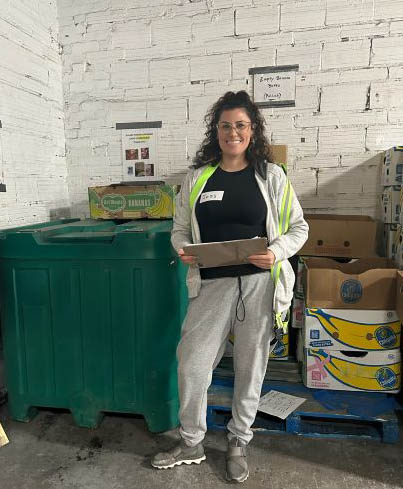
For Jessica Litman, sustainability research is about connecting academic knowledge with the needs of the community.
As part of her graduate work, Litman joined a team working with the Saskatoon Food Bank & Learning Centre to coordinate a food waste audit. The project brought together environmental sustainability, food security, and organizational needs, helping the organization better understand food waste and identify opportunities to address it.
"Jessica is an outstanding student and true representative of the values of the school,” said Dr. James Robson (PhD), SENS, program director and co-nominator.
"Beyond her commitment to sustainability, Jessica brought a degree of professionalism and leadership to the food bank team, right from day one," said Dr. Graham Strickert (PhD), SENS, program director and co-nominator. "Jessica cultivated a relationship with the partner that carries on today.”
The partnership also demonstrates the value of community-engaged learning and research, giving graduate students opportunities to apply their knowledge to real-world challenges while providing community organizations with additional research capacity and fresh perspectives.
"I’m very proud of this award but mostly grateful, both for the opportunity and experience,” said Litman. “It has really solidified how important our relationships are for creating the pathways to meaningful change right here in our community. I want to express how valuable volunteer work has been for me, and this award highlights how many wonderful things can happen when you become involved.”
Arezou Askarian Abyaneh, Master of Water Security
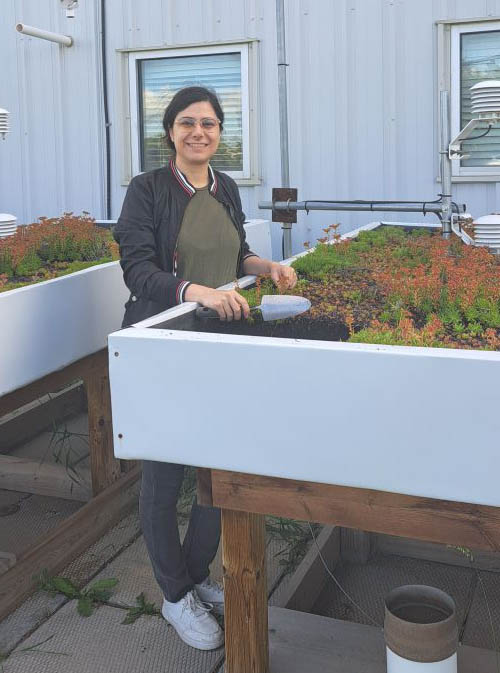
Arezou Askarian Abyaneh brought curiosity, technical skills, and a collaborative approach to her research on green roof water movement.
Working with her faculty advisor, Dr. Jeff McDonnell (PhD), Askarian Abyaneh took on the challenge of combining complex modelling methods with stable isotope tracing to better understand how water is stored, mixed, and drained within green roofs.
Her work generated new insights with practical implications for stormwater management and green roof design.
"Arezou’s finding that accurate runoff predictions can mask limitations in modelling internal water movement offers a valuable contribution to improving green roof models," said McDonnell. He also noted the research’s potential to be developed into a scientific manuscript.
Beyond her technical contributions, Askarian Abyaneh quickly became a valued member of an established research team, bringing new perspectives and helping advance the group's work.
"What interested me most was understanding what happens to water inside a green roof, not just how much flows out,” said Askarian Abyaneh. “I also wanted to know whether models could accurately predict both the amount of outflow and the source of water.”
Ananya Kowshal, Master of Environment and Sustainability

Ananya Kowshal is exploring how artificial intelligence can help communities better understand and prepare for flooding.
Through her MES thesis, Machine Learning Model for Ice-Jam Flood Prediction, Kowshal is applying machine learning and explainable artificial intelligence to improve predictions of ice-jam flooding not just for researchers, but for governments as well.
She also contributed to a peer-reviewed publication on the topic and a second manuscript currently under review; components of this research have since informed work in collaboration with the Government of Manitoba.
"Ananya's work addresses an important water security challenge," said Dr. Karl-Erich Lindenschmidt (PhD), Kowshal’s supervisor. “These tools have the potential to be utilized for flood forecasting, mitigation planning, and communities working to prepare for changing river conditions.”
The research reflects the value of combining emerging technologies with practical water-management needs, helping bridge the gap between scientific modelling and real-world decision-making.
"I’m grateful for the opportunity to explore how machine learning and explainable artificial intelligence can support flood prediction and decision-making," said Kowshal. “My goal has always been to develop tools that bridge advanced research and practical applications, helping communities and governments better prepare for flood-related challenges.”
Majid Dehghani Sanij, Master of Environment and Sustainability
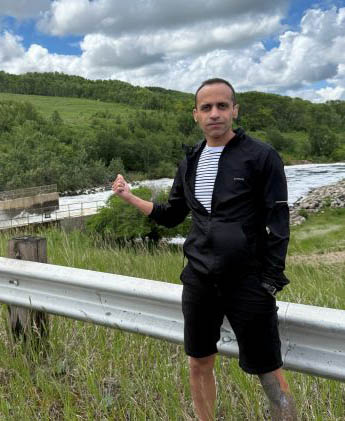
Majid Dehghani Sanij received an honourable mention for his MES thesis, Changing Flow-Generating Mechanisms in the Canadian Prairies.
His research examines how changing climate conditions affect the processes that generate streamflow and floods, with implications for flood forecasting and water management across the Prairies.
"Majid is an effective link between SENS and our government partners,” said Dr. Saman Razavi (PhD), Dehghani Sanij's supervisor. “He thoughtfully connects academic research with operational water-management needs, something governments need more and more as weather patterns continue to fluctuate.”
Dehghani Sanij also presented his research at the Canadian Water Resources Association's 2026 conference, sharing his findings with the wider research and professional community.
Before beginning his research in the MES program, Dehghani Sanij was enrolled in the MWS non-thesis program through SENS. His decision to continue building on his knowledge and interest in water security through graduate research reflects the value of interdisciplinary learning and the connections between academic research and industry needs.
This year's recipients demonstrate the diversity of research that make up SENS. As a graduate school whose strength is in its interdisciplinary approach, SENS students continuously showcase a broad range of sustainable research. This work is important in bringing together different disciplines, experiences, partners, and passions to help address complex and critical sustainability challenges.