

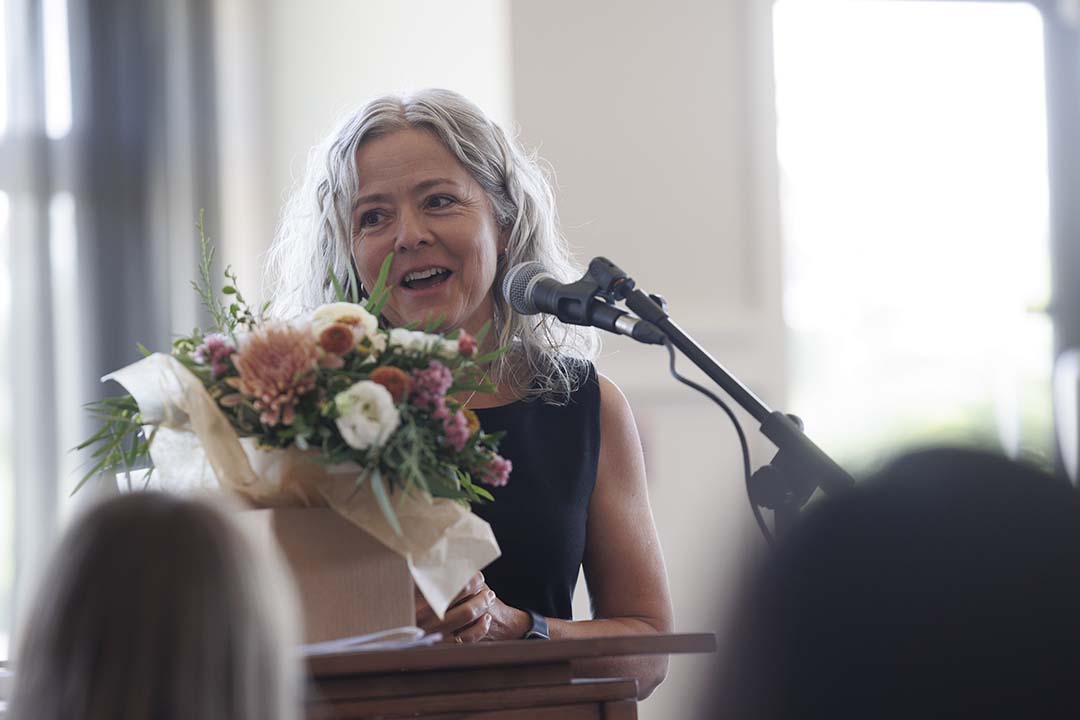
Take 5: Five things to know about this spring’s Distinguished Teacher Award recipient
Cheryl Besse, associate professor in USask’s College of Nursing, is humble, and she cares.
By University CommunicationsKnowledgeable and supportive are just two of the characteristics demonstrated by the recipient of this spring’s University of Saskatchewan (USask) Distinguished Teacher Award. While it’s difficult to distill her 30-year career as a nurse educator down to five things to know about Associate Professor Cheryl Besse, here is a breakdown:
1. She concisely summarizes her teaching philosophy as “passion and caring for learning.”
As a nursing student, Besse recognized that the best instructors cared.
“They cared about their discipline, they cared about teaching, they cared about students and, probably most importantly, they cared that the students learned what was needed to be successful.”
Over her career as an educator, she has consistently demonstrated passion for what she is teaching and has lived her belief that learning is optimized when we care about each other.
“While this may appear to be student-centred, I would describe it as learning-centred, with educators and students as partners in the learning relationship.”
2. Receiving the Distinguished Teacher Award feels surreal.
Her teaching has been recognized with a USSU Teaching Excellence Award in 2015, and several USSU nominations (in 2012, 2023 and 2024). Additionally, Besse received the Provost’s College Award for Outstanding Teaching in 2012 and the Saskatchewan Registered Nurses’ Association’s Elizabeth Van Valkenburg Award for Excellence in Nursing Education in 2020. Yet, this most recent award stands out to her.
“This award comprehensively represents all aspects of my teaching. Its breadth includes professional growth and broader impacts by including leadership and scholarship, plus it combines the perspectives of my peers and students. With so many amazing teachers on this campus – and the fact the award selection committee members are themselves previous winners of this award is humbling to even be considered is an honour,” she said.
3. Her research focuses on the scholarship of teaching and learning. Her teaching innovations and published work has been disseminated regionally, nationally and internationally, and her leadership and mentorship in this area are inspirational to her colleagues and peers.
Many people have heard of the “sandwich” approach to offering feedback; Besse developed and published an alternative to the sandwich, the “WRAP.”
WRAP stands for Wonder, Reinforce, Adjust, Plan. The most important part of WRAP, explains Professor Besse, is engaging the student in the feedback process and including development of a plan for improvement vs just the typical positive- negative- positive feedback sandwich. More recent scholarship includes publications to support instructors with practical strategies in clinical teaching.
4. While she finds it hard to pinpoint any specific comments, student feedback examples from her nomination package provide insight.

“Cheryl has high expectations of her students but is the most realistic instructor I’ve ever had. She has a subtle way of making you feel confident in yourself and has equipped me to change my thinking and take ownership of my nursing care.” - student feedback
“Professor Besse is the only professor who has made each student feel included, acknowledged, and cared for in the most professional way possible.” - student feedback
“She really cares about her students and focuses on how her students learn best and I think that is an important skill as an instructor to make the class successful.” – student feedback
Throughout her teaching career, she has always sought, received and responded to student end-of-course feedback and has used minute memos, exit tickets and stop-start-continue surveys to make changes and improve the course to meet student learning needs before the course ends.
“While receiving positive feedback is very meaningful, I think it is more important to ensure students feel safe enough to offer suggestions for improvement while they are learning,” she said.
5. Besse firmly believes being a leader is about action and impact, not a title or position.
“Early in my career, I did not see myself as a leader. I had never considered that I might influence anything beyond the classroom, lab, or clinical setting. Eventually that changed, and I became aware that while I may not have set out to be a leader, I was exemplifying leadership by being willing to step up where and when there was a need, in keeping with my belief ‘you don’t need a title to be a leader.’”
Jill Zdunich, registered nurse, instructor, in the College of Nursing, said Besse is admired and respected by her peers for her work ethic, her professionalism, and her willingness to embrace change.
“She is a creative leader, an upstream thinker and is able to consider issues from multiple perspectives.”
Besse said her most significant professional leadership has been through mentorship using coaching, collaborative problem solving and confidence building. The support and advice she provides to new and established instructors on pedagogy, course development, clinical teaching, student support and navigating policy and processes, contributes not only to the quality of their instruction, but to their growth, which then has multiplying effect on improving student learning, enhancing program delivery and ultimately influencing the profession of nursing and quality of the health care system.
“In a profession where technical skill and academic demands can overshadow the human side of nursing, she places compassion, care, joy, passion, and hope at the very center of her teaching,” said nursing student Njemile Wickham. “Every student who learns from her benefits not only from her expertise but from her extraordinary humanity. In doing so, she is actively shaping the next generation of nursing leaders, equipping them to practice with both skill and heart.”