

Unexplored trace fossils give USask researchers climate change insights
What can fossils teach us about our future?
By Matt Olson, Research Profile and ImpactThat’s one of the questions being tackled by Dr. Gabriela Mángano (PhD), a distinguished professor and MacLeod Research Chair in the Department of Geology in the College of Arts and Science at the University of Saskatchewan (USask).
In a recently published article in Nature Ecology & Evolution, Mángano and a team of interdisciplinary researchers from institutions around the world explored a collection of trace fossils – fossilized evidence of the small things living organisms left behind hundreds of millions of years ago, like the tiniest of footprints or winding serpentine paths preserved for researchers to explore.
But as Mángano puts it, these tiny trace fossils can give us insights into how organisms responded to significant environmental changes that in some ways aren’t dissimilar to changes happening today in some regions of our oceans.
“It gives you an insight into a completely unknown world,” Mángano said. “The very small, we tend to ignore it, but it has a crucial place in modern food webs and gives us clues to the first steps of recovery after mass extinction events.”
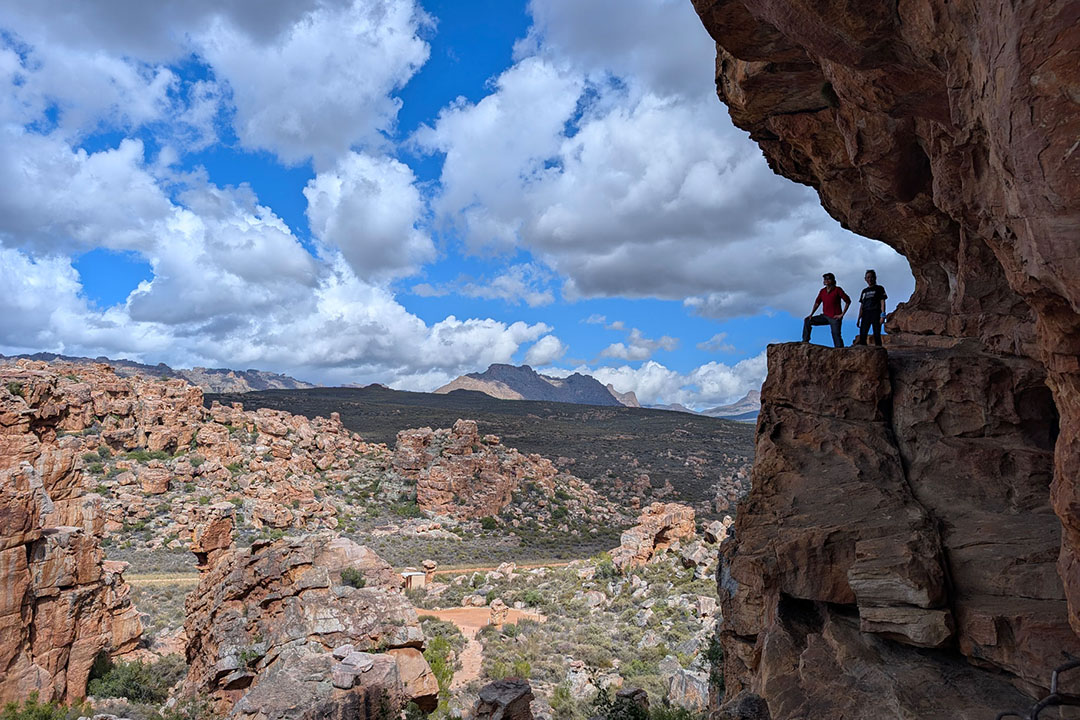
Mangano’s new research paper focuses on trace fossils of ancient, tiny invertebrates called meiofauna found in the Soom Shale. The Soom Shale, located in South Africa, is renowned for being a repository of incredibly well-preserved fossil samples, including soft tissue, which represent a rare record of marine life persisting under extremely adverse conditions in the aftermath of the Ordovician extinction event, one of the earliest mass extinction events in Earth’s history.
But Mángano and her team decided to look at the miniscule, overlooked trace fossils in the Soom Shale. The trace fossil record shows a flourishing ecosystem of tiny meiofauna that would have thrived along the sea floor.
The fact that these tiny organisms were still able to survive and have success during a critical period for other life on earth gives more insights into how ecosystems find the way to recover after major crises.
“Studying deposits like the Soom Shale is thrilling as it offers us a glimpse into the ancient biosphere in action, navigating extreme change,” said Mángano. “The fossil record shows us both the extraordinary resilience of life and its vulnerability. By uncovering how life endured past crises, we also confront our responsibility today – to understand the complexity of Earth’s systems and to act as stewards of our biosphere that is both ancient and profoundly unique.”
In addition, Mángano said the behaviour of these ancient meiofauna reflected in their trace fossils is similar to behaviour of those same kinds of organisms today in oxygen-limited marine environments.
The trace fossils from the Ordovician extinction event show how organisms responded to the kinds of environmental stresses caused today by climate change and could provide researchers clues for how modern organisms might recover from those changes.
“If we understand how ecosystems recovered in the past, we can, in a way, understand how they might recover in the future,” Mángano said. “There is not a perfect analogy, because of course communities in the Ordovician were different, but physiological constraints and behaviour in response to environmental stress are likely to be comparable.”
Researchers from USask, including Dr. Luis Buatois (PhD) in the Department of Geology, as well as colleagues from the University of Cape Town in South Africa, the University of Leicester in the United Kingdom, and the University of Poitiers in France, participated in this research project. Mángano highlighted the value of her international colleagues and the breath of interdisciplinary collaboration underpinning this high level of research and discovery.