

USask researchers pioneer blood test for rapid Parkinson’s diagnosis
A new blood test created by University of Saskatchewan (USask) researchers could mean faster diagnosis of the most devastating and aggressive types of Parkinson’s disease.
By Matt Olson, Research Profile and ImpactDr. Chris Phenix (PhD), an associate professor of chemistry in USask’s College of Arts and Science, said rapid detection of aggressive Parkinson’s could lead to better outcomes for patients and provide new insight into the disease for medical researchers.
“Neurologists don’t have too much difficulty in diagnosing Parkinson’s, but the key part of it is that by the time you actually start getting classic Parkinson’s symptoms, like 30 or 40 per cent of the related neurons are already dead. It’s irreversible,” he said. “Being able to rapidly screen for aggressive forms is going to be very helpful because you can start initiating therapies very, very shortly after diagnosis.”
This innovative research project received funding from the Saskatchewan Health Research Foundation (SHRF) Solutions Program, which provides support to impactful research addressing timely health needs in Saskatchewan.
Parkinson’s disease is a neurodegenerative disease that damages or destroys dopamine-producing neurons and causes movement issues including tremors and muscle stiffness, and can create cognitive impairment in some patients.
Phenix, who grew up in the small town of Arcola, Sask., said his grandmother had Parkinson’s. Seeing the effects of the disease on a family member is one of the reasons Phenix said he was drawn to this area of research.
“It motivated me to get into the world of Parkinson’s disease research to use my expertise to answer important questions in the field,” he said.
According to Phenix, an enzyme in cells called glucocerebrosidase (GCase) displays reduced activity in patients with Parkinson’s, particularly fast-acting and aggressive forms of Parkinson’s.
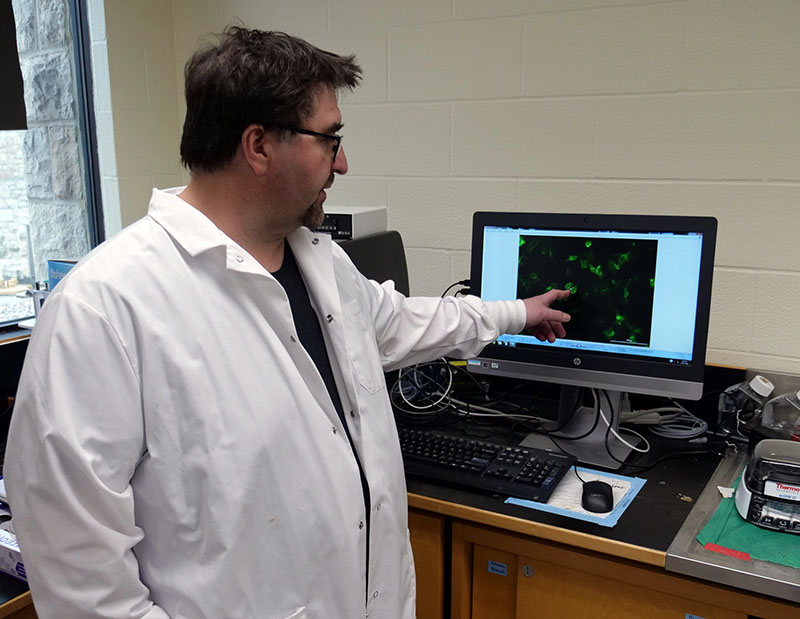
It can be difficult to see and test neurons – nerve cells in the brain – in living patients. Using unique chemical tools discovered at USask called fluorescent probes, Phenix and his team devised a method that will measure the activity of the enzyme in cells found in the blood. The probes attach to the GCase enzyme and cause them to literally “light up” using a clinical device called flow cytometry.
The newly developed test is convenient because it highlights the activity of enzymes in blood that are related to Parkinson’s but doesn’t require brain scans. It could be a much faster, inexpensive, and more accessible test to screen for the disease. Phenix said the fluorescent probe tool could potentially have results within minutes of the blood test being conducted.
“The activity of the enzyme in white blood cells also appears to drop in Parkinson’s patients. So that gives us a strategy where we could develop a convenient way to measure the enzymes in these blood cells that could mirror the activity in the brain,” Phenix said.
For researchers, Phenix said there is also tremendous value to use a blood test like this for drug trials to identify patients who will have aggressive forms of Parkinson’s. It could enable drug companies to more effectively test new medicines they are developing for the disease and get clearer results in a much quicker manner.
Phenix called the support of SHRF for this kind of research “critical,” and said it was important to show this high-level, high-impact research was happening in Saskatchewan. He credited working with local experts like Dr. Eric Noyes (MD), a neurologist in USask’s College of Medicine and a co-applicant on the project, as being crucial to the success of this kind of research.
“All our probes are Saskatchewan-made, pioneered here, and we are working with local physicians like Dr. Eric Noyes taking these all the way into the clinic here,” he said. “It’s a small, tight-knit community open to working with researchers and getting things done. That’s a unique strength.”
Below is a list of all USask SHRF Solutions grant recipients this round:
Alison Oates (PhD), College of Kinesiology – Touch, balance, and the brain: A new approach to improving balance and preventing falls – $50,000 (funding partner: Brain Canada)
Ivar Mendez (PhD), College of Medicine – Improving mental health support for Northern Indigenous communities using a culturally grounded mobile app – $150,000 (funding partner: Brain Canada)
Anand Krishnan (PhD), College of Medicine – Tackling lung cancer brain metastasis by targeting muscarinic signaling – $150,000 (funding partners: Brain Canada and Lung Saskatchewan)
Justin Botterill (PhD), College of Medicine – Exploring hypothalamus stimulation as a new treatment for drug-resistant epilepsy – $150,000 (funding partner: Brain Canada)
Gary Groot (MD, PhD), College of Medicine – Improving COPD care pathway implementation for Indigenous communities in Saskatchewan – $149,773 (funding partner: Lung Saskatchewan)
Nnamdi Ndubuka (PhD), College of Medicine – Improving brain health through increase in childhood vaccination coverage rates among northern Saskatchewan First Nation communities – $50,000 (funding partner: Jim Pattison Children’s Hospital Foundation)
Eric Noyes (MD), College of Medicine – Skin oil and earwax analysis for the identification of laboratory tests in Parkinson’s disease and related disorders – $50,000 (funding partner: Brain Canada)
Michael Levin (MD), College of Medicine – Novel drug shows promise in reducing disability in multiple sclerosis (MS) – $150,000 (funding partner: Brain Canada)
Ghita Wiebe (MD), College of Medicine – The Baby Bridge Project: Helping families access early support for child development and well-being – $149,768 (funding partner: Jim Pattison Children’s Hospital Foundation)
Wendie Marks (PhD), College of Medicine – Exploring the effects of a novel Wistar rat model of early life adversity on behaviour and brain health – $50,000 (funding partner: Jim Pattison Children’s Hospital Foundation)
Darrell Mousseau (PhD), College of Medicine – Pediatric heart disease and autism spectrum disorder may share a common molecular trigger – $50,000 (funding partner: Jim Pattison Children’s Hospital Foundation)
Katie Crockett (PhD), College of Medicine – Working with communities to understand the unique needs and supports for autism in First Nations children in Saskatchewan – $147,385 (funding partner: Jim Pattison Children’s Hospital Foundation)
Meghan Maiani (PhD), College of Medicine – Improving detection of vision difficulties in children with early life brain injuries – $150,000 (funding partner: Jim Pattison Children’s Hospital Foundation)
Sarah Donkers (PhD), College of Medicine – Boosting the brain's ability to adapt: acute intermittent hypoxia in later stages of MS – $49,993 (funding partner: Brain Canada)
Valerie Caron (PhD), College of Medicine – Evaluating a wearable sensor that provides sound feedback to improve walking in people with early dementia – $149,308 (funding partner: Alzheimer Society of Saskatchewan)
Allison Cammer (PhD), College of Pharmacy and Nutrition – The Cognitive Kitchen: A culinary nutrition program to promote cognitive health for older adults, caregivers and persons living with dementia – $150,000 (funding partner: Alzheimer Society of Saskatchewan)
Hassan Vatanparast (PhD), College of Pharmacy and Nutrition – Eating healthy, staying active, and social connections to reduce Alzheimer’s disease risk within a public recreational facility – $146,149 (funding partner: Alzheimer Society of Saskatchewan)
Holly Mansell (PhD), College of Pharmacy and Nutrition – HELPing people with chronic pain and FASD manage their health using a mobile app – $150,000 (funding partner: Brain Canada)
Kelsey Cochrane (PhD), College of Pharmacy and Nutrition – The impact of maternal folic acid vs methyl folate supplementation on breastmilk composition and infant neurodevelopment – $150,000 (funding partner: Jim Pattison Children’s Hospital Foundation)