

USask accelerates research, training for critical mineral innovation
Critical minerals are essential to modern technology, from clean energy to smartphones and medical imaging. As global demand for these materials increases, the University of Saskatchewan (USask) is leading the way for critical mineral resource research and development.
By Matt Olson, Research Profile and ImpactThere are 34 minerals that have been defined by the Government of Canada as “the foundation upon which modern technology is built” and have importance relating to energy, economic or national security.
Researchers throughout USask have and are continuing to build strength in critical minerals research. Dr. Matt Lindsay (PhD), a professor with the Department of Geological Sciences in the College of Arts and Science, and Dr. Camille Partin (PhD), an associate professor in the Department of Geological Sciences and the inaugural Shklanka Chair in Precambrian Critical Mineral Systems, are two experts exploring critical minerals at USask.
Lindsay said USask is uniquely positioned to help Saskatchewan and Canada grow sustainable production of critical minerals.
“Saskatchewan is a very exciting place for researchers to study various aspects of critical minerals, from mineral exploration to mine remediation,” Lindsay said. “Saskatchewan’s significant and growing critical mineral potential is illustrated by a number of exciting projects, including major initiatives focused on rare earth elements, potash, copper, and zinc.”
Of Canada’s 34 critical minerals, 27 of them can be found in Saskatchewan. At this point, only a few of them are being produced – potash, uranium and helium – but there are more upcoming projects that will increase the amount and variety of critical minerals produced in Saskatchewan in the very near future, including producing copper and zinc within the year.
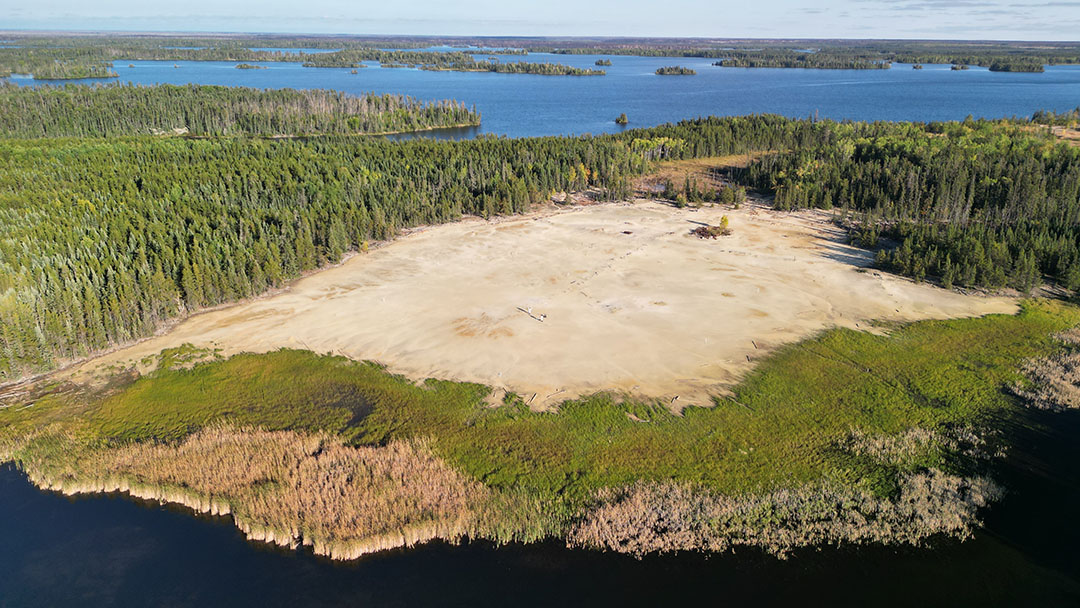
Lindsay’s research focuses on finding ways to mitigate environmental impacts of waste materials generated during mining. To do this kind of cutting-edge research, Lindsay regularly uses the Canadian Light Source (CLS) synchrotron on the USask campus to better analyze and understand the molecular form and structure of potentially harmful materials in mining waste.
But there’s a new avenue for Lindsay to explore in his research – the possibility of obtaining critical minerals from mine waste. As Lindsay puts it, legacy mine wastes can contain critical minerals that were not recovered in the past.
Using the powerful synchrotron beamline and other methods, Lindsay can attempt to identify the amount and form of these critical minerals in mining waste and assess whether or not they could be worth trying to recover.
“Metals present in legacy mine wastes are often viewed as environmental contaminants, and our research has focused on understanding how to prevent them from ending up in nearby water or soil,” Lindsay said. “Increasingly, however, we are considering how this same understanding could be used to develop ways to recover metals that are also considered critical minerals.”
Lindsay said there has been a concerted and increased interest in Saskatchewan for sources of critical minerals, from new mining projects to investigating innovative extraction techniques like obtaining minerals through brine water sources. Four research projects led by USask received more than $4.3 million from the Natural Sciences and Engineering Research Council of Canada (NSERC) through Alliance Missions grants for critical minerals research.
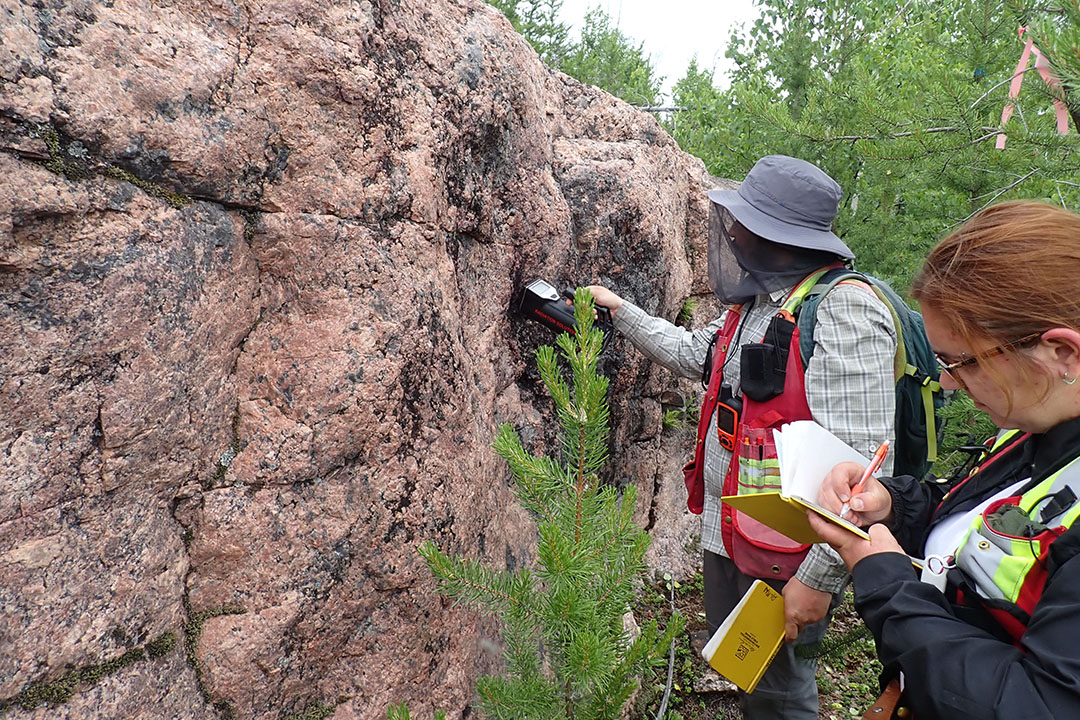
Partin is the lead on one of the NSERC Alliance Missions grant projects at USask. Her funded project involves exploring a multidisciplinary approach to understanding rare earth elements (REEs) found in pegmatite intrusions in northern Saskatchewan. These rocks contain concentrated amounts of the mineral monazite that hosts REEs such as neodymium. REEs are one of Canada’s identified critical minerals due to their application in electronics and sustainable energy technologies like wind turbines.
In addition, Partin’s project received funding from the U.K.-Canada Sustainable Critical Minerals Research Partnerships program and was one of only five projects across Canada to receive that kind of international support.
Partin said that support speaks to the global importance of furthering critical mineral development, and why the work being conducted here in Saskatchewan is so vital.
“This speaks to the international importance of some of these critical minerals,” she said. “Some countries don’t have domestic sources and so they need to go abroad to friendly countries where they think they might be able to advance these projects.”
Partin’s main research interests involve Precambrian geology – rocks formed throughout a four-billion-year history before the evolution of animals. But even understanding the distribution of Precambrian rock formations can help inform geological maps of today for researchers and exploration companies alike to try to find critical minerals, especially in remote parts of northern Canada and Greenland where she has done research over the last 17 years.
She said critical minerals are a key part of one of USask’s Signature Areas of Research, Energy and Mineral Resources for a Sustainable Future, and having geoscience data at the core of research and industry decision-making is “incredibly important” for the future of critical minerals in the province.
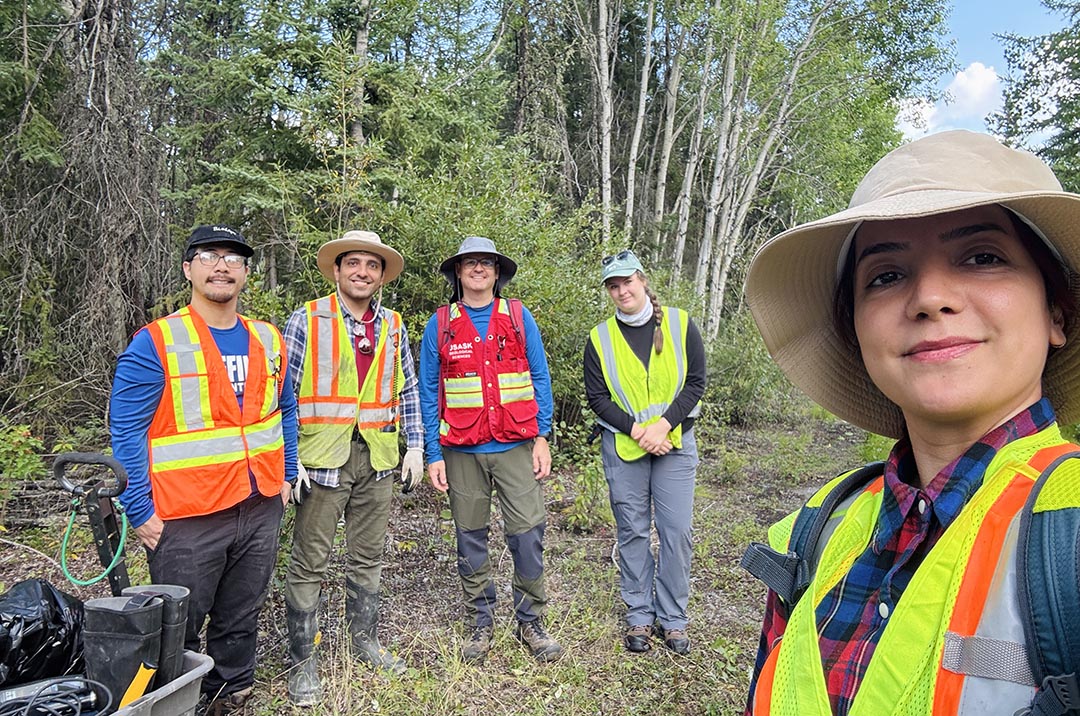
“Industry collaboration is key for these projects,” Partin said. “They routinely provide samples, access to remote sites, and share data they’ve collected. Our research collects things like advanced mineral chemistry data, and the synthesis of that data in our research gives us the full geological picture to understand the deposit.”
Another key partner is the Saskatchewan Research Council, whose Rare Earth Processing Facility will be a cornerstone for Saskatchewan to become a REE hub once opened, as outlined in Saskatchewan’s Critical Mineral Strategy.
As the push for critical minerals continues, USask’s role in training the next generation of geoscientists and engineers becomes even more important.
Lindsay and Partin both noted that with the interest invested in critical minerals by the provincial and federal governments, along with local and international mining companies who are growing their presence in Saskatchewan, it is vital to train the scientists and engineers who are essential to this sector.
Partin pointed to the establishment of the Global Institute for Energy, Minerals and Society (GIEMS) – a joint endeavour between USask, the University of Regina, and Saskatchewan Polytechnic to expand research and training in this sector – as a cause for optimism.
“We’re hopeful that it will allow us to come together and really strengthen our training programs,” she said. “I think we are united in a common goal of seeing people succeed in a meaningful way in Saskatchewan.”
The questions around critical minerals will continue into the future and hold tremendous importance for researchers and industry members alike. The science and scholarship that goes into critical mineral research includes more than mining and geology – environmental engineering, ecology, public policy, economics and more will play a role in shaping critical minerals.
As Saskatchewan strengthens its role in Canada’s critical mineral sector, USask is continuing to position itself as a crucial hub for preparing up-and-coming scientists and engineers to tackle the critical mineral questions of tomorrow.
“Geoscience is a key piece of the puzzle, but it is not separated from the policy, from the finance, from the engineering, or from other sciences,” Lindsay said. “These are complex challenges, and there is a need for people with advanced training.”