

Black History Month at USask: ‘Put yourself out there to find your community’
Research award recipient reflects on experience at USask, Black History Month
By Kristen McEwenFebruary is a time to reflect on the history of Black people in Canada and to celebrate historic and modern achievements. The USask College of Arts and Science joins the university community in celebrating Black History Month.
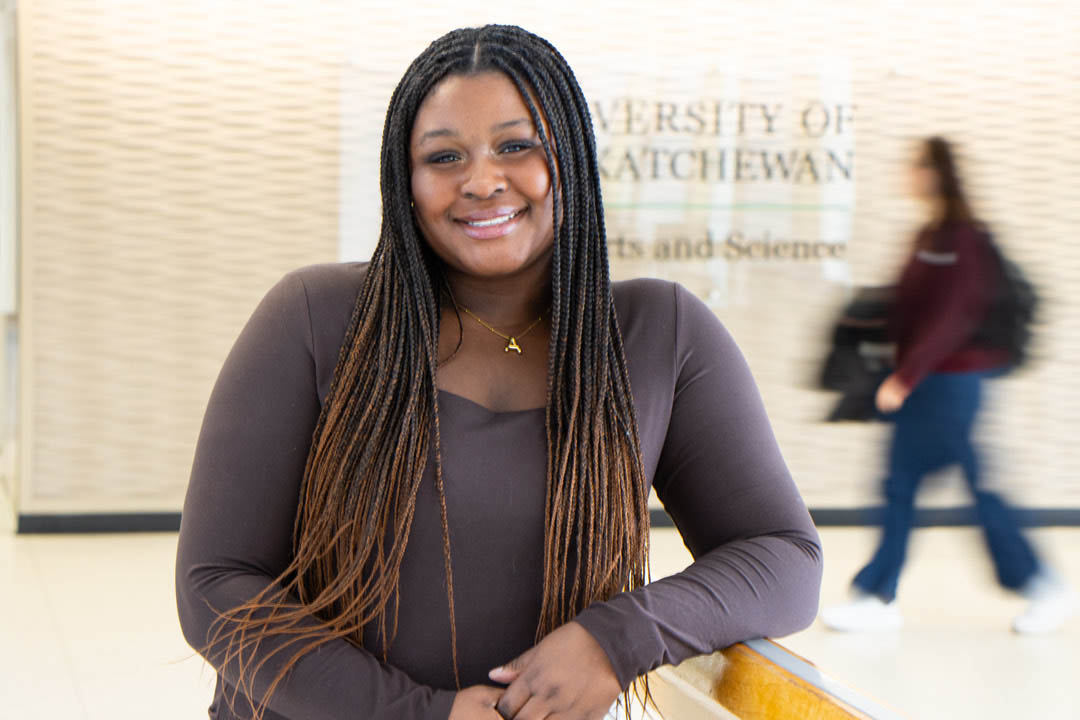
Alaafia Plumptre is in her final year as a psychology student at the University of Saskatchewan (USask). Born in Ireland, Plumptre moved with her family to Saskatoon when she was about 10 years old.
While at USask, Plumptre has become involved in the Saskatoon Psychology Students’ Society as a student representative. She has received scholarships at St. Thomas More College (STM), including the Terrence & Margaret Downey Scholarship in 2024 and the Sister of Our Lady of the Cross First Year Scholarship in 2022.
As an undergraduate student, Plumptre also decided to explore research. She applied for Tri-Agency URSAs (Undergraduate Student Research Awards). She was a successful applicant for research awards two years in a row.
Plumptre received a CIHR USRA for Black Student Researchers in 2024 with faculty supervisor and psychology assistant professor Dr. Katherine Collins (PhD). She also received a SSHRC URSA for Black Student Researchers in 2025, with faculty supervisor and STM sociology associate professor Dr. Sarah Knudson (PhD).
URSAs provide undergraduate students with paid, full-time work over the summer as student assistants on a research project under the supervision of a USask faculty member.
The following interview has been edited for length and clarity.
Arts and Science: What made you choose to be a psychology major?
Plumptre: My closest friend’s mom did a psych degree at the U of S. I remember attending her graduation. As I got a little bit older, she was talking about what she learned and I thought that was super interesting to me.
She did a thesis in narcissism. And I was like, “That’s so cool.” I love learning about the motivations people have for what they do, why they do (something).
A&S: You’ve received a Tri-Agency URSA two years in a row, which is really exciting. What was your reaction to receiving those awards?
Plumptre: The first one, I didn’t think I was going to get it. I was so shocked. Like I couldn’t really see myself receiving (the award), even just doing research outside of school (in the summer). So, it was so exciting.
The second one, I was like, “Okay, maybe I should just apply.” And then I remember I was washing the dishes, and I checked my emails and it was right there. It’s awesome.
A&S: What was your research about?
Plumptre: I did two very pretty different research projects. The first one I did with the CIHR (award) was more focusing on Indigenous communities. I was a research assistant. I did like a whole month-long initiative for Orange Shirt Day. The research project I helped the most with was on vaccine hesitancy within Indigenous communities and learning about land use within Indigenous communities. I read a lot of literature about that and organized it.
And in 2025, it was really interesting. I did a netnography, which is just kind of scouring the internet to see what people are talking about. The research question was like, what are older adults—what are they talking about when it comes to dating? So, I read, I watched so many YouTube videos, I scrolled on Instagram, I went on Twitter. I went and read magazines, blogs, just anything that older adults were talking about (regarding) dating. And I came up with certain themes, like dating advice was a major theme, and love after loss was a major theme.
I ended up presenting at two conferences for that research. It was really interesting. I did the last conference in December, but we wrapped up in August. It was fun.
A&S: The theme for Black History Month at USask is “Celebrating Black brilliance rooted in legacy and leading the future.” Does this theme resonate with you?
Plumptre: I definitely think building the future—especially when I reflect on what Saskatoon was like when I moved here like 10 years ago. There wasn’t really much of a Black community, but now it’s so much (larger). It’s just more diverse in general these days.
I really feel like our voices, our inputs, I feel like they’re really not needed here, but I feel like they have a very important place here, just kind of giving diverse opinions. So I feel like it’s a pretty homogenous city, the way people like to think of things. Definitely celebrating our voices.
A&S: What does Black History Month mean to you?
Plumptre: February is about highlighting Black culture and celebrating Black culture. Every year in February, I come across Black history inventions I didn’t know existed. I’m like, “Oh, that’s so cool.”
But it’s also about remembering and reflecting on the hardships and acknowledging the hardships that Black Canadians have been through. I took a women’s and gender studies course last year and I learned about the slavery in Canada. I had no idea about that. And I feel like most people don’t.
I really feel like just bringing those stories you may not hear to the fore is pretty important. And also highlighting stories that we all hear about, like Viola Desmond in Africville, Nova Scotia.
Even though we hear about these stories every (year), or at least I hear about these stories every year, I still think it’s important to make sure we keep telling them so they’re not just (pushed) to the wayside and make sure people still remember them.
A&S: Is there anything else you wanted to add?
Plumptre: I think it’s so important (for Black students) to find your community here, especially if you’re international. It’s very different here. It can be a little isolating, especially in the winter when it’s cold, and dark, and no one wants to go out.
I think you really have to put yourself out there to find your community. It takes a little bit of work. Like, no one’s going to come to your door and be like, “Hey, we’re your community.” I think you’ve got to get out there.
I feel like attending PASA events, that’s our Pan-African Students Association, attending their events—even going to some events you may enjoy alone. Just putting yourself out there and just taking that chance. Because I feel like every time I’ve done that, it’s always worked out for me. No one laughed at me when I walked in there.
For more information about Black History Month and how it is being recognized at USask, visit spotlight.usask.ca