

Tech talk: How USask researchers are utilizing new technology
As digital technology continues to change, advance and shape our everyday lives, experts are leveraging new tech and new tools to push the boundaries of research, scholarly and artistic work.
By Matt Olson, Research Profile and ImpactResearchers at the University of Saskatchewan (USask) are at the forefront of new and evolving digital tech and are harnessing this innovation to advance their research and the livelihoods of people around the world. Exploring the ever-evolving and always-exciting tech space, USask researchers are finding new ways to leverage growing technology like drones, artificial intelligence, virtual reality, and quantum computing. From commercially available digital technology to the most advanced hardware and software possible, USask researchers, scholars, and artists are pushing the boundaries of what is possible through ever-evolving innovations.
Eye in the sky: Using drones for efficient and effective research
The quality of high-flying drone technology is advancing rapidly and USask researchers are using it to soar higher than ever before.
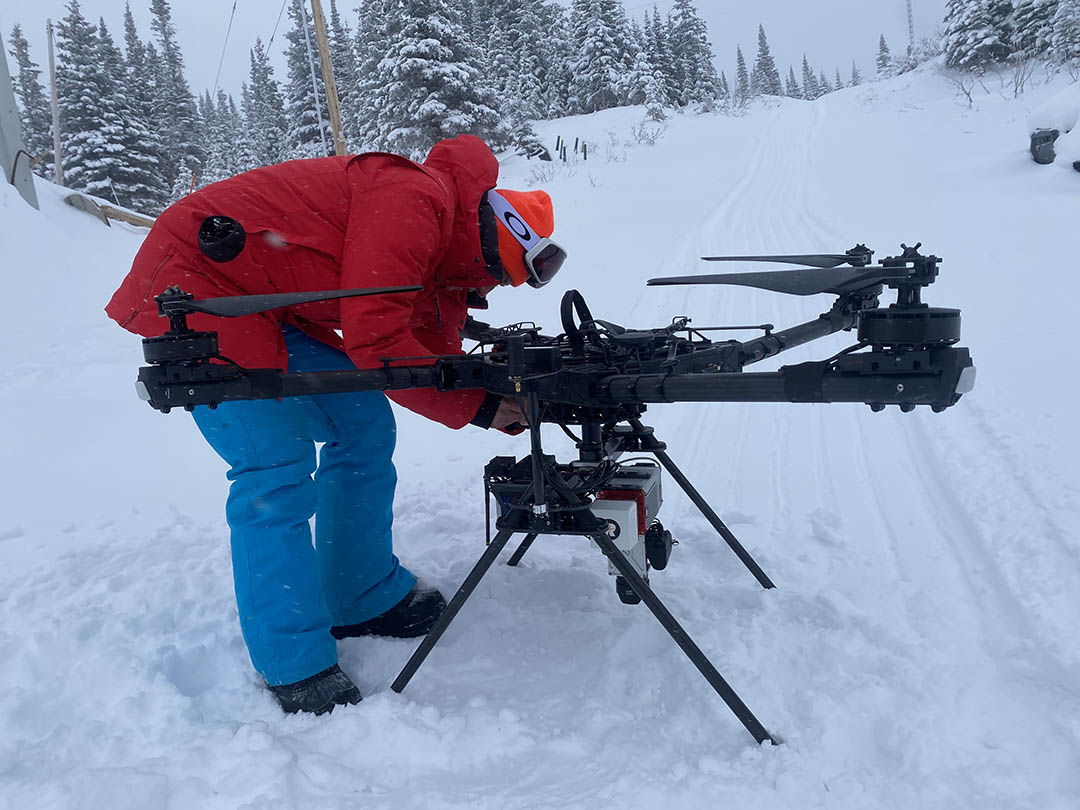
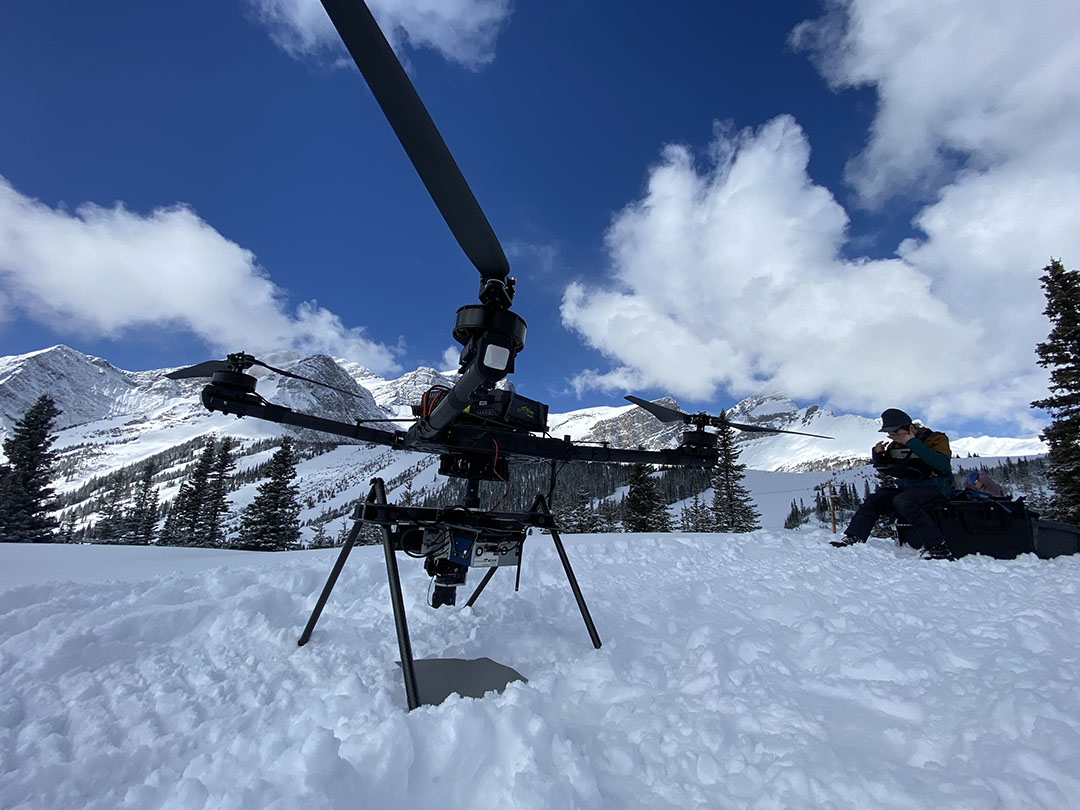
Alex Cebulski, a PhD candidate in the Department of Geography and Planning, with supervisor Dr. John Pomeroy (PhD) based at the Coldwater Lab in Canmore as part of USask’s Centre for Hydrology, uses drone-based lidar (light detecting and ranging) to assess theories of snow storage in needleleaf forests in the Canadian Rocky Mountains.
His research focuses on snowfall interception and ablation in forest canopies — or how much snow gets caught in trees or makes it to the ground, and then how that water returns to the atmosphere or to streams.
“It’s important from a water balance perspective,” Cebulski said. “Understanding how snow accumulates across time and space and across different future climates as well ... is crucial to understanding water resources and the energy balance across the snowy forests of our country.”
Cebulski — with support from drone pilots and technicians working for the Global Water Futures Observatories facilities funded by the Canada Foundation for Innovation (CFI) Major Science Initiatives — conducted fieldwork as part of his PhD research to measure snowfall accumulation in needleleaf forests. That involved a quadcopter drone with a custom payload equipped with a lidar sensor that simultaneously shoots and measures reflections of 100,000 laser pulses per second to provide precise measurements of surface elevation. The system was developed with support from Western Economic Development Canada and the CFI.
By conducting drone surveys before and after snowfalls, this data can be used to determine millions of snow accumulation measurements and to develop a 3D model of the forest canopy across a wide spatial scale. With these measurements, along with data analysis methods to handle the millions of data points, the researchers were better able to investigate where and why snow accumulates within those needleleaf forest canopies.
Cebulski said this drone-based technology is breaking down previous barriers in scale and quality of snow accumulation and canopy structure measurements and resulted in a new theory to represent snow-forest interactions as part of his PhD research. This science and technology is contributing to the United Nations’ Decade of Action for Cryospheric Sciences.
“It’s an exciting time to be doing this research because this technology is enabling hypothesis testing across spatial scales previously not possible,” he said. “With drone-based LiDAR and 10 minutes, we can fly over a whole hectare and get many orders of magnitude more snow depth measurements compared to manual methods.”
Cebulski said having access to this technology through USask as a water researcher makes the work even more impactful. New technology becomes more reliable year after year, and researchers are constantly developing new tools to advance scientific research.
Steadily growing in use and popularity in the research world, drones are making a huge difference in the world of water research.
“We’ve tested this, and we’re getting sub-centimetre accuracy, which is almost better than you can do when you shove your ruler into the snow,” Cebulski said, before joking, “But luckily we cannot automate this process completely and there’s still some human work involved in the ground-based measurements to keep us outside and employed.”
Other USask research, scholarly and artistic work (RSAW) with drones:
What Canada’s melting glaciers tell USask researchers
Drone innovation by USask researcher comes from family farm roots
Outside the frame: Augmented reality for creativity and accessibility
Professor Lisa Birke (MFA) has often looked at pushing past the traditional square frames used to hang works of art.
Birke, an associate professor in digital and extended media in USask’s School for the Arts, said she started her art practice in a “traditional painting space.” But what eventually drew her to digital media tools and augmented reality (AR) was a hope to break free of the confines of that classic frame.
“With AR, you can put art anywhere at any scale, and at a low cost if you understand the software,” she said. “To make a public artwork is hugely expensive ... AR allows you to put your ideas—a large sculpture and animation, photographs, audio, storytelling—into a public space without those barriers of access.”
AR technology involves layering computer graphics over the real world using mobile devices, like smartphones. Some common examples of augmented reality include the use of fun photo filters on apps like Snapchat, or using Google Translate through a smartphone camera to overlay text translations over unfamiliar languages through the camera.
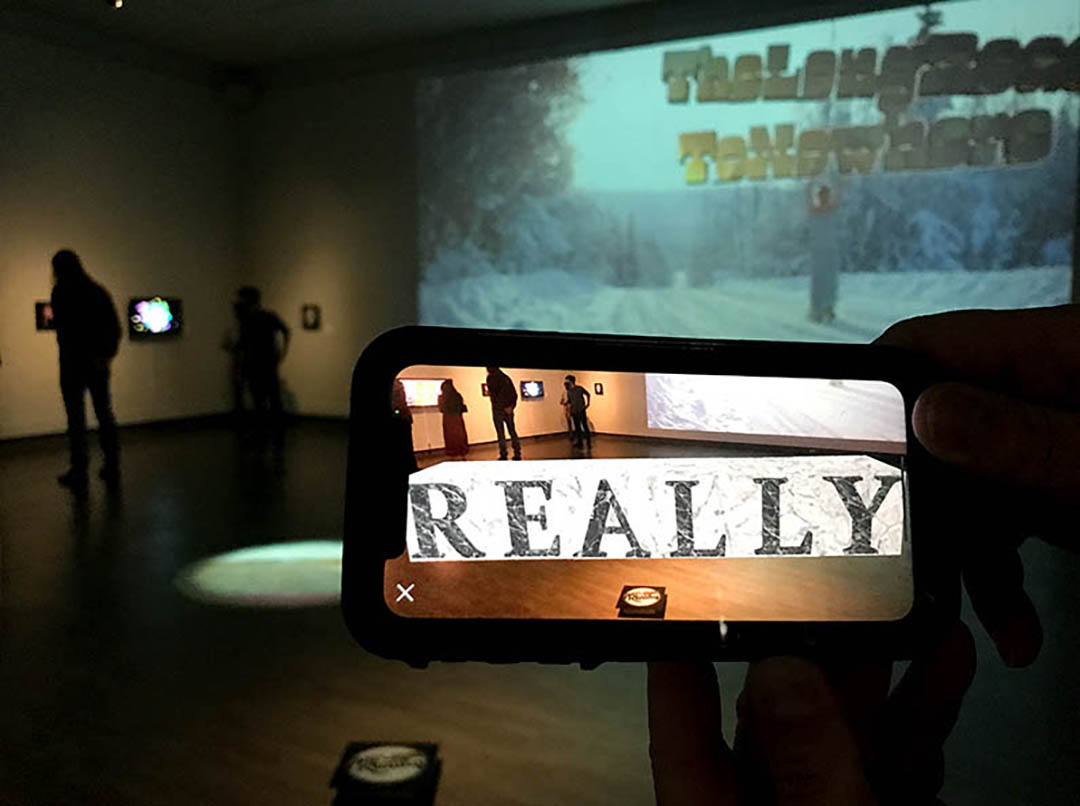
Birke has been instrumental in introducing AR to classes and projects at USask, working with students to add sound clips and mixed media art pieces to the physical space of the university through AR technology.
In 2024, Birke had an AR and video media-focused art exhibition at the Stuttgarter Filmwinter – Festival for Expanded Media in Germany. While at the festival, Birke had the opportunity to work with Grade 8 students on a public art piece in which they were invited to create drawings about identity that were animated by Birke and her team. The students then carried signs with visual trigger images printed on them like a picket line, and when someone pointed their camera at the sign, the students’ drawings came to life through AR and, as Birke put it, “popped off the signs.”
For Birke, the biggest drawback of tapping into AR is not financial or technical. She said AR is a relatively inexpensive way to activate public spaces with art. Instead, it’s that smartphones are still the gateway through which AR is perceived.
As the technology continues to be improved and further integrated into wearable technology like glasses or even contact lenses, Birke believes the breadth and depth of how AR is used will continue to grow.
“You’ve got this big world and you’ve got this tiny screen you’re moving around. I think where it’s going to start to become more integrated and accepted is when it’s just there, in front of our eyes,” she said.
Other USask RSAW with AR:
Alumnus uses augmented reality to enhance his artwork
High-tech simulators at USask create new reality for dental training
Exponential speed: Quantum computing to solve modern problems
Quantum computing isn’t up and coming – it’s already here.
And it has the potential to outpace standard computing by a tremendous margin.
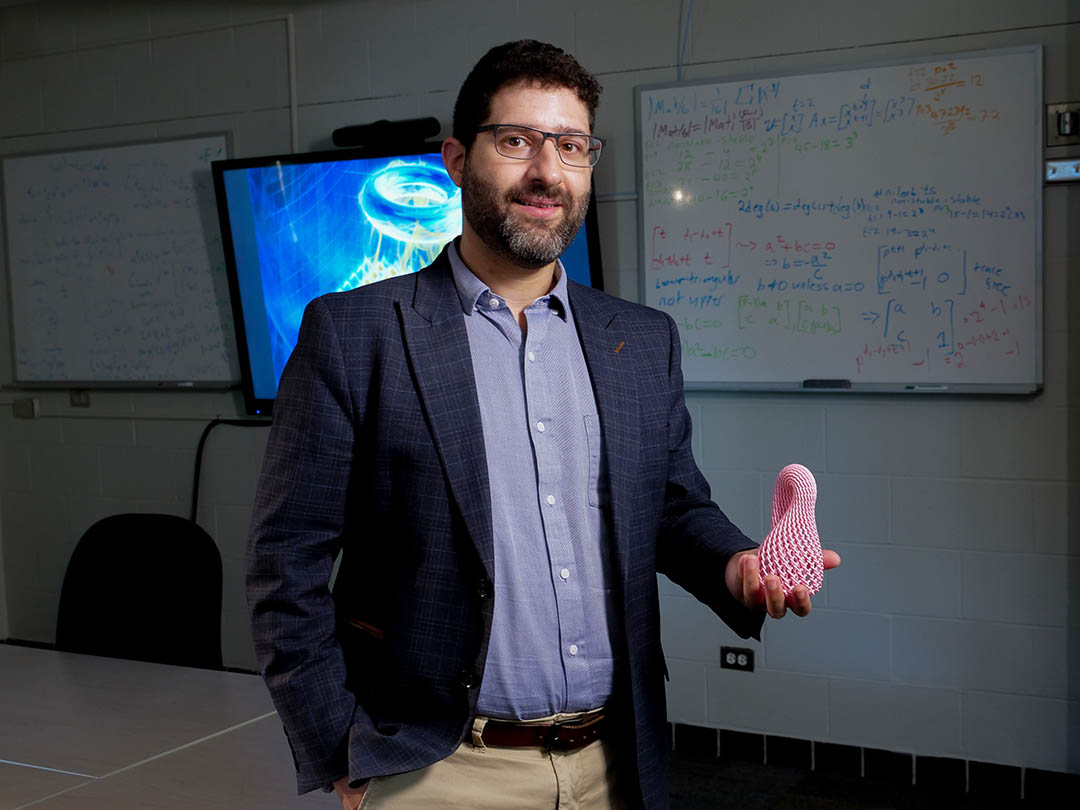
“A bit in a computer is like an on-off switch, zero or one, true or false. But a quantum bit is like a dimmer switch. It’s one or zero and everything in between,” said Dr. Steven Rayan (PhD), the director of USask’s Centre for Quantum Topology and Its Applications (quanTA) and a professor of mathematics and statistics in the College of Arts and Science. “A quantum bit therefore has the capacity for encoding infinitely more information than a classical bit. There’s no comparison.”
Rayan, an internationally renowned expert in quantum computing, said quantum technology is already being used on the USask campus to tackle problems too large for standard computers.
One example Rayan gave is working with the Vaccine and Infectious Disease Organization (VIDO) to efficiently develop vaccines by exploring the structure of proteins in the immune system and in viruses through high-powered quantum simulations. For evolving viruses, this kind of rapid response is crucial for responding to future pandemics.
“Quantum simulations can not only simulate how the immune system and a virus will interact, but also allow us to access multiple scenarios about the evolution of the virus, driven by those interactions and other forces,” he said. “An ordinary computer might make a single prediction about how a virus might evolve. But a quantum computer might give us 10 or 20 different realities of evolution, ranked from first to last.
“If the conditions around the virus were slightly different, knowing these nearby results can help us predict better what the next step of its strategy might be and then develop more effective interventions.”
Rayan refers to quantum as part of a “hybrid future,” where quantum computers are used to support standard computing. Where quantum computing really stands apart is in exploring questions where the number of variables and possible solutions are so tremendously large that it would take months or years or even centuries to make headway with regular computing.
With quantum vaccines, modelling power grids, and data security, researchers are already bridging the gap between quantum as a theoretical concept and something practical.
As Rayan puts it, there is a “need” for quantum to solve the problems of today. And as those problems continue to grow in scope and complexity, access to quantum computing could shift from a benefit to a necessity. That shift is being recognized globally, as 2025 was the UNESCO International Year of Quantum Science and Technology.
Rayan said the researchers at USask and the quanTA Centre are already playing a major role in what the future of quantum technology looks like, and are preparing to take on the world’s modern problems – whatever and wherever they may be.
“There are complex problems that we’re facing at this point in our history, and there’s an urgent need for quantum as a way to solve these problems quickly,” he said.
Other USask RSAW with quantum technology:
USask researcher trying to unlock mysteries of ‘strange and fascinating’ quantum materials
Simulating new worlds: Virtual reality for taking risks in safe environments
New tech is giving researchers the opportunity to conduct in-depth experiments and test theories and innovations in advanced, safe, and in-depth virtual environments.
The USask Driving Research and Simulation Laboratory (DRSL), the only lab of its kind in Saskatchewan (funded by the JELF-CFI), gives researchers a chance to explore the conditions of vehicles, roads, and people in an objective and comprehensive way.
“All the metrics are consistent, the outputs are all embedded in the simulators, and the tests we put our participants through are consistent,” said Dr. Alexander Crizzle (PhD), professor in the School of Public Health and the director of the DRSL. “The data is purely objective. We’re not subjectively assessing a driving error is because the system is doing that for us.”
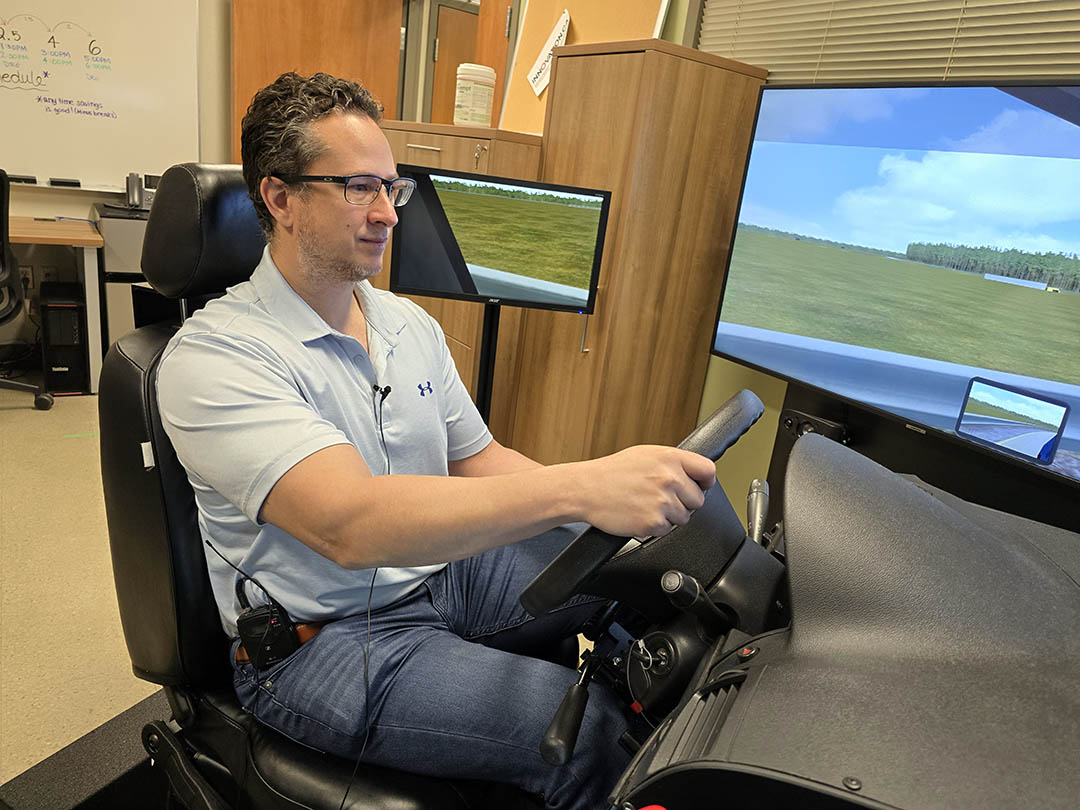
Virtual reality (VR) is technology that creates a three-dimension space through computer technology that the user can directly interact with. Everyday examples include VR video games that put the player in new and fascinating worlds through the use of headsets, or more simply when realtors use 3D cameras to create realistic walkthroughs of houses for sale.
Crizzle’s research moves far beyond the basics of VR and simulator technology to explore human activity. Crizzle, a long-time proponent of VR technology, said it gave researchers ways to explore detailed experiments with real-world implications.
“They’re not a complete replica, but the more and more closely they get to being a replica, the more we can actually test and see how people react to the environment,” Crizzle said. “Without this technology, research in the real world becomes a lot more difficult.”
The DRSL is not only home to multiple VR sets, but also large driving simulators. The simulators are built to be as accurate as possible to real driving, with physical feedback in the seat as you brake, turn, and accelerate, and multiple surrounding screens and speakers to create an immersive simulated experience.
By using simulator technology, Crizzle and his team have explored the effects of driving under the influence of cannabis, rehabilitation training for individuals recovering from traumatic brain injuries, assessments for health and wellness impacts on truck drivers, and more.
VR and simulator technology is consistently getting better and better, and Crizzle and his team are at the forefront of leveraging that technology for research.
“If you test someone for 45 minutes, using AI and VR can really give you pinpoint information about where you might see a deficit or an event. I think that’s where the future of this research is going, is being able to fine-tune how we look at things and predict what’s going to happen,” Crizzle said. “We can translate the findings from here into real-world applicability.”
Other USask RSAW with VR:
USask community research uses virtual reality for Indigenous health education
USask researchers see virtual reality as way to build anesthesiology skills in physicians
Big data for every day: Putting artificial intelligence in the hands of farmers
USask researchers are leveraging artificial intelligence (AI) for new and innovative research projects that often connect cutting-edge technology to the people who could benefit from it most.
“AI helps you make better-informed decisions. It has the tools and capability to help us understand variables in three, sometimes four dimensions,” said Dr. Kwabena Nketia (PhD), an assistant professor in USask’s College of Agriculture and Bioresources.
Nketia’s main research area is the use of AI in precision agriculture—using new technological innovations to put every scientific advantage possible, no matter how large or small, into agricultural production.
His PhD thesis involved examining crop water requirements and soil moisture dynamics across toposequences in Ghana. They combined ground-based measurements with satellite imagery to create an AI-driven model that could predict soil water storage in various farming fields over space and time.
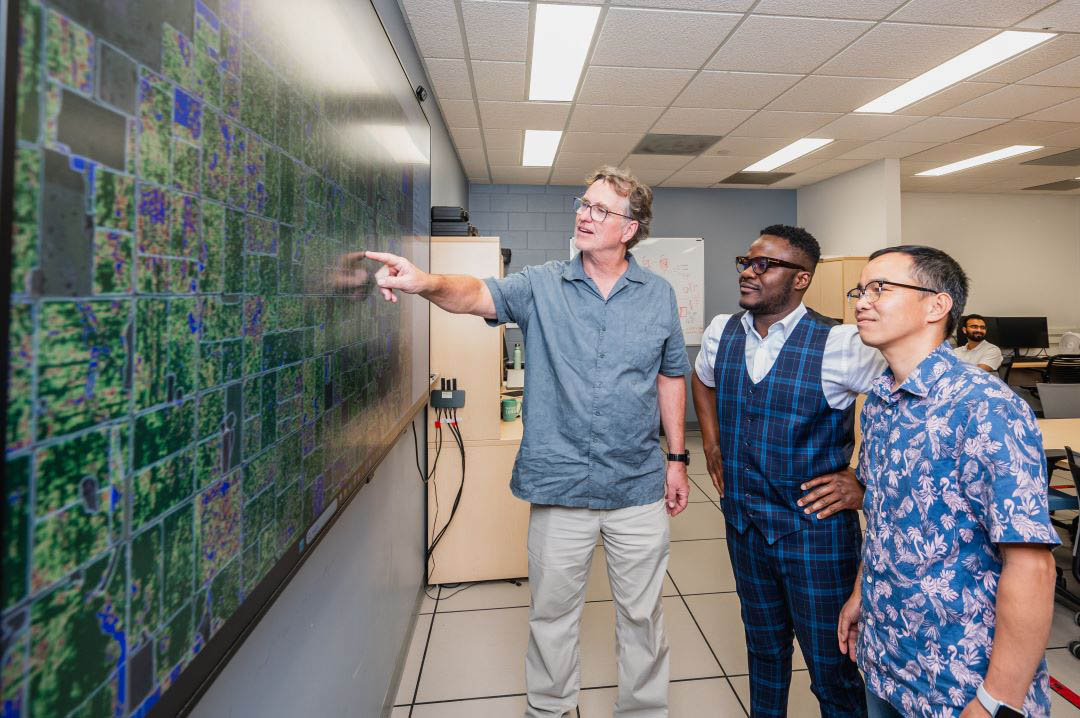
Understanding moisture levels in soil helped Nketia recommend different crops for specific areas that could be more effective in drawing moisture from deeper in the ground as a year-round sustainable livelihood alternative for farmers.
Now, Nketia is working on site-specific precision solutions including apps for producers on the ground to access all the agroecosystem datasets and AI-driven modelling tools created by USask researchers. By putting the power of AI technology in the hands of producers, Nketia said they want to help producers make decisions as fast and efficiently as possible about their own fields.
“Satellites, you probably get new data every five to 10 days. As a producer, sometimes you don’t have time to wait five to 10 days before solutions to problems are decided,” he said. “We want our AI-driven data and solutions to be readily available on a farm so when (a producer) needs to make any decision, they don’t have to wait.”
AI has made its way into the agriculture research space in multiple ways. Nketia is working with Dr. Steve Shirtliffe (PhD) in the College of Agriculture and Bioresources on a large-scale research project aiming to map within-field variability across all producers’ fields in Western Canada—a massive undertaking made possible through AI modelling. And USask recently received a $15 million gift from Nutrien which will help establish the Nutrien Centre for Sustainable and Digital Agriculture on campus.
Creating new AI-driven tools requires “training” these models on data that will help them learn and understand the complex agricultural variables, and Nketia lauded the data resources and technology infrastructure available for agricultural research at USask.
“The use of AI has really transformed the way we do things, and I would say it’s a big innovation for us especially when you want to understand how to be both sustainable and profitable,” Nketia said. “Without AI trying to understand all the intricate variable interactions in real time at the field scale, I think would be incredibly challenging to do.”
Other USask RSAW work with AI:
USask researchers developing AI to predict cardiovascular disease
USask spearheads AI-driven detection of early Alzheimer’s through eye screenings